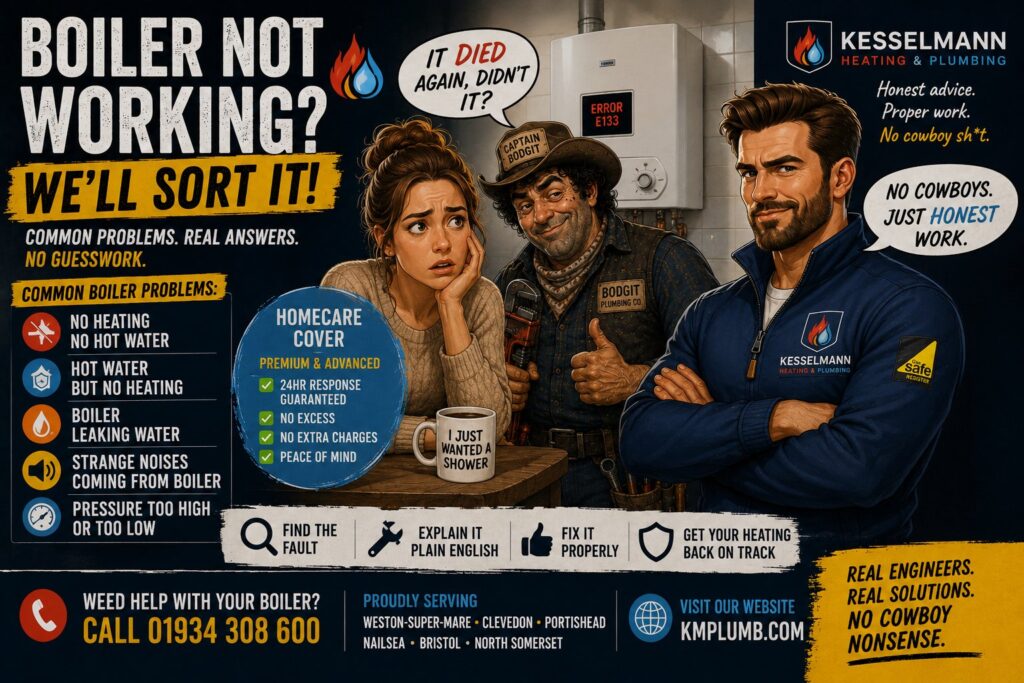
Your boiler never packs up when you’re sitting in the garden during a heatwave.
That would be far too convenient.
It normally waits until the house is freezing, everybody needs a shower and you’ve got absolutely no time to deal with it.
Then it flashes a mysterious code at you.
Helpful.
A boiler breakdown is frustrating because your heating and hot water aren’t luxuries. They are a basic part of running your home properly.
The good news is that some boiler problems have relatively simple causes.
The bad news is that several completely different faults can create almost identical symptoms.
Which is why proper testing matters.
Randomly changing parts until the boiler works again is not diagnosis. It’s just expensive guessing with a screwdriver.
Quick answer: Why has my boiler stopped working?
The most common boiler problems include:
- Low system pressure
- Thermostat or control faults
- Frozen condensate pipes
- Failed pumps
- Diverter valve problems
- Motorised valve faults
- Air trapped in the heating system
- Water leaks
- Electrical faults
- Ignition or flame detection problems
- Blocked or dirty heating systems
- Internal boiler component failures
Before calling an engineer, you can safely check the boiler display, thermostat settings, system pressure and whether your gas and electrical supplies are working.
Do not remove the boiler casing.
Do not work on gas components.
And don’t keep pressing reset twenty seven times as though the boiler will eventually respect your persistence.
First, look at the boiler display
Modern boilers usually show a fault code when something stops them operating.
That code is useful.
It does not always identify the exact failed part, but it gives the engineer somewhere sensible to begin.
Take a photograph of:
- The fault code
- The boiler display
- The pressure gauge
- Any warning lights
You should also note what happened before the fault appeared.
Did the boiler make a noise?
Did the pressure drop?
Was the heating already struggling?
Did somebody change the thermostat settings?
Did the electrics trip?
That information can save time.
Common boiler problems at a glance
What is happening?What may need checking?No heating and no hot waterPower, gas supply, pressure, thermostat, fault code, condensate and internal boiler faultsHot water but no heatingThermostat, programmer, pressure, pump, diverter valve, motorised valves and heating controlsHeating but no hot waterDiverter valve, hot water sensor, cylinder controls or boiler componentsBoiler pressure keeps droppingLeaks, pressure relief discharge, expansion vessel or internal componentsBoiler pressure rises too highExpansion vessel, filling loop or pressure control faultsWater leaking from boilerSeals, valves, pump, pipework, corrosion or excessive pressureBoiler making strange noisesAir, limescale, sludge, poor circulation, pump or fan faultsBoiler keeps switching offPressure, overheating, circulation, controls, sensors or flame faultsRadiators not heating properlyAir, sludge, balancing, pump, valves or poor system flowBoiler won’t igniteGas supply, ignition components, flame detection, condensate or control faults
This table gives you a starting point.
It is not a diagnosis.
Unfortunately boilers have not agreed to only develop one clearly labelled fault at a time.
No heating and no hot water
If you have no heating and no hot water, start with the basic checks.
Is the boiler receiving power?
Check whether the display is illuminated.
If the boiler appears completely dead, check:
- The fused spur near the boiler
- Your consumer unit
- Whether other electrical items are working
- Whether there has been a power cut
If a fuse or circuit keeps tripping, do not repeatedly switch it back on.
Something may be causing it to trip.
That needs investigating.
Is your gas supply working?
Check whether another gas appliance, such as your hob, is working.
Only do this if it is safe and normal for you to use that appliance.
If you smell gas, do not start testing things.
Turn off the gas supply if safe, open windows, avoid electrical switches and contact the National Gas Emergency Service.
Is there a fault code?
Write it down or take a photo.
The code may relate to:
- Low pressure
- Failed ignition
- Flame loss
- Overheating
- Poor circulation
- A frozen condensate pipe
- A fan or sensor fault
Is the thermostat calling for heat?
Make sure the thermostat is switched on and set higher than the current room temperature.
Check that it is not in:
- Holiday mode
- Frost mode
- Summer mode
- A timed off period
Wireless thermostat batteries also fail.
Sometimes a boiler breakdown is two AA batteries wearing a convincing disguise.
Hot water but no heating
If your taps are producing hot water but the radiators are cold, the boiler can clearly create heat.
The fault is more likely to involve the heating side of the system.
Possible causes include:
- Incorrect thermostat settings
- Flat thermostat batteries
- A programmer fault
- Low boiler pressure
- A failed circulation pump
- A stuck diverter valve
- A faulty motorised valve
- Air trapped in the system
- Closed radiator valves
- A control or wiring fault
Start by checking whether the thermostat is asking for heat.
Then look at the system pressure.
If those appear normal and the heating still will not work, the system probably needs testing by a heating engineer.
Do not immediately assume the entire boiler needs replacing.
Sometimes it does.
Often it doesn’t.
Heating but no hot water
This depends on the type of heating system you have.
With a combination boiler, heating without hot water may point towards:
- A diverter valve fault
- A hot water flow sensor problem
- A temperature sensor fault
- An internal boiler component failure
With a system boiler and hot water cylinder, the problem might involve:
- Cylinder controls
- A motorised valve
- The cylinder thermostat
- The programmer
- Electrical controls
- The boiler itself
Again, the symptom tells us where to start.
It does not tell us which expensive part to order before we’ve tested anything.
Boiler pressure is too low
Most sealed heating systems operate somewhere around 1 to 1.5 bar when cold, although you should always check the manufacturer’s instructions for your boiler.
If the pressure is very low, the boiler may stop working.
You might be able to repressurise it using the filling loop, but only if:
- You know how your system is filled
- The filling arrangement is in good condition
- The boiler instructions explain the process
- You are confident doing it
Do not overfill the system.
And do not keep topping it up every few days.
If the pressure keeps dropping, the water is going somewhere.
Possible causes include:
- A leaking radiator valve
- A leaking pipe or fitting
- Water escaping inside the boiler
- The pressure relief valve discharging
- A faulty expansion vessel
- Air being removed from radiators
- A hidden heating system leak
Repeatedly adding fresh water is not a repair.
It can also introduce oxygen into the system, which encourages corrosion.
Find the reason.
Boiler pressure is too high
If the boiler pressure is too high while the system is cold, the filling loop may have been left open or may be passing water.
If the pressure starts normally but rises sharply when the heating comes on, the expansion vessel may need checking.
The expansion vessel absorbs the increase in water volume as the heating system warms.
If it has lost its air charge or failed, the pressure can rise until the pressure relief valve opens and discharges water outside.
You then turn the heating off.
The system cools.
The pressure drops.
You top it up again.
The whole irritating cycle starts over.
Great fun.
Draining a little water might temporarily reduce the pressure, but it does not repair the cause.
Boiler is leaking water
Water around a boiler should never be ignored.
A leak might come from:
- A worn seal
- A leaking pump
- A faulty valve
- A loose connection
- Corroded pipework
- An internal component
- Excessive system pressure
- The condensate system
The amount of water does not always tell you how serious the problem is.
A small leak can reach electrical components.
It can also become a much bigger leak without sending you a calendar invitation first.
If water is leaking near electrical parts, switch the boiler off safely and arrange an inspection.
Do not remove the boiler casing and start tightening things.
Gas boilers are not a good place to learn DIY through trial and error.
Boiler making banging, whistling or kettling noises
Boilers make some noise during normal operation.
They should not sound like somebody has trapped a washing machine full of cutlery inside them.
Whistling or kettling noises can be linked to:
- Limescale inside the heat exchanger
- Sludge or debris
- Poor water circulation
- Restricted pipework
- A failing pump
- Air trapped in the system
- Excessive boiler temperature
- Incorrect system setup
People often hear the word “kettling” and immediately assume the system needs powerflushing.
Maybe.
Maybe not.
The system water should be tested.
The temperatures and circulation should be checked.
The actual cause should be found before somebody arrives with a very expensive machine and a strong opinion.
Other noises may indicate different problems.
Grinding could suggest a pump or fan issue.
Gurgling may point towards trapped air.
Banging could be caused by poor circulation, pipe movement or overheating.
Record the noise on your phone if you can.
Boilers have an annoying habit of behaving perfectly as soon as the engineer arrives.
Boiler keeps switching itself off
A boiler that fires and then stops repeatedly could be reacting to:
- Low pressure
- Overheating
- Poor water circulation
- A blocked or frozen condensate pipe
- A thermostat fault
- A faulty sensor
- Flame detection problems
- Pump failure
- Incorrect control settings
- A blocked heating system
The boiler is often switching off because a safety control has detected something outside its expected operating conditions.
Resetting it may temporarily restart the boiler.
It does not explain why it stopped.
If the same fault keeps returning, it needs diagnosing.
Reset.
Fault.
Reset.
Fault.
At that point, the boiler is not being difficult. It’s telling you something.
Frozen condensate pipe
Condensing boilers produce water as part of their normal operation.
This water drains away through the condensate pipe.
During cold weather, external sections of that pipe can freeze, particularly if they are:
- Too small
- Poorly insulated
- Installed with the wrong fall
- Exposed for a long distance
- Terminated badly
A frozen condensate pipe can cause the boiler to lock out.
If the frozen section is safely accessible at ground level, it may sometimes be thawed using warm water.
Not boiling water.
Warm.
Do not climb ladders in icy conditions and do not start dismantling boiler components.
Once the boiler is working again, the condensate installation should be checked.
Otherwise it may freeze again the next time the temperature drops.
Radiators are not heating properly
Sometimes the boiler is operating but the house still feels cold.
Possible causes include:
- Air trapped inside radiators
- Sludge in the system
- Stuck thermostatic radiator valves
- Poor system balancing
- A weak or failed pump
- Incorrect boiler settings
- Undersized radiators
- Poor water circulation
- Closed valves
- A dirty magnetic filter
If the top of a radiator is cold, it may contain air.
If the bottom remains cold, sludge or poor circulation may be involved.
If one radiator is cold, the issue may be local.
If every radiator is struggling, look at the wider system.
A boiler cannot heat a house properly if the water cannot circulate around it.
Changing the boiler without dealing with the dirty system is like putting a new heart into somebody and reconnecting it to blocked arteries.
A bit dramatic.
Still true.
Common homeowner mistakes
Pressing reset over and over again
One reset may be reasonable.
If the fault returns, stop.
The boiler is not a fruit machine.
Ignoring small leaks
Small leaks become larger leaks.
They also cause pressure loss, corrosion and damage.
Sort them before they turn into a ceiling stain downstairs.
Topping the pressure up constantly
If you have to top the boiler pressure up regularly, you have a fault.
You have not created a new weekly household chore.
Turning the thermostat up to 30 degrees
This does not make the heating warm up faster.
It tells the system to keep heating until the room reaches 30 degrees.
Which it probably won’t.
Assuming every fault means a new boiler
Some boilers are beyond economical repair.
Others need a sensor, valve, pump or control repaired.
Test first.
Decide second.
Choosing somebody purely because they are cheap
A proper boiler diagnosis takes time, equipment and experience.
Someone who guesses quickly may look efficient.
Until you pay for three parts and the original fault remains.
Not servicing the boiler
A service cannot guarantee that your boiler will never break down.
Nothing can.
What it can do is identify wear, poor combustion, leaks, contamination and other warning signs before the boiler gives up during the coldest week of the year.
Maintenance changes the odds.
That’s the point.
Safe checks before calling a heating engineer
You can safely check:
- Whether the boiler has electrical power
- Whether a fault code is displayed
- Whether the gas supply appears available
- Whether the thermostat is switched on
- Whether thermostat batteries need replacing
- Whether the timer or schedule is correct
- Whether the boiler pressure is unusually low or high
- Whether there are visible water leaks
- Whether other gas or electrical appliances are working
- Whether the issue affects heating, hot water or both
Take photographs.
Write down the fault code.
Explain when the problem started.
Mention any noises, leaks or pressure changes.
That information helps us arrive with a better idea of what we may be dealing with.
What not to do
Do not:
- Remove the boiler casing
- Work on gas components
- Bypass safety devices
- Keep resetting a repeating fault
- Pour boiling water over frozen pipework
- Repressurise the boiler without understanding the filling loop
- Ignore water leaking near electrics
- Buy parts online because somebody on a forum sounded confident
Forums can be useful.
They can also convince you that a £12 sensor is definitely the problem based on a three sentence description and a blurry photo.
Brilliant.
Our professional recommendation
Start with the symptoms.
Is there no heating?
No hot water?
Both?
Is the boiler losing pressure?
Is it leaking?
Is there a fault code?
Then test the system logically.
Check the demand.
Check the controls.
Check the pressure.
Check the circulation.
Check the boiler operation.
Check the system around it.
A boiler does not work in isolation.
It relies on the gas supply, electrical controls, pumps, valves, radiators, pipework and water quality around it.
That whole picture matters.
The best repair is not the fastest part change.
It is the correct diagnosis.
When should you call a Gas Safe registered engineer?
Arrange an inspection if:
- The boiler is leaking
- The same fault code keeps returning
- You smell gas
- The pressure repeatedly rises or falls
- The boiler will not ignite
- The boiler makes new or severe noises
- The heating or hot water keeps cutting out
- Electrical supplies keep tripping
- You suspect an internal boiler fault
- You are unsure what you are looking at
For gas boiler work, use an appropriately qualified Gas Safe registered engineer.
Not your mate who “used to fit boilers years ago”.
Not a handyman with a multimeter and extraordinary self belief.
Someone currently qualified for the work.
Boiler repairs in Weston-super-Mare and North Somerset
Kesselmann Heating & Plumbing provides boiler fault finding and heating repairs across:
- Weston-super-Mare
- Clevedon
- Portishead
- Nailsea
- Bristol
- North Somerset and surrounding areas
We inspect the fault, test the boiler and explain what we have found in plain English.
No mysterious jargon.
No replacing half the boiler because one part looked a bit tired.
And no pretending every breakdown means you need a new boiler immediately.
Sometimes repair is sensible.
Sometimes replacement is the better long term decision.
We’ll tell you which one we believe it is and why.
summary
Common boiler problems include low pressure, thermostat faults, frozen condensate pipes, pump failures, diverter valve problems, leaks, ignition faults and poor circulation.
If there is no heating or hot water, check the boiler display, power supply, gas supply, thermostat and system pressure. If a fault keeps returning, the boiler leaks or its pressure repeatedly changes, contact a qualified Gas Safe registered heating engineer.
Most boiler faults require proper testing before the failed component can be identified. Replacing parts without diagnosis can increase the cost without fixing the original problem.
Final thought
Common boiler problems can create similar symptoms.
No heating.
No hot water.
Pressure dropping.
Strange noises.
The boiler repeatedly switching itself off.
The answer is not to keep pressing reset and hope it eventually develops a better attitude.
Check the simple things.
Take note of the fault code.
Look for leaks.
Then get the system tested properly.
Because a good boiler repair starts with understanding why it failed.
Not throwing parts at it until one sticks.
Need help with a boiler fault?
Kesselmann Heating & Plumbing provides boiler repairs, heating diagnostics and servicing across Weston-super-Mare, Clevedon, Portishead, Nailsea, Bristol and the surrounding North Somerset area.
We’ll inspect the problem, explain what we find and discuss the sensible repair options with you.
Contact Kesselmann Heating & Plumbing to arrange a boiler inspection or repair.
Need a Gas Safe engineer in Weston-super-Mare?
Frequently asked questions
Why has my boiler suddenly stopped working?
Common causes include low pressure, control faults, failed ignition, frozen condensate pipes, circulation problems and internal component failures.
Check the display for a fault code and confirm the thermostat and power supply are working.
Why do I have hot water but no heating?
The problem may involve the thermostat, programmer, pump, diverter valve, motorised valves or heating controls.
Check the thermostat and boiler pressure first.
Why do I have heating but no hot water?
On a combination boiler, the diverter valve, flow sensor or hot water controls may be involved.
On a cylinder system, the fault may involve the cylinder thermostat, motorised valves or programmer.
What pressure should my boiler be?
Many sealed systems operate at around 1 to 1.5 bar when cold, but you should check your boiler manufacturer’s instructions.
Why does my boiler pressure keep dropping?
The heating system may be losing water through a leak, pressure relief valve, boiler component or expansion vessel fault.
Repeated topping up is not a permanent solution.
Is a leaking boiler dangerous?
It can be.
Water may damage electrical components and the leak could indicate excessive pressure or a failed internal part.
Switch the boiler off safely and arrange an inspection.