Common Plumbing Problems and How Much They Cost to Fix
TLDR
Most everyday plumbing repairs cost somewhere from under £100 to a few hundred pounds, depending on the fault, access, parts and whether it is an emergency. Current UK guides put a leaking tap at roughly £45 to £200, a toilet repair at around £50 to £300 and an accessible burst pipe repair at roughly £100 to £500.
Spoiler
The tiny plastic or rubber part that actually failed is often not the expensive bit.
You’re normally paying for somebody to find the fault, get to it, repair it properly and make sure it doesn’t leak again.
And occasionally for whoever thought burying the isolation valve behind a kitchen unit was a reasonable idea.
The short answer
For common plumbing problems in the UK, expect simple repairs such as dripping taps and toilet faults to generally sit towards the lower end of plumbing costs, while concealed leaks, burst pipes and difficult access cost more. Which?’s 2026 guide puts a leaking kitchen tap at £45 to £200, toilet repairs at around £50 to £300, and an accessible emergency burst pipe repair at £100 to £500. These are guide prices, not quotations.
Key takeaways
- A small visible fault can still cost money because diagnosis and labour matter.
- Access often affects price more than the replacement part.
- Emergency and out of hours work normally costs more.
- Hidden water damage can cost far more than the plumbing repair itself.
- Get the fault diagnosed before assuming the most expensive component needs replacing.
Fun fact
A single dripping tap can waste more than 5,500 litres of water a year, according to WaterSafe.
So yes, the tiny drip that sounds like Chinese water torture at 2am is also quietly wasting a fairly stupid amount of water.
Typical plumbing repair costs in 2026
These are UK guide prices, not Kesselmann fixed prices.
Property type, access, materials, location, parking, whether isolation valves work and how long the repair takes can all change the final bill. Which? specifically identifies access, property condition, isolation arrangements and fitting quality as factors affecting plumbing costs.
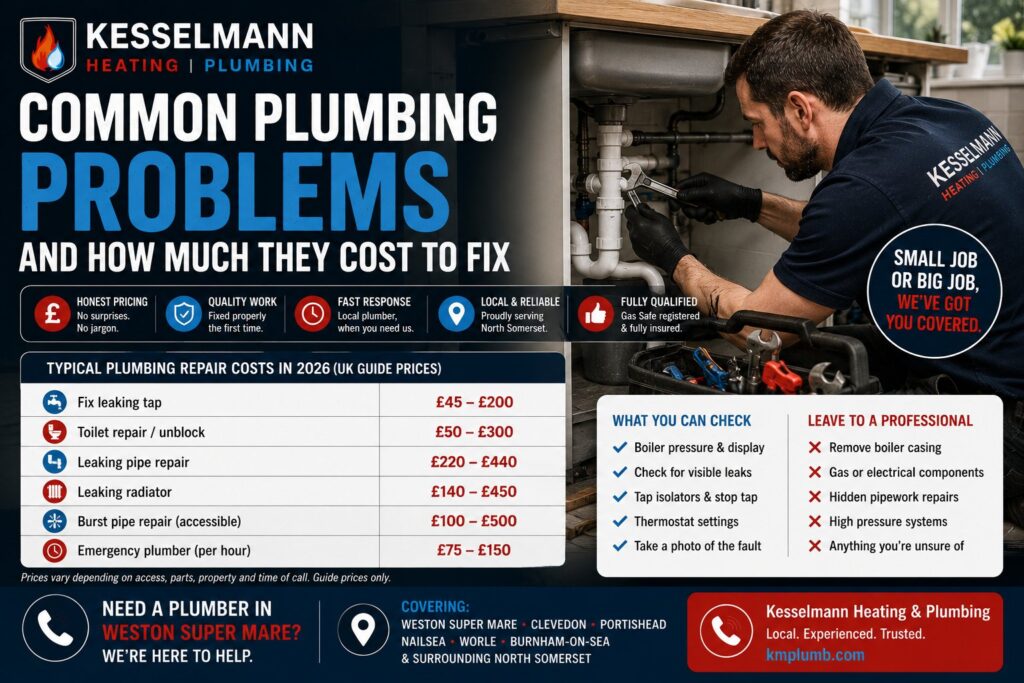
Common plumbing problemCurrent UK guide priceFix leaking kitchen tap£45 to £200Replace kitchen mixer tap£50 to £300 plus tap depending on circumstancesRepair toilet cistern valve£50 to £300Unblock or repair toilet£75 to £300Repair accessible burst pipe£100 to £500Repair leaking water pipeAround £220 to £440Repair leaking radiatorAround £140 to £450Emergency plumberAround £75 to £150 per hour
Sources: Which? survey of Trusted Traders and Checkatrade’s 2026 cost guides.
The ranges are quite wide.
That isn’t because plumbers collectively spin a giant wheel before writing the invoice.
The jobs themselves can be completely different.
How much does it cost to fix a dripping tap?
Which? currently gives £45 to £200 for repairing a standard leaking mixer tap where isolation valves are available. Checkatrade’s more recent 2026 guide puts its typical leaking tap range at £95 to £170.
Why the difference?
Because “dripping tap” might mean:
- Replace a washer
- Replace a cartridge
- Remove limescale
- Repair a valve
- Source an obscure cartridge
- Replace the whole tap
- Fight an isolation valve that has apparently been welded shut by Satan
The visible symptom is the drip.
The actual repair determines the price.
Can I fix it myself?
Sometimes.
WaterSafe says common causes include worn washers, damaged cartridges and limescale, and provides homeowner guidance for replacing straightforward tap parts after safely isolating the water.
If you cannot isolate the tap, the fittings are seized or replacing the obvious part does not stop the drip, get a plumber.
How much does a toilet repair cost?
A toilet problem is another wonderfully broad description.
Which? gives:
- £50 to £300 for replacing a faulty cistern valve
- £80 to £300 to fix or unblock a toilet
Checkatrade’s 2026 guide puts a straightforward toilet unblock at £75 to £150.
Typical faults include:
- Toilet constantly running
- Cistern not filling
- Flush not working
- Toilet leaking
- Pan connector leaking
- Blockage
- Faulty fill valve
- Faulty flush valve
A replacement rubber seal may cost very little.
Removing the toilet because the leak is behind it takes slightly longer than holding the seal up and admiring how inexpensive it was.
How much does a leaking pipe cost to repair?
Checkatrade’s July 2026 guide puts a leaking water pipe repair at approximately £220 to £440, with an average quoted figure around £330.
But access matters enormously.
A leaking compression joint underneath the kitchen sink?
Fairly accessible.
The same size leak beneath:
- A tiled bathroom floor
- Kitchen units
- A finished ceiling
- Concrete
- A fitted wardrobe
Very different job.
The plumbing repair itself can be tiny.
Getting to it and repairing everything around it can become the expensive bit.
WaterSafe lists taps, toilets, showers, radiators and pipework among common household leak sources and warns that concealed leaks may show themselves through damp patches, mould, pressure loss or unexpected water use.
How much does a burst pipe cost?
For an accessible emergency burst pipe, Which?’s current guide gives approximately £100 to £500, assuming the water can be isolated and the pipe is reasonably easy to reach.
That figure is for the plumbing repair.
It does not necessarily include the consequences of the burst.
And that distinction matters.
A £150 repair can potentially sit alongside:
- Damaged flooring
- Wet plasterboard
- Ceiling repairs
- Decoration
- Damaged kitchen units
- Electrical work
- Drying equipment
WaterSafe advises immediately turning off the incoming water, switching off the heating, draining the system and managing escaping water during a burst pipe.
The first thing to save money during a serious leak is not finding the cheapest plumber.
It’s turning the bloody water off.
How much does a leaking radiator cost to repair?
Checkatrade’s 2026 guide gives roughly £140 to £450 for repairing a leaking radiator.
The actual repair could involve:
- Radiator valve
- Bleed valve
- Pipe connection
- Failed fitting
- Corroded radiator
- Replacement radiator
If the radiator itself has corroded through, repairing the leak may make little sense.
You cannot PTFE tape your way out of a radiator slowly dissolving from the inside.
How much does an emergency plumber cost?
Checkatrade’s June 2026 UK guide gives approximately:
- £75 to £150 per hour for emergency plumbing
- Around £100 to £120 as a typical emergency call out fee
Its normal plumber average is around £50 per hour.
Emergency work costs more because you are buying something ordinary appointments do not include:
urgency.
Someone dropping what they are doing, travelling to you and dealing with a fault immediately is obviously going to cost more than a tap booked in for next Thursday at 10am.
That does not make every leak an emergency.
If you’ve isolated it completely and nothing else is being damaged, it may be perfectly sensible to wait for a normal appointment.
Why do plumbing prices vary so much?
This is probably more useful than memorising the numbers.
Two customers can apparently have the same fault and receive completely different prices.
Because one job takes 30 minutes.
The other takes three hours and requires half the bathroom to move.
The biggest cost factors are:
Access
Can the plumber actually reach it?
This is huge.
Isolation
Does the local valve work, or does the whole property need shutting down?
Which? specifically notes that the presence or absence of isolation valves can substantially change the time and cost of a tap replacement.
Parts
A £3 washer and a specialist £80 cartridge are not the same thing.
Age and condition
Old pipework tends to make straightforward jobs more entertaining.
Undo one fitting.
Another begins leaking.
Lovely.
Emergency timing
Evenings, weekends and urgent attendance can increase labour costs.
Follow on damage
The plumber may stop the leak.
That does not automatically repair the floor, ceiling, units or decoration already damaged.
The mistake people make with plumbing prices
They focus on the broken part.
“It’s only a washer.”
Yes.
The washer might be £1.
But the plumber still has to:
- Travel to your property
- Diagnose the fault
- Isolate the system
- Take the tap apart
- Find the correct component
- Fit it
- Turn everything back on
- Check for leaks
- Take responsibility if it starts leaking through the kitchen ceiling tomorrow
You are not buying a washer.
You are buying the repair.
That is quite an important distinction.
What can you safely check before calling a plumber?
Safe homeowner checks
You can usually:
- Look for visible leaks
- Check beneath sinks
- Check toilet cisterns
- Check radiator valves
- Identify exactly when the leak occurs
- Check whether the local isolation valve works
- Locate your main stop tap
- Take photographs
- Check your water meter for unexplained use
WaterSafe advises homeowners to know where their internal stop tap is and check periodically that it operates. It is commonly under the kitchen sink, but may also be in a utility room, downstairs toilet, garage or under the stairs.
That five minute exercise can save an extraordinary amount of money later.
Get a plumber when:
- You cannot isolate the leak
- Water is damaging the property
- The source is hidden
- Fittings are seized
- The problem keeps returning
- Waste or sewage is involved
- You are not confident completing the repair safely
WaterSafe recommends using a qualified plumber where you are not completely confident carrying out the work yourself.
Common mistakes that make plumbing repairs more expensive
Ignoring a small leak
Small leaks have no incentive to stay small.
WaterSafe warns that hidden leaks can lead to damp, mould and other damage if left unresolved.
Not knowing where the stop tap is
Find it now.
Not while water is coming through the ceiling.
Forcing old fittings
If something is badly seized, unlimited enthusiasm with a spanner can convert one fault into several.
Using the wrong trade
A tiler may remove a toilet.
That does not automatically mean they should reconnect it.
Being excellent at one trade does not unlock the entire construction skill tree.
Automatically choosing the cheapest quote
Compare what is included.
A cheap repair that has to be done twice was not cheap.
Leaving water damage until later
Once the leak is repaired, wet building materials may still need drying or replacing.
What I would recommend
For small plumbing repairs, ask three questions:
What has actually failed?
What does it need to repair it properly?
Is anything else already damaged?
That gives you a useful picture.
If the plumber says:
“It’s the inlet valve. I can replace it and test the toilet afterwards.”
Great.
If they say:
“Could be anything. I’ll start changing parts.”
Less comforting.
For larger or less obvious faults, get the diagnosis before obsessing over the final number.
You cannot price an unknown job accurately.
And anyone who confidently can, without seeing it or asking useful questions, may simply be pricing the job they hope you have.
Need a plumbing repair in Weston super Mare?
Kesselmann Heating & Plumbing provides plumbing repairs across Weston super Mare, Worle, Clevedon, Portishead, Nailsea and surrounding areas of North Somerset. The current website lists repairs for leaks, blockages and general plumbing problems, alongside emergency plumbing support.
If you have a leak, broken toilet, faulty tap, radiator problem or another plumbing fault, tell us exactly what’s happening and we’ll work out the sensible next step.
Plumbing Repairs in Weston super Mare → Kesselmann Heating & Plumbing
Need a Gas Safe engineer in Weston-super-Mare?
Frequently asked questions
How much does a plumber charge per hour in the UK?
Checkatrade's June 2026 guide gives an average of around £50 per hour, with a typical range of roughly £40 to £60. Emergency plumbing is higher, at approximately £75 to £150 per hour.
How much should it cost to fix a dripping tap?
Which?'s current guide gives approximately £45 to £200 for a standard leaking mixer tap where isolation is straightforward. Checkatrade puts its current typical range at £95 to £170.
How much does it cost to repair a toilet?
Which? gives around £50 to £300 for a faulty cistern valve and £80 to £300 to fix or unblock a toilet.
How much does it cost to repair a burst pipe?
An accessible burst water pipe is currently estimated at around £100 to £500 by Which?, depending on the circumstances. Water damage and making good may cost extra.
Why is a plumber charging much more than the price of the part?
Because the job includes diagnosis, travel, access, labour, isolation, fitting, testing and responsibility for the completed repair. The replacement component itself may be the cheapest element.
Should a plumber give me a fixed price?
Some straightforward jobs can be quoted as a fixed price. Others, especially fault finding and hidden leaks, may initially require an estimate because the full problem is not visible until investigation begins. Which? recommends asking for a clear breakdown so you understand what the price includes.