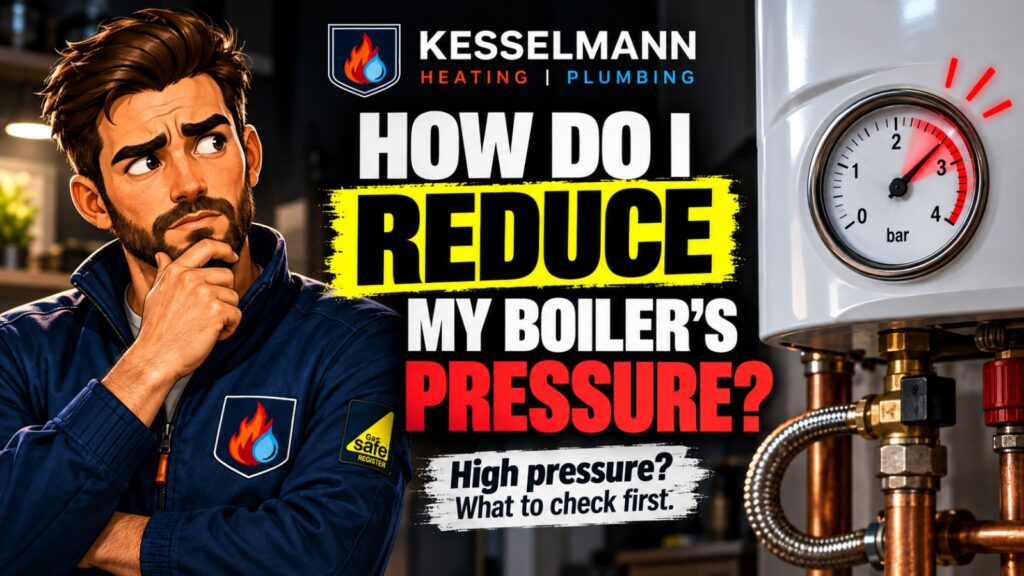
How Do I Reduce My Boiler Pressure?
TLDR
If your boiler pressure is too high because the heating system was overfilled, switch the heating off, let the radiators cool and release a small amount of water through a radiator bleed valve while watching the pressure gauge. Most systems sit around 1 to 1.5 bar when cold. If the pressure rises again by itself, get the cause investigated. Baxi
Spoiler
Getting the pressure down is usually straightforward.
If the pressure keeps coming back up, reducing the number on the gauge is only dealing with the symptom.
The short answer
Turn the heating off and let the system cool. Check the pressure recommended in your boiler manual. If you simply overfilled the heating system, slowly open a radiator bleed valve with a radiator key, collect the water in a cloth or container and watch the boiler gauge fall. Close the valve once the cold pressure reaches the correct range, commonly around 1 to 1.5 bar. Baxi
Key takeaways
- Let the heating cool before releasing water.
- Around 1 to 1.5 bar cold is common, but check your own boiler manual.
- Bleeding a radiator is the simplest homeowner method for reducing excess pressure.
- Make sure the filling loop or filling link is fully closed.
- Pressure which repeatedly rises needs diagnosis rather than repeated draining. Baxi
Fun fact
Your boiler pressure should rise when the heating gets hot.
Water expands as temperature rises. The expansion vessel absorbs most of this change, which is why the pressure gauge moves between cold and hot readings. Vaillant UK
So a moving pressure gauge is normal.
A gauge attempting to reach orbit every evening is less normal.
What pressure should your boiler be?
Check the boiler manual first.
Different manufacturers specify slightly different figures.
British Gas states 1 to 1.5 bar when the heating is off. Worcester Bosch also gives 1 to 1.5 bar when the heating system is cool. Baxi describes 1 to 2 bar as its normal boiler pressure range. British Gas
A useful general guide:
Boiler conditionTypical readingHeating coldAround 1 to 1.5 barHeating runningSome increase is normalAbove 2.5 bar coldWorth reducing before useApproaching 3 barFault investigation becomes sensible
Vaillant advises reducing pressure before running the appliance where cold pressure exceeds 2.5 bar. Vaillant UK
How do I reduce the pressure by bleeding a radiator?
This is the simplest homeowner method where the system has been overfilled.
Baxi, Vaillant, Worcester Bosch and British Gas all describe radiator bleeding as a way to reduce excessive system pressure. Baxi
1. Turn the heating off
Let the radiators cool.
Do not start opening a radiator bleed valve while the system is roasting hot.
British Gas warns that heating water reaches temperatures capable of causing serious scalding. British Gas
2. Check the pressure gauge
Take a photo.
Useful for two reasons.
You know where you started, and if the problem returns you have evidence for the engineer.
3. Find a radiator bleed valve
You will normally find this at the top corner of a radiator.
Most need a radiator key. Some use a screwdriver.
4. Put a cloth or small container underneath
Turn the bleed valve anticlockwise slowly.
Very slowly.
You are releasing pressure, not opening a garden tap.
Air might come out first.
Then water.
5. Watch the boiler gauge
Release a little water.
Check the gauge.
Repeat until the pressure reaches the cold level recommended by the boiler manufacturer.
For many systems, somewhere around 1 to 1.5 bar is the target. Worcester Bosch
6. Close the radiator valve
Turn the bleed valve clockwise until closed.
Do not attack the tiny valve with the strength of a gorilla.
Closed is enough.
7. Run the heating and check again
The pressure should rise somewhat as the system warms.
That is normal.
Why did my boiler pressure get too high?
If you recently topped the pressure up, the answer might be wonderfully boring.
You added too much water.
Baxi lists accidental overfilling as a common cause of high boiler pressure. Baxi
Perhaps you aimed for 1.2 bar.
Looked away.
Ended up at 2.4.
We’ve all seen more complicated disasters.
Bleeding some water from a radiator should sort an accidental overfill.
The more interesting problems start when nobody has touched the boiler and the pressure keeps increasing anyway.
Is the filling loop completely closed?
Check this next.
The filling loop or filling link connects the mains water supply to the sealed heating circuit during repressurisation.
Once you have finished filling, the valves need closing.
Baxi advises checking the filling loop is fully closed when boiler pressure remains high. Vaillant also lists a faulty external filling device as a cause of continuous pressure increase. Baxi
Higher pressure mains water slowly entering the heating circuit pushes the system pressure upwards.
So if you reduce the boiler to 1.2 bar tonight and find 2.2 bar tomorrow morning with the heating stone cold, tell the engineer exactly that.
Useful clue.
Why does the pressure rise when the heating gets hot?
Some rise is supposed to happen.
The important bit is how much.
Worcester Bosch says a pressure rise greater than around 1 bar as the heating reaches temperature suggests the expansion vessel needs attention. Worcester Bosch
For example:
Cold: 1.2 bar
Hot: 1.6 bar
Nothing immediately alarming.
Cold: 1.0 bar
Hot: 2.8 bar
Different conversation.
The expansion vessel exists to absorb the extra volume created as system water heats. If the vessel loses its charge or develops a fault, pressure rises much further than intended. Vaillant UK
Testing or recharging an internal expansion vessel belongs with a suitably qualified engineer.
What happens at 3 bar?
Most sealed boilers have a pressure relief valve, usually called the PRV.
This protects the heating system from excessive pressure.
When pressure climbs too high, the valve releases water through a discharge pipe, often visible outside the property. Vaillant UK
You might notice:
- Pressure rising towards 3 bar
- Water dripping from a copper pipe outside
- Pressure falling again after the heating cools
Do not assume the PRV caused the fault.
The valve might have opened because another problem pushed the pressure too high.
If the expansion vessel failed, for example, the PRV might simply be doing the job you paid for.
Should I use the pressure relief valve to lower the pressure?
No.
Leave the boiler’s safety devices alone.
British Gas specifically advises against trying to reduce boiler pressure by adjusting the pressure relief valve yourself. It recommends radiator bleeding as the straightforward homeowner option and professional help for draining or other pressure work. British Gas
Do not turn safety valves because YouTube made the job look easy.
The radiator already gives you the sensible route.
What if bleeding a radiator does not solve the problem?
Stop repeatedly removing water.
If you bring the boiler down to its correct cold pressure and the gauge climbs again without you refilling the system, another fault is present.
Likely areas for investigation include:
- Filling loop or filling link passing water
- Expansion vessel trouble
- An internal boiler fault
- On applicable combi boilers, pressure crossing from another water circuit
Vaillant advises getting the system inspected where pressure stays high after radiator bleeding. Vaillant UK
Safe homeowner checks
Before booking an engineer, gather some useful information.
- Photograph the pressure when fully cold.
- Check the filling controls are closed.
- Run the heating.
- Photograph the pressure again once hot.
- Check whether the pressure rises again overnight with the heating off.
- Look outside for water dripping from the PRV discharge pipe.
- Note whether the problem started after repressurising the boiler.
Those observations narrow the fault down considerably.
Work that needs a professional
Leave these alone:
- Internal expansion vessel testing
- PRV replacement
- Opening the boiler casing
- Internal filling valve repairs
- Draining the boiler itself
- Gas appliance components
- Internal pressure faults
HSE states domestic gas work must be performed by someone Gas Safe registered and competent for the work involved. HSE
Common mistakes
Bleeding the radiator every morning
Pressure goes up.
Release some water.
Pressure goes up tomorrow.
Release more water.
Congratulations. You have invented a manual pressure control system.
The boiler already has one.
Find out why yours is not behaving properly.
Reducing the pressure while the heating is hot
Cold pressure gives the useful baseline.
Let everything cool first.
Leaving the filling loop slightly open
A tiny amount of mains water entering the heating circuit over several hours is enough to steadily increase pressure.
Close the filling controls fully.
Thinking 1.5 bar is a magic number
Your boiler manual gives the figure for your appliance.
If the manufacturer says 1.2 bar cold is fine, stop trying to achieve exactly 1.500 like you are calibrating laboratory equipment.
Assuming high pressure means the boiler needs replacing
No.
Overfilling is common.
Filling valves fail.
Expansion vessels lose charge.
Individual faults need diagnosis before anybody starts discussing replacement boilers.
What I would recommend
If you know you accidentally overfilled the boiler, let everything cool and release a small amount of water through a radiator bleed valve.
Bring the pressure back to the manufacturer’s cold range.
Then leave it alone and watch what happens.
If the pressure stays there, good.
If the gauge rises again while the boiler is cold, tell the engineer.
If the pressure behaves normally cold but shoots towards 3 bar when the heating gets hot, tell the engineer that too.
Those two descriptions point the investigation in different directions.
Reducing pressure once solves an overfill.
Regularly reducing pressure means we need to find out why the pressure keeps increasing.
Boiler pressure still too high in Weston super Mare?
Kesselmann Heating & Plumbing provides boiler fault finding and repairs across Weston super Mare, Clevedon, Portishead, Nailsea, Bristol and surrounding North Somerset. The Kesselmann website lists boiler repairs alongside pressure related fault finding and heating services. Kesselmann Heating And Plumbing
If the pressure keeps climbing after you have returned the system to its normal cold range, get the fault diagnosed rather than repeatedly bleeding water away.
Kesselmann boiler repair in Weston super Mare
Need a Gas Safe engineer in Weston-super-Mare?
Frequently asked questions
Is 2 bar too high when the heating is off?
Not automatically. Manufacturer ranges vary. Baxi gives 1 to 2 bar as its normal range, while British Gas and Worcester Bosch quote around 1 to 1.5 bar cold. If your system normally sits lower and has suddenly reached 2 bar, check the manual and watch what happens when the heating runs.
Is 2.5 bar too high?
The boiler's safety system should protect against excessive pressure, often by opening the pressure relief valve. Repeated pressure near 3 bar still needs investigation rather than being treated as normal operation.
Why does my boiler pressure keep rising overnight?
If the system is cold and pressure still increases, thermal expansion does not explain the rise. A filling arrangement allowing mains water into the heating circuit becomes one area an engineer should investigate.
Will bleeding a radiator reduce boiler pressure?
Yes. Baxi, Vaillant, Worcester Bosch and British Gas all recommend controlled radiator bleeding as a homeowner method for reducing excessive system pressure after overfilling.
Why does my boiler pressure go from 1 bar to nearly 3 bar when hot?
A large cold to hot increase points towards the system's ability to absorb expansion. Worcester Bosch says a rise greater than around 1 bar suggests the expansion vessel needs attention from a service engineer. Worcester Bosch
Should I drain water directly from the boiler?
Leave direct boiler draining and pressure relief valve work to an engineer. British Gas advises radiator bleeding as the simple homeowner method and recommends professional help for more involved pressure reduction work.