
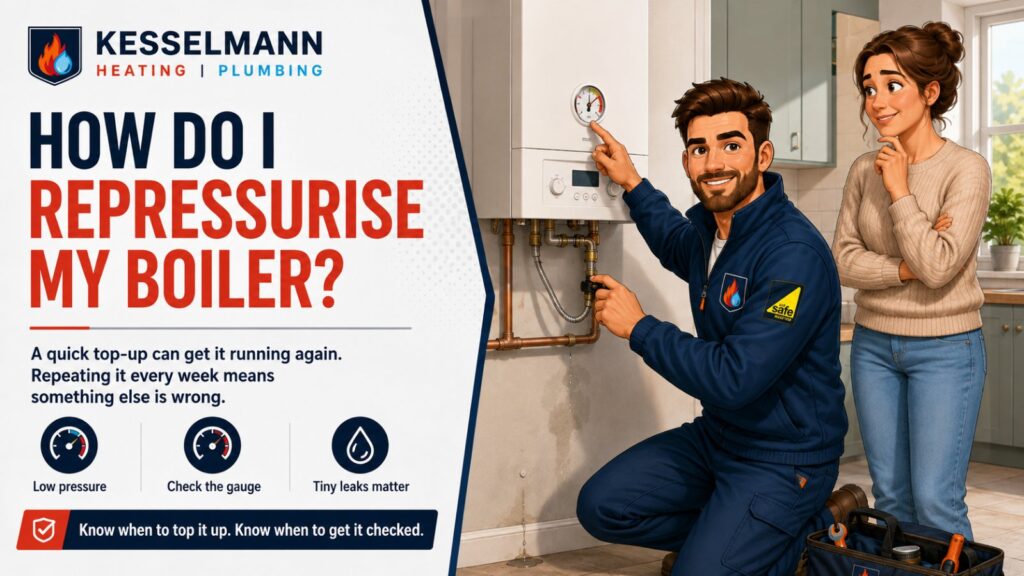
How Do I Repressurise My Boiler?
TLDR
If your sealed heating system has low pressure, you normally repressurise it by using the boiler’s filling loop to let a small amount of mains water into the heating system. Most manufacturers expect roughly 1 to 1.5 bar when the system is cold, but check your boiler manual because models differ.
Spoiler
Repressurising a boiler is usually easy.
Needing to do it every week is the interesting bit.
You have put the water back. You have not necessarily fixed whatever made the water disappear.
The short answer
Turn the boiler off and let the heating system cool. Check your boiler manual and identify the filling method fitted to your system. Slowly open the filling valve or filling link while watching the pressure gauge. Stop when the pressure reaches the level specified by the manufacturer, commonly around 1 to 1.5 bar when cold. Close the filling valve properly, then restart the boiler if needed.
Key takeaways
- Check your boiler manual before touching the filling controls.
- Around 1 to 1.5 bar cold is common, but use the figure for your boiler.
- Add water slowly while watching the gauge.
- Close the filling valve fully when finished.
- If pressure keeps falling, stop repeatedly topping it up and find the cause.
Fun fact
Worcester Bosch says a heating system might need topping up once or twice a year. If you are doing it far more frequently, Worcester advises contacting the installer.
So topping your boiler up every Friday is not maintenance.
You have simply added feeding the boiler to your weekly chores.
What does repressurising a boiler mean?
Most modern sealed central heating systems contain water under pressure.
The pressure helps move water around the boiler, radiators and pipework.
You will normally see the system pressure on:
- A round pressure gauge
- A digital display
- A pressure reading on the boiler screen
When pressure falls too low, some boilers stop operating and display a fault code.
Repressurising means adding a controlled amount of mains water back into the sealed heating system through the filling arrangement.
You are not adding gas.
You are not doing anything to the burner.
You are topping up the water inside the heating circuit.
What pressure should my boiler be?
Check your boiler manual first.
Different manufacturers and models specify slightly different operating ranges.
As a general guide:
Boiler conditionTypical pressureHeating coldAround 1 to 1.5 barHeating runningPressure normally rises somewhatBelow 1 barOften needs attentionPressure repeatedly approaching 3 barNeeds investigation
Vaillant says normal operating pressure is generally between 1 and 2 bar, with around 1 to 1.5 bar commonly used when repressurising. Worcester Bosch specifies 1 to 1.5 bar when its systems are cool. Baxi gives a normal operating range of 1 to 2 bar.
That variation is why your own manual wins over a random number from the internet.
Why has my boiler pressure dropped?
A small pressure drop does not automatically mean disaster.
Common reasons include:
- Radiators have recently been bled
- A small amount of water has been lost from the system
- A radiator valve or pipe connection is leaking
- Water is escaping through the boiler or heating system
- A pressure relief valve is passing water
- An expansion vessel or another boiler component has developed a fault
Vaillant identifies leaks and radiator bleeding among common causes of low pressure.
The diagnostic question is simple:
Where did the pressure go?
Ask engineers who deal with sealed heating systems regularly and repeated pressure loss quickly moves the conversation from “top it up” to “find out where the water is going”.
[ED: If you have a genuine example of somebody repeatedly topping a boiler up before the real fault was found, one sentence here would add useful first hand experience.]
First, identify your filling system
This is where people get understandably confused.
There is no single universal filling loop.
Depending on the boiler and installation, you might have:
External braided filling loop
Often a short silver braided hose beneath the boiler or somewhere nearby.
There are normally valves controlling the connection between the cold mains and heating system.
Internal filling key
Some Worcester Bosch boilers use a removable plastic filling key and valve beneath the appliance.
Keyless filling link
Some Worcester Bosch models have a blue lever which allows the heating system to be topped up without a separate key.
Easy filling link
Baxi uses an Easy Fill arrangement on some boilers, normally identified by its green control beneath the appliance.
If you look underneath your boiler and have no idea which of seventeen little valves is supposed to do what, stop there.
Get the manual.
Guessing is unnecessary.
How to repressurise a boiler with a filling loop
Manufacturer instructions differ, so treat this as the general process rather than instructions for every boiler ever manufactured.
1. Turn the boiler off
Vaillant advises switching the boiler off and letting the heating system cool before repressurising.
A cold pressure reading also gives you a much more useful reference.
2. Check the current pressure
Look at the gauge or digital display.
If your boiler already shows normal pressure, do not add more water simply because the boiler has stopped working.
Low pressure might not be the fault.
3. Find the filling arrangement
Use the user manual.
Look for terms such as:
- Filling loop
- Filling link
- Filling key
- Repressurisation
- System pressure
If the instructions require opening an integral boiler casing, leave that work to an appropriately qualified Gas Safe registered engineer.
Gas Safe Register explains that many boiler casings form part of the combustion circuit and should not be removed by the householder.
4. Open the filling control slowly
You should normally hear water entering the heating system.
Watch the gauge while you do this.
Do not wander off.
This is a thirty second job, not something to start before going upstairs to answer an email.
5. Stop at the correct pressure
For many boilers, you are aiming at roughly 1 to 1.5 bar when cold.
Use the pressure stated in your boiler’s instructions.
Worcester Bosch, for example, advises stopping at around 1 to 1.5 bar on systems using its external and internal filling methods.
6. Close the filling valve fully
Once you reach the correct pressure, shut the filling control.
Make sure it is properly closed.
Leaving the filling loop partly open risks the pressure continuing to rise.
7. Follow the manufacturer’s finishing instructions
Some external filling loops require the hose to be disconnected afterwards. Other systems have built in filling devices.
Follow the instructions for your appliance rather than assuming every boiler works the same way. Worcester Bosch, for example, instructs users of some external filling loops to disconnect the hose after repressurising.
8. Turn the boiler back on
Check the pressure again.
Some boilers need resetting after a low pressure fault.
Follow the manufacturer’s user instructions for your model.
What if I have a Worcester Bosch filling key?
Several Worcester Bosch boilers use a keyed filling system.
Broadly, the key goes into the filling mechanism beneath the boiler, turns into its locked position, then a separate control allows water into the system.
Once the required pressure is reached, you close the water control and return the key to its original position before removing it.
The important bit is model identification.
Worcester has used several different filling arrangements over the years.
Do not follow instructions for a Greenstar model you found on YouTube if yours uses a completely different filling mechanism.
What if my boiler has a keyless filling link?
Worcester Bosch’s keyless system uses a blue lever.
On applicable models, pulling the lever allows water into the heating circuit. You watch the gauge and release the lever once the correct pressure is reached.
Again, check the manual for your exact appliance.
Blue lever under one boiler does not mean every blue object underneath every boiler is now fair game.
What if the pressure does not rise?
Stop.
Close the filling valve.
Vaillant advises closing the filling loop and getting an engineer involved if you try repressurising but the pressure gauge fails to register an increase.
Possible reasons need diagnosis.
Do not keep opening valves harder because nothing happened the first time.
What if I accidentally put too much pressure in?
Do not keep adding water once you have passed the manufacturer’s specified cold pressure.
Remember, the pressure normally rises as the heating gets hot.
If you have significantly overfilled the system, follow the manufacturer’s instructions or ask a heating engineer for help.
If the pressure repeatedly climbs excessively whenever the heating warms up, Worcester Bosch identifies the expansion vessel as one possible area requiring an engineer’s attention.
That is different from accidentally adding slightly too much water once.
Why does the pressure keep dropping after I repressurise it?
This is where repressurising stops being the solution.
If you fill the system today and the gauge is low again tomorrow, the system needs investigating.
Look for obvious signs around accessible areas:
- Damp radiator valves
- Drips beneath radiators
- Corrosion marks
- Damp patches
- Water beneath the boiler
- Signs of discharge from external boiler pipework
Vaillant says repeated loss after repressurisation often points towards a significant leak or pressure relief valve fault.
Worcester Bosch similarly advises contacting an installer if the heating system needs topping up far more than once or twice a year.
Heating engineers also tend to watch what happens between cold and hot.
If pressure starts around 1 bar cold, races towards 3 bar hot, then collapses again as the system cools, an expansion problem moves much higher up the diagnostic list.
That is engineer territory.
The customer’s boiler kept losing pressure.
So they did what most people do.
Topped it back up.
Boiler works again. Happy days.
Then the pressure drops.
Top it up again.
And before long, repressurising the boiler has somehow become part of the household routine.
When I investigated properly, the boiler wasn’t the problem. There was a tiny leak on the heating system.
Nothing dramatic. No water pouring through the ceiling. No massive puddle giving the game away.
Just a small leak, quietly losing enough water over time to drop the system pressure.
Once the leak was found and repaired, the pressure stayed where it should.
And this is the important bit.
Repressurising the boiler fixed the symptom.
Finding where the water was going fixed the problem.
If you’re topping your boiler up once in a blue moon, fine.
If you know the filling loop better than some members of your own family, something wants investigating.
What you can safely check yourself
You can check:
- The pressure gauge
- The boiler display
- The user manual
- Visible radiator valves
- Accessible heating pipework
- Whether radiators were recently bled
- Whether pressure falls slowly or quickly
- Whether pressure rises dramatically when the heating runs
You can also photograph the gauge cold and again when the heating is hot.
That gives the engineer useful information.
Work that needs a professional
Get a Gas Safe registered engineer involved if:
- You need to remove the boiler’s functional casing
- Pressure repeatedly drops
- Pressure rises excessively when heating
- Water leaks from inside the boiler
- The filling device does not work
- The gauge does not respond
- You suspect an expansion vessel fault
- You suspect a pressure relief valve fault
- The boiler continues showing faults after repressurising
Gas Safe Register advises consumers not to remove functional boiler casings or work on internal gas appliance components.
Common mistakes
Topping it up every few days
No.
You have not fixed the problem.
You have developed a relationship with the filling loop.
Repeated pressure loss needs diagnosing.
Putting 2.5 bar into a cold boiler
More is not better.
Use the manufacturer’s figure.
Opening random valves underneath the boiler
Find the manual first.
There are water valves, isolation valves and gas related components underneath boilers.
Accuracy seems preferable to enthusiasm.
Leaving the filling loop open
Once the pressure reaches the correct level, close it properly.
Assuming low pressure means the boiler needs replacing
Low pressure is a symptom.
A small radiator valve leak and a failed boiler component both produce pressure loss.
One costs considerably less to solve than the other.
Diagnose first.
What I would recommend
If the boiler has dipped slightly below its normal pressure and has not needed topping up for months, follow the manufacturer’s instructions and repressurise it.
Then watch it.
If the pressure stays stable, lovely.
If you are back underneath the boiler next Tuesday doing exactly the same thing, stop.
Find out why.
The water has gone somewhere.
A sealed heating system should not become another household pet which needs feeding every morning.
Boiler pressure keeps dropping in Weston super Mare?
Kesselmann Heating & Plumbing provides boiler repairs across Weston super Mare, Worle, Clevedon, Portishead, Nailsea, Burnham on Sea and surrounding North Somerset.
Low pressure and repeated pressure loss are specifically listed within Kesselmann’s boiler repair service.
If you can safely repressurise the boiler following the manufacturer’s instructions, fine.
If it keeps happening, we need to find out why.
Boiler repair in Weston super Mare with Kesselmann Heating & Plumbing
Need a Gas Safe engineer in Weston-super-Mare?
Frequently asked questions
What pressure should my boiler be when cold?
Around 1 to 1.5 bar is common for many sealed systems. Worcester Bosch gives 1 to 1.5 bar cold, while Baxi describes 1 to 2 bar as its normal operating range. Check your own boiler manual for the correct figure.
Is repressurising a boiler safe to do myself?
Manufacturers including Worcester Bosch, Vaillant and Baxi publish homeowner instructions for repressurisation, so on suitable systems it is normally a homeowner task. Follow the instructions for your exact model and do not remove a functional boiler casing.
Why has my boiler dropped below 1 bar?
Water has been lost from the sealed heating system. Recent radiator bleeding is one harmless explanation. Leaks, pressure relief valve problems and boiler faults are other possibilities.
How often should I need to repressurise my boiler?
Worcester Bosch says topping up once or twice a year is normal for its systems, but much more frequent repressurisation deserves investigation. Your boiler manufacturer might give different guidance.
Why does my boiler pressure rise when the heating is on?
Heating the system water makes the pressure rise. A modest increase is normal. Worcester Bosch says a rise of more than about 1 bar from cold to hot might indicate an expansion vessel issue requiring an engineer.