How to Find a Reliable Plumber in Weston super Mare
TLDR
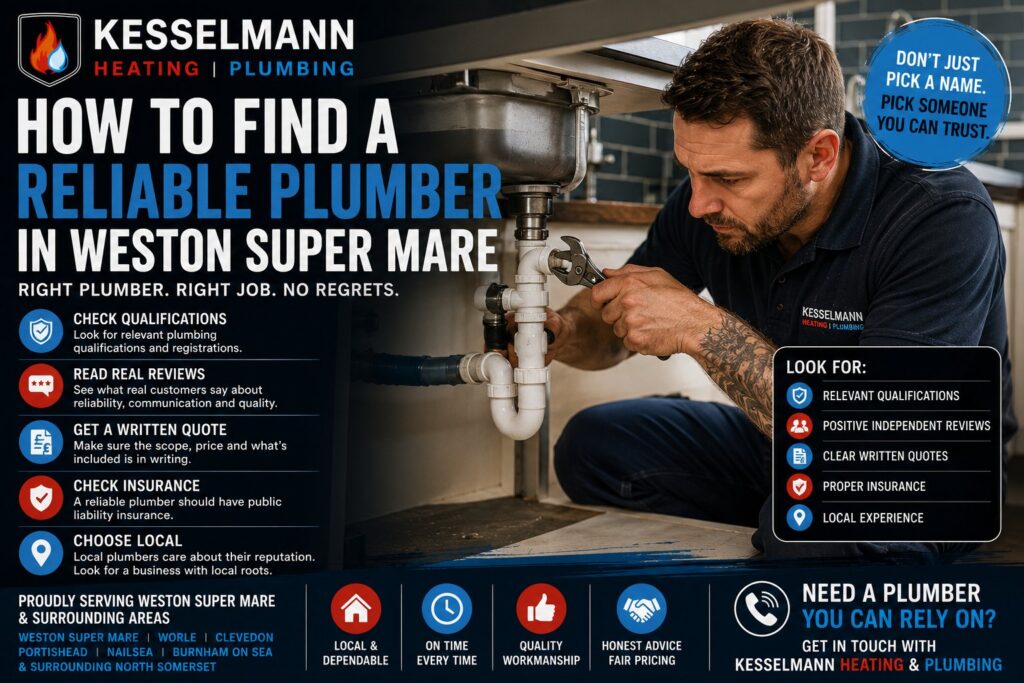
A reliable plumber should be properly qualified for the work, insured, easy to identify, clear about pricing and willing to explain exactly what they are doing. Check independent reviews, registrations, previous work and what is actually included in the quote before choosing purely on price. WaterSafe recommends checking credentials, insurance and business details before hiring.
Spoiler
The cheapest plumber is not automatically the cowboy.
The most expensive one is not automatically brilliant either.
What matters is whether they can prove what they know, explain what they are doing and put in writing what you are actually buying.
The short answer
To find a reliable plumber in Weston super Mare, look for a real local business with verifiable qualifications, proper insurance, strong independent reviews and a clear written quote. For drinking water plumbing, WaterSafe provides a postcode searchable register of vetted businesses. If gas work is involved, check the engineer separately on the official Gas Safe Register rather than taking a logo on a van as proof.
Key takeaways
- Check qualifications that are relevant to your particular job.
- Read independent reviews, but read the actual comments rather than staring at the star rating.
- Get the scope and price in writing before work begins.
- Ask what is included, excluded and what could create additional cost.
- If the answers are vague before the job starts, they rarely become clearer once your bathroom is in pieces.
Fun fact
WaterSafe approved plumbing businesses are required to have at least £2 million of public liability insurance, and are audited as part of the scheme.
That does not mean every excellent plumber has to belong to WaterSafe.
It does mean there is an independent standard you can actually check rather than relying on:
“Yeah mate, been doing this twenty years.”
What does a reliable plumber actually look like?
It is not really about appearance.
Cowboy plumbers do not normally arrive on horseback wearing a Stetson and shouting yee haw.
Unfortunately.
They normally look exactly like every other plumber.
The difference tends to appear in how they behave.
A reliable plumber should be able to tell you:
- Who they are
- Where the business is based
- What they are qualified to do
- Whether they are insured
- How they intend to carry out the work
- What the job includes
- What it does not include
- What could change the price
- How long it should take
- What happens if something unexpected is discovered
WaterSafe specifically recommends choosing plumbers who can provide a physical address, telephone number, evidence of time in business, insurance and relevant registrations.
That is fairly basic stuff.
You are allowing somebody to alter pipework carrying water around your house.
Knowing their surname feels like a reasonable starting point.
Check the right qualification for the job
One of the biggest misunderstandings is that there is one universal badge that makes somebody qualified for absolutely everything involving pipes.
There isn’t.
Different work can require different competence.
Ordinary plumbing work
WaterSafe approved businesses employ plumbers with recognised plumbing qualifications and Water Fittings Regulations training. WaterSafe says approved plumbers have at least an NVQ Level 2 in a plumbing related discipline plus recognised Water Fittings Regulations training.
Gas boilers and gas appliances
If somebody will work on a gas boiler or another gas appliance, check the Gas Safe Register.
Gas Safe’s official search allows customers to check businesses and individual engineers. It also makes an important distinction: being Gas Safe registered confirms gas competence, but the register does not assess things such as price, customer service or general experience.
That is important.
Gas Safe tells you they are legally competent for the gas work they are registered for.
It does not tell you whether they answer the phone.
Or turn up.
Or put your kitchen back together afterwards.
Different questions.
Do not just look at the Google star rating
Reviews are useful.
Very useful.
But the number itself does not tell you much.
Read what customers actually say.
Look for repeated comments about:
- Communication
- Turning up when agreed
- Cleanliness
- Reliability
- Explaining the problem
- Sticking to quotations
- Resolving problems afterwards
- Quality of workmanship
Which? Trusted Traders says its listed traders go through assessment including reference and background checks, while customer reviews on the platform are moderated.
WaterSafe also recommends referrals and references as part of checking competency and reliability.
What I would look for in reviews
Not:
“Amazing plumber. Five stars.”
Lovely.
But almost useless.
Much more interesting is:
“Turned up when promised, diagnosed the leak, explained the options, quoted before doing the repair and left everything clean.”
That tells you how the business behaves.
Patterns matter.
One angry review proves very little.
Twenty customers complaining that nobody answers the phone after payment is slightly more educational.
Get the quote in writing
For anything beyond a very small reactive repair, get the important details written down.
Citizens Advice recommends getting written quotes and explains that a quote is different from an estimate. A quote is an agreed price for the stated work, whereas an estimate is an approximate figure and can change.
WaterSafe similarly advises getting two or three written quotes before larger work so you can compare both cost and scope.
Ask these questions
Before agreeing:
- What exactly is included?
- What is not included?
- Is this a fixed quote or an estimate?
- What could increase the final price?
- Are materials included?
- How long should the work take?
- Will it be completed in one visit where practical?
- Who is actually doing the work?
- Will you take away waste?
- What happens if another fault is discovered?
- Is the work guaranteed?
- What paperwork will I receive?
A quotation that says:
“Bathroom £7,500”
is not necessarily a quotation.
It is a number with confidence.
You need to know what the number buys.
Cheap does not automatically mean good value
This is where people understandably get caught.
One plumber quotes £600.
Another quotes £950.
Both seem to be offering the same job.
Except they may not be.
One could include:
- Proper preparation
- Better materials
- Isolation valves
- Testing
- Making good
- Waste removal
- Certification
- Additional protection
- A return visit if required
The other could include:
“Fit it.”
You cannot compare prices until you compare scope.
WaterSafe’s consumer guidance specifically warns that unusually low prices deserve caution and that the cheapest quote is not always the best value.
That does not mean choose the most expensive.
It means understand why prices differ.
Watch how they answer questions
This is probably one of the most useful tests.
Ask simple questions.
A good plumber should normally be able to explain the answer without becoming irritated or drowning you in technical nonsense.
Try:
“Why are you recommending that?”
or:
“What happens if we don’t do that?”
or:
“How will you test it when you’ve finished?”
They do not need to produce a forty minute lecture.
But they should know.
Vague answers such as:
“It’ll be fine.”
“We always do it like this.”
“Don’t worry about that.”
are not particularly reassuring when you are spending thousands of pounds.
A strong tradesperson usually has a process.
And they should be able to explain it.
Check whether they actually listen
Reliability starts before anyone picks up a spanner.
Do they ask questions?
For example:
- What problem are you actually experiencing?
- When did it start?
- Has anyone previously worked on it?
- Is the fault constant or intermittent?
- What outcome do you want?
- Are there access restrictions?
- Has anything changed recently?
A plumber who arrives with the solution before understanding the problem may simply be selling whatever they already decided you needed.
Sometimes that works.
So does guessing heads on a coin.
Are they insured?
Ask.
WaterSafe says approved businesses must maintain at least £2 million public liability insurance, along with employers’ liability cover where applicable.
If you are using somebody outside an approved scheme, there is nothing unreasonable about asking for evidence of insurance.
Especially on larger work.
The job may involve:
- Mains pressure water
- Floors
- Ceilings
- Bathrooms
- Boilers
- Kitchens
- Thousands of pounds of surrounding property
If someone accidentally floods the downstairs ceiling, this suddenly becomes much more interesting than whether they saved you £80 on the quotation.
Should I ask for references?
For a dripping tap?
Probably excessive.
For a £15,000 bathroom?
Very sensible.
WaterSafe recommends referrals or references where appropriate, and Which? Trusted Traders provides independently reviewed trader profiles.
For larger jobs you can ask:
- Have you done something similar?
- Can I see photographs?
- Do you have reviews for this type of work?
- Can I speak with a previous customer?
If they have supposedly installed 200 bathrooms but cannot show you a single completed one, that is at least worth a raised eyebrow.
Red flags to watch for
None of these individually proves somebody is a cowboy.
But several together?
Start paying attention.
Very vague quotations
Little information.
Lots of exclusions.
Plenty of room for:
“Oh, we didn’t allow for that.”
later.
Pressure to decide immediately
A genuine emergency is one thing.
A new bathroom generally does not become £2,000 more expensive if you sleep on the decision.
Cash only with no paperwork
Not automatically sinister.
Still worth asking why.
WaterSafe’s consumer guidance specifically suggests caution around cash only arrangements combined with other warning signs.
They cannot explain what they are doing
Not good.
No physical business details
WaterSafe recommends checking business address and contact information before planning work.
Gas work but they avoid the Gas Safe question
Stop there.
Gas Safe provides a public register specifically so customers can verify engineers.
They want a huge payment before doing anything
Deposits can be perfectly reasonable for larger work, particularly where materials are being ordered.
But understand:
- What the deposit covers
- When materials are ordered
- What happens if dates change
- What the cancellation terms are
Do not transfer substantial money to a stranger because their WhatsApp profile photo looks trustworthy.
Do local plumbers have an advantage?
Sometimes.
A genuinely local plumber may have:
- A reputation to protect
- Customers nearby
- Existing supplier relationships
- Better knowledge of local properties
- Easier aftercare
- Shorter travel for return visits
That is not proof they are better.
A terrible plumber can also live conveniently close to your house.
But locality combined with a long trading history, verifiable reviews and visible accountability is useful.
Kesselmann Heating & Plumbing currently lists its base in Weston super Mare and services including plumbing repairs, boiler work and bathrooms across Weston super Mare and surrounding North Somerset areas. The website also displays customer reviews discussing reliability, cleanliness, communication and workmanship.
What should a reliable plumber’s quote look like?
At minimum, for meaningful work, I would expect enough information to understand:
QuestionWhat you should knowWhat are they doing?Clear scope of workWhat materials are included?At least enough detail to compare quotesWhat isn’t included?Clear exclusionsHow much?Quote or clearly identified estimateHow long?Approximate durationWhat could change?Potential extras explained beforehandWho is doing it?Business and relevant credentialsWhat happens afterwards?Testing, paperwork and guarantee where relevant
This protects both sides.
Customers hate surprise invoices.
Tradespeople hate:
“But I thought that was included.”
Good paperwork prevents both.
What can you check yourself before booking?
You can do quite a lot in ten minutes.
Safe homeowner checks
- Search the business name
- Read recent reviews
- Read poor reviews as well as good ones
- Check the business address
- Check their website
- Check relevant professional registrations
- Verify Gas Safe registration for gas work
- Ask for insurance where appropriate
- Ask for a written quote
- Compare scope, not just total price
- Ask whether they have done the job before
WaterSafe has a postcode search specifically for vetted approved plumbing businesses, while Gas Safe provides its own separate engineer search for gas work.
Common mistakes
Choosing entirely on price
Price matters.
Obviously.
But price without scope is meaningless.
£700 for what?
Assuming five stars guarantees perfection
Reviews provide evidence.
Not divine intervention.
Read them properly.
Not asking what is excluded
This is where some apparently cheap quotations become expensive.
Assuming every plumber can do every plumbing and heating job
Different work requires different skills and qualifications.
Check the job, then the competence.
Not checking Gas Safe registration
If gas is involved, verify it yourself.
Do not assume.
Ignoring communication problems before the job
If getting an answer to a simple question before payment is like trying to contact the International Space Station, consider what aftercare might look like.
What I would recommend
Make your decision using four things:
Competence.
Communication.
Evidence.
Clarity.
Can they do the job?
Can they explain the job?
Can you see evidence that other people trust them?
And do you clearly understand what you are paying for?
If those four things are strong, price becomes much easier to evaluate.
If those four things are weak, the cheapest quote in Weston super Mare may become the most expensive one you’ve ever accepted.
Looking for a plumber in Weston super Mare?
Kesselmann Heating & Plumbing provides plumbing repairs and heating services across Weston super Mare, Worle, Clevedon, Portishead, Nailsea, Burnham on Sea and surrounding areas of North Somerset. Its current website lists plumbing repairs, boiler services, bathroom installations and emergency work, along with customer reviews and local contact information.
If you have a plumbing problem, tell us what is happening first.
We’ll explain what needs looking at and what happens next.
Plumbing repairs in Weston super Mare → Kesselmann Heating & Plumbing
Need a Gas Safe engineer in Weston-super-Mare?
Frequently asked questions
How do I know if a plumber is genuinely qualified?
Check their credentials rather than relying on advertising. WaterSafe approved businesses employ plumbers with recognised plumbing qualifications and Water Fittings Regulations training. For gas work, verify the individual or business through the official Gas Safe Register.
Should I get three plumbing quotes?
For larger planned work, it is sensible. Citizens Advice recommends trying to get written quotes from at least three traders, while WaterSafe also recommends comparing multiple quotes. For small emergency repairs this may not always be practical.
Is a quote the same as an estimate?
No. Citizens Advice explains that a quote is an agreed price for the stated work, while an estimate is an approximate figure that may change. Ask which one you are receiving before work begins.
Do plumbers need to be Gas Safe registered?
No. WaterSafe states that customers are not legally required to use an approved plumbing business. However, businesses on its register have been vetted against scheme requirements including qualifications, Water Fittings Regulations knowledge and insurance.
Are Google reviews enough to choose a plumber?
They are useful evidence, but should be combined with qualifications, written quotations, insurance and your own conversation with the tradesperson. Which? and WaterSafe both provide additional routes for checking approved or assessed businesses.