Pre Winter Heating Survival Guide: What To Check Before It Gets Cold
Every year, the same thing happens.
The weather turns.
Everyone suddenly remembers winter exists.
They walk over to the thermostat, turn the heating on for the first time in months, and then the boiler does absolutely nothing.
Lovely.
Now they are cold, annoyed, and ringing every heating engineer in the area at the exact same time as everyone else.
That first cold snap panic is real.
And the daft thing is, a lot of it can be avoided.
Not all of it. Boilers can break. Pumps can fail. Valves can stick. Winter is winter.
But the October and November chaos?
A lot of that is just people finding out too late that their heating does not work.
This pre winter heating survival guide is simple on purpose.
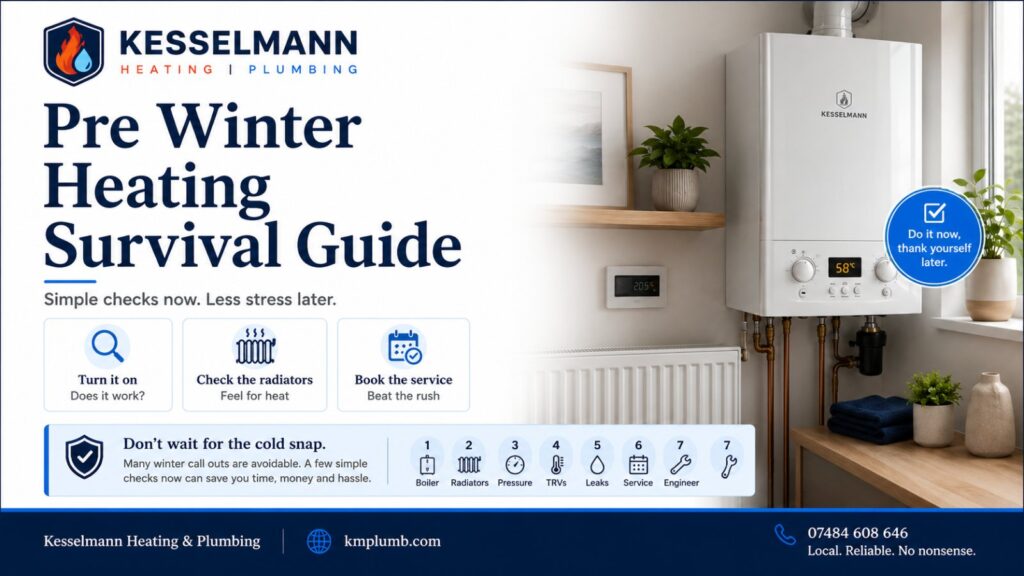
Turn it on.
Feel the rads.
Book the service.
Do it before everyone else remembers winter exists.
Quick Answer: What Should I Check Before Winter?
Before winter arrives properly, do three things:
StepWhat to doWhy it matters1Turn the heating onFind out whether the boiler actually fires up2Check the radiatorsMake sure heat is moving around the house3Book the boiler serviceGet someone who knows what they are looking at to check it properly
That is it.
Do not make this harder than it needs to be.
Turn it on.
Does it work?
Do the radiators get hot?
Does it sound normal?
If yes, happy days.
If no, call an engineer before everyone else does.
Step 1: Turn The Heating On Before You Need It
This is the biggest one.
Just turn it on.
Not when the house is freezing.
Not when your wife, husband, kids, dog and left foot are all cold.
Do it before that.
Turn the heating on while you still have time to deal with a problem calmly.
Because if the boiler does not fire up, that is your main problem.
Everything else is secondary.
Radiators, TRVs, balancing, pressure, programmer settings, all of that can come after.
First question:
Does the boiler actually fire up?
Yes or no.
That is the starting point.
If it does not fire up, you know you have an issue.
Simple as that.
Step 2: Listen To The Boiler
You know what your boiler normally sounds like.
You might not know the technical terms, and that is fine.
You do not need to.
But you know if it suddenly sounds angry.
When the heating comes on, listen.
Ask yourself:
- Does it fire up?
- Does it sound normal?
- Is it banging?
- Is it rumbling?
- Is it whistling?
- Is it kettling?
- Does it sound strained?
- Does it sound different from last year?
If it sounds normal, good.
If it sounds weird, do not ignore it.
Noise is information.
A boiler should not sound like it is arguing with itself every time it fires up.
Step 3: Feel The Radiators
Once the heating has been on for five or ten minutes, go around and touch the radiators.
This is not complicated.
You are checking whether heat is actually moving around the house.
Ask:
Is the radiator getting hot?
If yes, great.
If no, look at the pipe legs going into the radiator.
Are either of the pipes getting hot?
If neither pipe is getting hot, there may be no circulation to that radiator.
If one pipe is getting hot but the radiator is not really changing, it may be a circulation issue. A stuck TRV is common.
If the radiator is warm but the top is cold, that usually points to air trapped in the radiator.
If the bottom middle section is cold and stays cold, especially a good chunk of the radiator, that may point towards sludge.
So the radiator gives clues.
You just need to check it.
What Your Radiator Might Be Telling YouWhat you noticeWhat it may meanWhole radiator gets hotGood signTop of radiator is coldAir may be trappedBottom middle stays coldPossible sludge build upOne pipe hot, radiator coldPossible stuck valve or circulation issueNeither pipe gets hotNo flow reaching that radiatorRadiator never gets hotNeeds checking properly
Do not panic.
A cold radiator does not automatically mean disaster.
But it does mean something is not right.
And it is much better to find that out in September or early October than in the first freezing week of the year.
Step 4: Check The Boiler Pressure
If you have a sealed heating system, your boiler will normally have a pressure gauge.
Many systems sit around 1 to 1.5 bar when cold, but always follow the boiler manufacturer’s guidance.
If the pressure is too low, the boiler may not fire up.
This is one of the classic winter call outs.
The heating has been off for months.
Air has built up in the system.
The heating comes on.
Air gets pushed out through an automatic air vent.
Pressure drops.
Then the boiler stops working.
Now the homeowner is stood there wondering what happened.
The answer is usually simple:
The system pressure has dropped and they do not know how to top it up.
Which is fair enough if nobody has ever shown them.
But this is exactly why you test it early.
Step 5: Know Where Your Filling Loop Is
If your boiler pressure is low, you may need to top it up using the filling loop.
The problem is, plenty of people do not know where the filling loop is.
And even if they find it, they may not have touched it for 12 months.
Or longer.
Then they use it and it starts leaking.
What did you think was going to happen?
If you did not use your legs for 12 months, then suddenly stood up and fell over, you would not be shocked.
Same principle.
Things that never get used can be a pain when you suddenly need them.
Before Bleeding Radiators, Check This First
Before you start bleeding half the house, make sure you can put the water back in.
Otherwise you have not fixed the problem.
You have just created a new one.
The sensible order is:
- Find the filling loop
- Check it works
- Make sure it does not leak everywhere
- Bleed a couple of radiators
- Check the pressure
- Top it back up if needed
- Repeat carefully
Dead simple.
But only if you do it in the right order.
Step 6: Bleed Radiators Safely
If the top of a radiator is cold, it may need bleeding.
Do this when the system is cool.
If something goes wrong, you do not want hot water involved.
Cold water is annoying.
Hot water is a problem.
Basic radiator bleeding process
You will usually need:
- Radiator bleed key
- Tissue or cloth
- Something to catch small drips
- Access to the filling loop
- A working pressure gauge
Then:
- Turn the heating off and let the system cool
- Find the radiator bleed valve
- Open it slowly with the bleed key
- Let the air come out
- Close it when water appears
- Check the boiler pressure
- Top the system back up if needed
If you are not confident, stop.
Call someone.
There is no medal for flooding your own kitchen because you were trying to save a call out.
Step 7: Check The TRVs
TRVs are thermostatic radiator valves.
They are the valves on the side of radiators that let you control the heat in each room.
They can stick.
Especially if they have been sat in one position for months.
This is another classic winter problem.
Heating comes on.
Boiler works.
Most radiators work.
One radiator does nothing.
Sometimes the valve is stuck.
It might be a simple fix.
It might not.
The main point is to find out early.
If a radiator does not heat and one pipe is getting hot, the TRV is one of the things to suspect.
Step 8: Check For Leaks
When heating systems warm up, things expand.
Old joints, valves and seals that were just about behaving can start showing themselves.
That is why leaks can appear when the heating gets used again.
Check around:
- Radiator valves
- Pipework
- Boiler area
- Towel rails
- Filling loop
- Any visible joints
- Around the pressure relief pipe outside if relevant
You are not doing a full engineer inspection.
You are just looking for the obvious.
Water where water should not be.
That is the technical term.
Well, not really.
But it works.
Step 9: Book The Boiler Service Before Winter
This is the bit people leave too late.
Get the boiler serviced before winter.
Not during the first cold week when every engineer is being battered by calls.
A proper boiler service is not just someone turning up, sticking an analyser in, staring at it for two minutes and disappearing.
A proper service should check the appliance properly.
It should help confirm:
- Is the boiler firing correctly?
- Is it burning correctly?
- Is it safe?
- Is the flue safe?
- Are the readings where they should be?
- Is the boiler doing what the manufacturer says it should do?
- Is the pressure stable?
- Are there leaks?
- Is the filter clean, if fitted?
- Is the system water protected?
- Are there early warning signs?
The homeowner’s job is simple.
Use the heating early and see if it behaves.
The engineer’s job is to open it, test it, service it and tell you what it is actually doing.
If it involves gas, combustion testing, taking the boiler apart or servicing the appliance, that is engineer territory.
Do not mess with it.
The Simple Pre Winter Heating Checklist
Here is the simple version.
The Kesselmann Pre Winter Heating Survival Checklist
CheckWhat to doIf it failsTurn heating onMake sure the boiler firesCall an engineerListen to boilerCheck it sounds normalCall an engineerFeel radiatorsMake sure they heat upCheck valves, air, pressure or call an engineerCheck pressureLook at the boiler gaugeTop up if you know how, otherwise call an engineerCheck TRVsMake sure radiators respondStuck valves may need attentionLook for leaksCheck visible pipework and valvesDo not ignore waterBook serviceDo it before the rushDo not wait until winter is in full swing
The short version:
Turn it on. Feel the rads. Book the service.
That is the survival guide.
Common Winter Heating Problems
Boiler will not fire up
This is the big one.
If the boiler does not fire, you have a problem.
It could be pressure, controls, a fault code, ignition issue, frozen condensate later in winter, or something else.
Do not guess if you are not sure.
Pressure has dropped
Very common.
Air leaves the system, pressure drops, boiler stops working.
If you know how to top it up safely, fine.
If you do not, get help.
Radiator top is cold
This usually means air is trapped.
Bleeding may help, but make sure you can top the system pressure back up afterwards.
Radiator bottom is cold
This may point towards sludge.
That is a different issue.
Bleeding will not remove sludge from the bottom of the radiator.
One radiator does not work
Could be a stuck TRV, circulation issue, balancing issue, pipework issue or sludge.
Find out early.
Pump stuck or failed
Pumps can stick or fail when they have not been used properly.
Again, heating systems do not love being ignored for months and then suddenly asked to work flat out.
Leaks appear
Heating creates movement.
Things expand.
Old weak points can show up.
Small leaks are much better found early than during the first freezing week.
The First Cold Snap Panic
Every winter, it happens.
Multiple calls.
Same story.
“My boiler is not working.”
Some winter breakdowns are unavoidable.
If something fails in January, February or March after the system has worked hard all winter, that is different.
That is just winter doing what winter does.
But the October and November ones?
A lot of those are avoidable.
That is usually people finding out too late that their heating did not work.
Testing your heating early will not stop every problem.
But it can stop you joining the first cold snap panic queue.
And trust me, that queue gets long.
What Homeowners Usually Get Wrong
Waiting until it is cold
This is the big one.
Do not wait until you need the heating.
Test it before you need it.
Assuming it worked last year, so it will work this year
That is not a plan.
That is hope.
Hope is lovely, but it does not fix boilers.
Not knowing how to top up pressure
If you have a sealed system, you should know where the filling loop is and how to use it safely.
If you do not, ask someone to show you.
Bleeding radiators without checking the filling loop
Before you let air out, make sure you can put water back in.
Dead simple.
Often ignored.
Ignoring one cold radiator
One cold radiator might be simple.
It might also be telling you something about circulation, valves or sludge.
Do not leave it until winter.
Skipping the boiler service
The boiler service is there to spot issues before they become expensive or inconvenient.
Not after the house is already cold.
Trying to do engineer work yourself
Turning the heating on is homeowner work.
Touching radiators is homeowner work.
Taking the boiler apart is not.
Stay in your lane.
It is safer and cheaper.
What An Engineer Should Check Before Winter
A proper engineer check should include the boiler service and the sensible checks around it.
That may include:
- Boiler condition
- Combustion readings
- Flue checks
- Safety checks
- Pressure checks
- Leak checks
- Controls
- Boiler operation
- Filter condition, if fitted
- System water protection
- Signs of wear
- Early warning signs
The point is not just to tick a box.
The point is to know whether the boiler is ready for winter.
A decent engineer should be able to explain what they checked, what they found and what it means.
If nobody explains anything, you are paying but not learning much.
Practical Homeowner Questions To Ask
When your boiler is serviced, ask:
- Is the boiler firing correctly?
- Are the readings where they should be?
- Is the pressure stable?
- Is the filter clean?
- Is the system water protected?
- Are there any leaks?
- Are there any signs of wear?
- Is there anything likely to become a problem this winter?
- Is there anything I should keep an eye on?
- Can you show me how to top the pressure up safely?
You do not need to become a heating engineer.
You just need enough information to not feel completely useless when the heating decides to have a moment.
When To Call An Engineer
Call an engineer if:
- The boiler does not fire up
- The boiler makes strange noises
- The pressure keeps dropping
- You cannot find or use the filling loop
- Water starts leaking
- A radiator will not heat and you do not know why
- You have fault codes
- The boiler needs resetting often
- You smell gas
- You are unsure about anything involving the boiler itself
If you smell gas, do not treat that as a normal heating fault.
Turn off the gas at the emergency control valve if safe, ventilate the property, avoid switches and flames, and contact the National Gas Emergency Service.
For boiler work, servicing and anything gas related, use a Gas Safe registered engineer.
Local Pre Winter Heating Help
Kesselmann Heating & Plumbing helps homeowners across Clevedon, Portishead, Nailsea, Bristol, Weston-super-Mare and North Somerset get their heating ready before winter properly arrives.
If your boiler has not been serviced, your radiators are not heating properly, your pressure keeps dropping, or the heating just does not feel right, it is better to deal with it before the cold snap panic starts.
We can check the boiler, heating controls, radiators, pressure, filters and general system condition.
Then we can explain what is happening in plain English.
No drama.
No nonsense.
Just honest advice before winter turns up and everyone starts ringing at once.
Want to get your heating ready before winter?
Kesselmann Heating & Plumbing can service your boiler, check your heating system and help spot problems before the first cold snap.
We cover Clevedon, Portishead, Nailsea, Bristol, Weston-super-Mare and North Somerset.
Contact Kesselmann Heating & Plumbing to book a pre winter boiler service or heating check before everyone else remembers winter exists.
Need a Gas Safe engineer in Weston-super-Mare?
Frequently asked questions
When should I test my heating before winter?
Ideally, test your heating before the cold weather arrives. Late summer or early autumn is sensible. The point is to find problems before everyone else is calling an engineer.
What is the first thing I should check?
Turn the heating on. Make sure the boiler fires up and the radiators start getting warm. Keep it simple.
Why does my boiler pressure drop when I turn the heating on?
Pressure can drop if air has left the system through vents or after radiators are bled. If the pressure drops often, there may be another issue that needs checking.
Why is only one radiator not getting hot?
It could be a stuck TRV, air, balancing, circulation, sludge or pipework. Check it early before you need the heating every day.
What should I do if my heating does not come on?
Check the basics, such as controls and pressure if you know how. If the boiler still does not fire, call an engineer.
What should I do if my filling loop leaks?
Check the basics, such as controls and pressure if you know how. If the boiler still does not fire, call an engineer.