
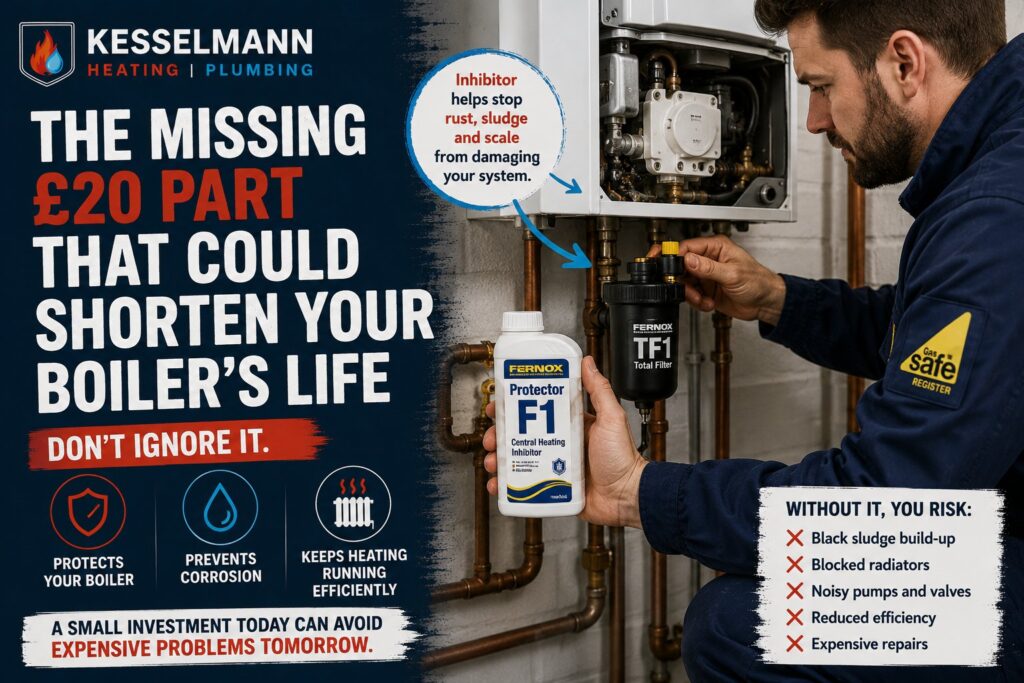
The Missing £20 Part That Could Shorten Your Boiler’s Life
There is a relatively cheap product that helps protect your boiler, radiators and heating pipework.
It does not flash.
It does not connect to WiFi.
Nobody proudly shows it to their neighbours.
In fact, once it has been added, you cannot even see it.
Which probably explains why it gets forgotten.
We are talking about central heating inhibitor.
A typical bottle can cost roughly £20 at current retail prices, depending on the brand, size and dosing method. Fernox F1 products, for example, were listed at around £19 to £20 through a major UK retailer when checked in August 2026.
Technically, it is not a “part”.
It is a chemical treatment added to your heating water.
But “The Missing £20 Bottle of Chemical Water Treatment” is a slightly less exciting headline.
So here we are.
The important bit is this:
Without enough inhibitor, the water inside your heating system can gradually corrode the metal around it.
That creates black sludge, restricts circulation and puts expensive components such as pumps, valves and heat exchangers at risk.
A cheap missing treatment can eventually become a very expensive problem.
Quick answer: What is the missing £20 boiler protection product?
The missing product is usually central heating inhibitor.
It is added to the water circulating through your boiler, radiators and pipes to help reduce corrosion and scale formation.
Without suitable treatment, metal components can corrode. This produces black magnetic debris called magnetite, which may collect in radiators, pumps, filters and narrow boiler waterways.
Current British industry guidance recommends ongoing water treatment to protect heating systems, maintain performance and reduce premature component failure.
The inhibitor level should not simply be assumed correct because somebody added a bottle years ago.
It needs checking.
What is central heating inhibitor?
Central heating inhibitor is a chemical treatment designed for the closed water circuit inside a wet heating system.
That is the water travelling between:
- Your boiler
- Radiators
- Heating pipes
- Pumps
- Valves
- Underfloor heating loops, where fitted
- Magnetic filters and other components
It is different from the water coming out of your taps.
The heating water normally remains inside the system and circulates repeatedly.
Inhibitor works by helping protect metal surfaces against corrosion and reducing scale formation. Products such as Fernox Protector F1 combine different corrosion control mechanisms to protect mixed metal heating systems.
Think of it as protection for the water side of the installation.
Not magic.
Not permanent.
But important.
Why does a heating system need inhibitor?
A heating system contains water and different metals.
Common materials include:
- Steel radiators
- Copper pipe
- Brass valves
- Aluminium or stainless steel boiler components
- Cast iron in some older systems
Water, oxygen and metal have a habit of creating corrosion.
They do not need supervision.
They manage it perfectly well on their own.
As the metal corrodes, fine particles form and begin circulating through the system.
In steel systems, much of the black debris is magnetite, a form of iron oxide.
That debris may settle:
- At the bottom of radiators
- Inside narrow pipework
- Around pump impellers
- Within heat exchangers
- Inside diverter valves
- Around sensors
- In strainers and filters
Sentinel warns that circulating debris can contribute to wear and premature failure of pumps, valves and heat exchangers.
The inhibitor is there to slow that process.
What happens when inhibitor is missing?
Nothing dramatic usually happens on day one.
That is what makes this easy to ignore.
The boiler still fires.
The radiators still warm.
The house does not immediately fill with black smoke while a siren announces:
“Inhibitor absent.”
Instead, corrosion starts quietly.
Over time, you may begin to notice:
- Black water from radiators
- Cold areas across the bottom of radiators
- Dirty magnetic filters
- Boiler noise
- Poor circulation
- Pumps struggling or failing
- Valves sticking
- Boiler pressure problems
- Small leaks caused by corrosion
- Heat exchangers becoming restricted
- Radiators developing pinhole leaks
BSI describes ongoing water treatment as a way to minimise corrosion, scaling, damage and premature failure while extending the life of heating systems and their components.
That is the whole point.
Spend a small amount protecting the system before you spend a much larger amount repairing it.
Wild concept.
What exactly is black heating sludge?
Black sludge is commonly made up of magnetite and other corrosion debris.
It can be extremely fine.
Almost like black paint when mixed with water.
When water flow slows, the particles settle. The bottom of radiators is a favourite location, because apparently sludge also prefers somewhere warm and inconvenient.
Over time, it may form thicker deposits that block the radiator waterways.
You may then get a radiator that feels:
- Hot at the top
- Cooler through the middle
- Cold across the bottom
That pattern often points towards sludge or restricted circulation.
A radiator cold at the top is more commonly linked to trapped air.
Two similar complaints.
Different causes.
Bleeding a radiator full of sludge will not clean it.
That is like opening a window because the carpet needs vacuuming.
Can missing inhibitor really shorten the boiler’s life?
It can contribute to failures that shorten the useful life of the boiler and heating system.
Vaillant states that magnetic filters and inhibitors can help prevent damage and support boiler life.
Its technical literature also says that system water should remain free from debris and be treated against hardness and corrosion throughout the boiler’s life. Failure to maintain suitable treatment may contribute to failures not covered by the guarantee.
Worcester Bosch similarly recommends suitable inhibitor and says its concentration should be checked every 12 months or sooner if system water has been lost.
So no, this is not just chemical companies trying to make heating water smell more interesting.
Boiler manufacturers care about it too.
Can sludge affect the boiler guarantee?
Potentially, yes.
The exact terms depend on the manufacturer, product and guarantee.
Worcester Bosch identifies damage caused by water quality, sludge and blockages as relevant exclusions within its support and guarantee information.
Fernox also notes that testing inhibitor concentration may be required for compliance with boiler warranty conditions and industry commissioning requirements.
This does not mean every black speck instantly cancels your warranty.
It means that poor system water quality can matter when a component fails.
A long boiler guarantee does not protect the appliance from being connected to filthy water.
It protects the boiler under the stated terms.
Slightly less exciting.
Much more accurate.
Inhibitor is not the same as cleaner
This is an important distinction.
Cleaner
Heating system cleaner is used to loosen or remove existing contamination such as:
- Sludge
- Flux
- Debris
- Corrosion deposits
- Some scale
The system is then drained and flushed according to the product instructions.
Inhibitor
Inhibitor is added after the system has been cleaned and refilled.
Its job is to help prevent future corrosion and scale.
It is not designed to swallow fifteen years of compacted sludge and quietly make it disappear.
If the system is already dirty, adding inhibitor alone may be too late.
It is protection.
Not resurrection.
Worcester Bosch advises that heating systems should be cleansed of debris and then refilled with inhibitor following boiler installation.
Inhibitor, cleaner and magnetic filter: what is the difference?
ProductMain jobWhat it does not doCleanerLoosens and removes existing contaminationDoes not provide permanent protectionInhibitorReduces future corrosion and scaleDoes not fully clean a badly contaminated systemMagnetic filterCaptures circulating magnetic debrisDoes not prevent all corrosion by itselfSystem flushCarries loosened contamination outDoes not protect the refilled systemWater testShows what may be happening insideDoes not repair the problem
A proper approach normally follows a sequence:
- Inspect and test
- Clean if required
- Flush properly
- Refill
- Add the correct amount of inhibitor
- Check the concentration
- Maintain the system and filter
Skipping number five because everyone is tired and wants to go home is not an efficiency improvement.
It is simply leaving the job unfinished.
Is a magnetic filter enough without inhibitor?
No.
A magnetic filter is useful, but it performs a different job.
It collects magnetic debris moving through the heating water.
It does not:
- Stop every metal surface corroding
- Protect against all forms of scale
- Remove thick sludge already settled in radiators
- Repair a leak
- Correct poor system design
- Replace chemical treatment
Worcester Bosch describes a system filter and inhibitor as complementary protection. The filter captures debris while the inhibitor helps prevent corrosion.
Fitting a filter without inhibitor is a bit like buying an excellent vacuum cleaner while deliberately manufacturing dust in every room.
It helps.
But perhaps stop creating so much of the problem.
Does inhibitor last forever?
No.
Its concentration can weaken or become diluted.
Common reasons include:
- Draining radiators
- Replacing a boiler
- Repairing leaks
- Changing components
- Repeatedly topping up low pressure
- Water being lost through a pressure relief valve
- The system being partially drained during maintenance
- Incorrect dosing from the start
Worcester Bosch recommends checking inhibitor concentration every 12 months or sooner when system water has been lost.
Fernox’s published guidance on BS 7593:2019 describes annual onsite inhibitor checks, with laboratory testing or redosing at longer intervals. The current standard is BS 7593:2019+A1:2024, but the full wording is sold by BSI, so exact professional obligations should be checked against the current standard and product instructions rather than guessed from summaries.
The homeowner version is much simpler:
Do not assume the inhibitor is still fine because someone might have added it in 2018.
Test it.
Why does topping up boiler pressure dilute inhibitor?
A sealed heating system should not normally require constant topping up.
If pressure is repeatedly falling, water is escaping somewhere.
When fresh mains water is added, the inhibitor already in the system becomes more diluted.
Fresh water also introduces more oxygen, which can encourage corrosion.
Sentinel notes that low inhibitor levels are often linked to repeated topping up or small leaks.
So if you are filling the boiler every Friday, you have two problems:
- The system is losing water.
- The protection inside it may be getting weaker.
You have not discovered a new household ritual.
You have discovered a fault.
How can you tell whether inhibitor is missing?
You cannot reliably tell just by looking at the boiler.
The system may appear fine while the protection is weak.
Possible warning signs include:
- Black radiator water
- A heavily contaminated magnetic filter
- Cold radiator bottoms
- Repeated radiator air
- Corroded valves
- Pinhole radiator leaks
- Boiler or pump noise
- Poor circulation
- A history of frequent top ups
- No record of inhibitor being added
- A recent drain down or component replacement
However, these signs do not prove inhibitor is absent.
The correct way to establish the condition is to test the system water.
Testing may include:
- Inhibitor concentration
- pH
- Dissolved metal levels
- Corrosion indicators
- Visual contamination
- Magnetic debris
- Laboratory analysis where appropriate
Fernox provides onsite tests for inhibitor concentration, pH and dissolved corrosion metals.
That gives information.
Far more useful than staring thoughtfully at a radiator and saying:
“Water looks a bit dark.”
Can a homeowner test the inhibitor?
Some manufacturers sell simple test kits.
But there are limitations.
The correct test depends on:
- Which inhibitor was used
- Whether different chemicals have been mixed
- The age of the system
- The water quality
- What the test strip actually measures
- Whether a meaningful water sample has been taken
A dip strip may confirm whether enough of a compatible inhibitor is present.
It may not provide a complete picture of:
- Sludge already inside the system
- Localised corrosion
- Blocked radiators
- Incorrect pH
- Mixed chemical treatments
- Microbiological growth in low temperature systems
- Boiler component damage
A professional water test is more useful when there are performance problems or a major boiler installation is being planned.
Safe checks a homeowner can carry out
You can safely check:
Is the boiler pressure stable?
A pressure gauge that repeatedly falls suggests water loss.
Are radiators cold at the bottom?
This may indicate sludge or poor circulation.
Is the magnetic filter serviced?
Ask whether it is cleaned during the annual boiler service.
Has the system recently been drained?
If radiators, the boiler or pipework have been replaced, inhibitor may need checking and replenishing.
Is there a commissioning record?
The Benchmark checklist or installer paperwork may record water treatment.
Does anyone actually know what was added?
“Some chemical stuff” is not especially useful.
The product and dose matter.
Is the heating water visibly black?
This suggests contamination, although clear water does not prove correct protection.
Do not open pressurised filters or boiler components unless you understand the isolation and draining process.
Black heating water has a strong personal commitment to cream carpets.
What a homeowner should not do
Do not:
- Pour random chemicals into the heating system
- Mix products without checking compatibility
- Assume more is always better
- Add inhibitor to a heavily contaminated system without assessing it
- Open the magnetic filter while the system is hot and pressurised
- Keep topping up low pressure indefinitely
- Drain heating chemicals into a place not permitted by the product instructions
- Remove boiler covers
- Ignore corrosion leaks
- Assume an annual boiler service always includes water testing
A standard boiler service may focus primarily on the appliance.
It does not automatically mean the entire heating system has been sampled, tested and treated.
Ask what is included.
Always ask.
Common installation mistakes
Forgetting inhibitor after draining the system
The system is repaired.
Refilled.
Tested.
Everything works.
The installer tidies up and leaves.
Nobody adds inhibitor.
The house is warm, so the missing protection remains unnoticed.
This is probably the purest version of the £20 shortcut.
Adding one bottle regardless of system size
A small flat and a large house with twenty radiators do not contain the same volume of water.
One standard bottle may treat a typical system, but larger systems require the dose to be calculated properly. Fernox states that one 500 ml bottle commonly treats a typical system of around ten single panel radiators, with larger systems requiring more.
Adding inhibitor without cleaning first
If the system is full of contamination, the cause has already arrived.
The correct process may require cleaning and flushing before protection is added.
Failing to test afterwards
Pouring something into a radiator does not prove the final system concentration is correct.
Topping up with water but not replacing protection
Leaks and repairs dilute the system.
The treatment should be reassessed.
Assuming the magnetic filter handles everything
It does not.
Using the wrong product
Central heating inhibitor is not the same as:
- Boiler noise reducer
- Leak sealer
- Cleaner
- Antifreeze
- Biocide
- Domestic limescale treatment
The label matters.
Does every system need the same treatment?
No.
The correct water treatment depends on:
- The boiler manufacturer
- System materials
- System volume
- Whether it is sealed or open vented
- Water hardness
- Existing contamination
- Underfloor heating content
- Aluminium components
- Whether antifreeze is required
- The product manufacturer’s instructions
Heat pumps and lower temperature systems may also require particular consideration around microbial contamination and biocide treatment.
Do not treat every heating system as though it is ten radiators and a combi boiler in a 1990s semi.
British houses have shown no interest in being consistent.
What does British guidance say?
The current relevant code of practice is BS 7593:2019+A1:2024.
BSI’s public summary says it covers preparation, commissioning and maintenance of domestic heating and cooling water systems, including:
- Cleaning and flushing
- Corrosion and scale treatment
- Ongoing system protection
- Inline filtration
- Maintenance of clean system water
- Reducing premature failure
- Extending component life
The full standard is not freely available, so this article does not pretend to quote requirements hidden behind the BSI paywall.
BEAMA also publishes industry guidance supporting chemical cleaning and inhibition as part of domestic heating system preparation and maintenance.
Approved Document L supports the energy efficiency requirements of the Building Regulations in England, but the technical application depends on which regulatory version covers the particular work. New 2026 guidance has been published, with transitional arrangements meaning older editions may still apply to some projects.
For the homeowner, the practical message remains:
A wet heating system should be clean, correctly treated and maintained.
Does adding inhibitor improve efficiency?
It can help preserve the system’s intended performance by reducing corrosion, scale and sludge formation.
A clean radiator transfers heat more effectively than one blocked across the bottom.
A clean pump works under better conditions than one grinding through magnetic debris.
A clear heat exchanger can transfer heat more reliably than one suffering from restriction.
What inhibitor cannot honestly promise is a precise saving on every energy bill.
If the system is already clean and healthy, adding the correct treatment maintains protection.
It does not suddenly make the house twice as efficient.
Anybody promising a guaranteed £400 annual saving from one bottle is getting slightly carried away.
Is inhibitor enough to fix black sludge?
No.
If the water is already heavily black or radiators have cold bottoms, the system may need cleaning.
Depending on its condition, this could involve:
- Chemical cleaning
- Magnetic cleaning
- Individual radiator flushing
- Dynamic flushing
- Powerflushing
- Cleaning the magnetic filter
- Replacing badly corroded radiators
- Repairing leaks before treatment
- Balancing the system afterwards
After the contamination has been removed, fresh inhibitor is added to protect the cleaned system.
Protecting a dirty system without cleaning it first is like applying deodorant instead of having a shower.
Technically, you did something.
It just was not the main thing required.
What should be checked during a boiler replacement?
Before a new boiler is connected, the installer should consider:
- Existing water quality
- Sludge and debris
- Radiator performance
- Magnetic filter condition
- Whether the system requires cleaning
- The correct inhibitor product and dose
- The boiler manufacturer’s instructions
- Whether the system leaks or loses pressure
- Final water testing
- Commissioning records
Worcester Bosch states that systems should be cleaned and treated with inhibitor after installation, and that a suitable filter may be recommended to protect the boiler.
The boiler is often the most expensive part of the heating system.
Connecting it to contaminated water because cleaning is inconvenient is not a shortcut.
It is volunteering the new boiler for abuse.
Our professional recommendation
Do not simply ask:
“Was inhibitor added?”
Ask:
“Was the system cleaned, what inhibitor was used, was the dose correct, and was it tested afterwards?”
Then maintain it.
During routine servicing, ask whether the heating water and inhibitor concentration are being checked.
If the system has been drained, repaired or repeatedly topped up, test it again.
If the water is already black, do not assume another bottle will solve everything.
Investigate the condition first.
The £20 chemical is cheap.
The knowledge to use it properly matters more.
Homeowner boiler protection checklist
Check whether:
- The boiler pressure remains stable
- You regularly top up the system
- Radiators have cold areas
- The magnetic filter is serviced
- The system water has ever been tested
- Inhibitor was added after the last drain down
- You know what product was used
- The dose matched the system size
- Heating water is visibly contaminated
- Radiators or valves show corrosion
- The boiler makes unusual noises
- The system was cleaned before the boiler was installed
- The service record mentions water quality
- The boiler guarantee has relevant water quality conditions
You do not need to become a heating chemist.
You just need to ask slightly better questions.
When should you call a professional?
Arrange an inspection when:
- Radiators are cold at the bottom
- Heating water is heavily black
- The filter repeatedly fills with sludge
- Boiler pressure keeps dropping
- Radiators develop pinhole leaks
- The boiler or pump becomes noisy
- Several radiators heat poorly
- The system has recently been drained
- No one knows whether inhibitor is present
- You are replacing the boiler
- You are considering a powerflush
- System water has not been tested for years
A competent engineer should be able to explain:
- What was tested
- What the result means
- Whether cleaning is needed
- What treatment is suitable
- How much is required
- How the system will be checked afterwards
“Chuck a bottle in and see how it goes” is not quite the scientific method.
Central heating water testing across North Somerset
Kesselmann Heating & Plumbing can inspect heating system performance and water condition across:
- Weston super Mare
- Clevedon
- Portishead
- Nailsea
- Bristol
- North Somerset and surrounding areas
Depending on the system and symptoms, this may involve checking:
- Heating water condition
- Inhibitor concentration
- Corrosion indicators
- Magnetic filter contamination
- Cold radiator areas
- Pressure loss
- Leaks
- Whether cleaning is needed
- Whether the system is suitably protected after repair or installation
The correct result is not always “sell a powerflush”.
Sometimes the system needs a proper clean.
Sometimes it needs inhibitor replenishing.
Sometimes the problem is a valve, pump or balancing fault.
Test first.
Then recommend.
Need a Gas Safe engineer in Weston-super-Mare?
Frequently asked questions
What is central heating inhibitor?
Central heating inhibitor is a chemical added to heating water to reduce internal corrosion and scale formation.
It helps protect the boiler, radiators, pipes, pumps and valves.
Is inhibitor really necessary?
Boiler manufacturers and British industry guidance recommend suitable water treatment to protect system performance and reduce corrosion related damage.
How much does central heating inhibitor cost?
A typical domestic bottle may cost roughly £15 to £25 at retail, depending on the brand, product size and dosing format. Prices change, and larger systems may require more than one bottle.
Does inhibitor last forever?
No.
It can become diluted through leaks, topping up, repairs and drain downs.
Can I add inhibitor myself?
Some products are designed for straightforward dosing, but the system must be correctly isolated and the product, dose and application method must be suitable.
When the system is contaminated or has performance problems, testing and professional assessment are more useful than simply adding chemicals.
Does inhibitor remove sludge?
No.
Cleaner removes existing contamination.
Inhibitor helps prevent new corrosion and scale.