Water Pressure Problems: Causes and Solutions
TLDR
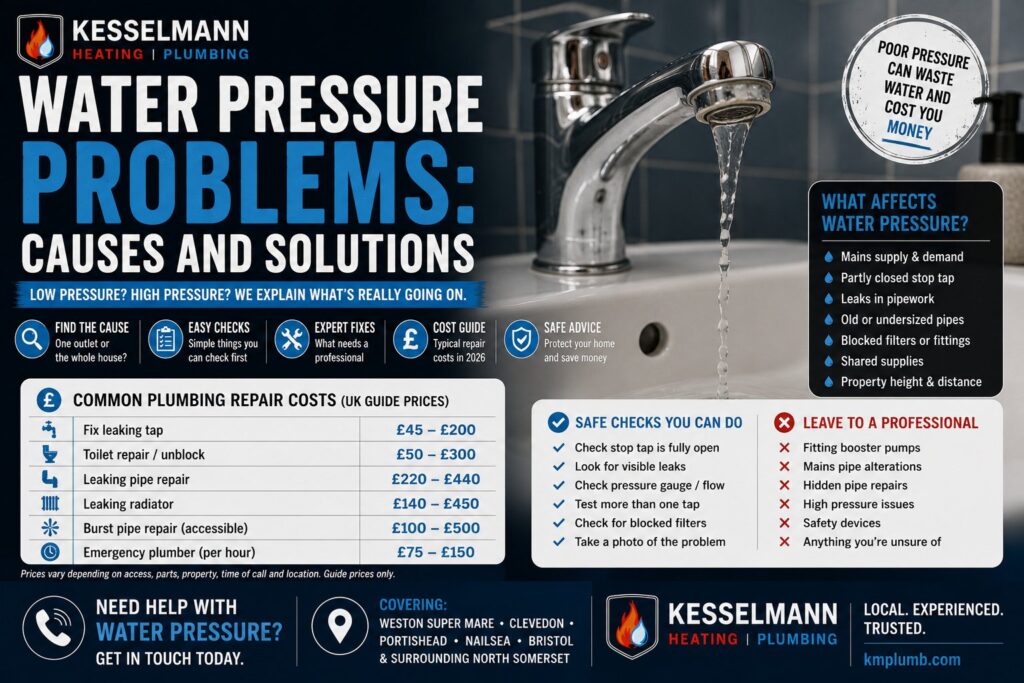
Water pressure problems can be caused by the mains supply, a partially closed stop tap, leaks, old or undersized pipework, shared supplies, blocked fittings or faults inside the property. Start by checking whether the problem affects one outlet or the whole house, whether neighbours are affected and whether the stop tap is fully open.
Spoiler
Before buying a pump, ripping out pipework or blaming the water company, work out where the pressure problem actually starts.
One weak shower and an entire house with poor flow are not the same fault.
The short answer
If your water pressure is poor, first establish whether it affects one tap, one bathroom or the whole property. Whole house problems can be caused by the mains supply, a leak, a partially closed stop tap, an old or restricted incoming main or a shared supply. A problem at one outlet is more likely to be local, such as a blocked aerator, showerhead, valve or section of pipework.
Key takeaways
- Check whether the problem affects one outlet or everything.
- Make sure your internal stop tap is fully open.
- Sudden pressure loss can point towards a leak or local supply problem.
- Poor flow and poor pressure are related, but they are not exactly the same thing.
- Do not fit a pump until you understand what the existing supply can actually deliver.
Fun fact
Water pressure is commonly described in bar or metres head.
Roughly speaking, 10 metres head is about 1 bar. WaterSafe says most suppliers aim for around 10 metres head at the point where their pipework meets yours.
So yes, plumbing occasionally turns into physics when nobody asked it to.
What is the difference between water pressure and water flow?
People use the words interchangeably.
Plumbers shouldn’t.
Pressure is the force pushing the water.
Flow is how much water actually comes out over a period of time.
Ofwat defines water pressure as the force pushing water through the pipes, while the resulting flow at your tap depends on pressure as well as the pipework supplying it.
You can therefore have reasonable incoming pressure but disappointing flow because:
- The pipe is too small
- A valve is partly closed
- A filter is blocked
- Pipework is restricted
- Several outlets are being used together
Imagine blowing through a drinking straw.
Plenty of pressure available.
Still not filling a bath anytime soon.
What should my mains water pressure be?
There are slightly different figures used in public guidance, depending on whether we are talking about the guaranteed minimum or the level suppliers generally aim to provide.
Ofwat says the Guaranteed Standards Scheme requires water companies to maintain at least 7 metres static head in the communication pipe serving a property, subject to the scheme’s conditions. WaterSafe says suppliers generally aim for around 10 metres head, or about 1 bar, at the boundary.
For local context, Bristol Water says it supplies at a minimum of around 7 metres head, approximately 0.7 bar, and generally aims for around 10 metres head, approximately 1 bar, where its pipe joins the customer’s.
That does not mean every shower upstairs will see exactly 1 bar.
The plumbing inside the property affects what reaches the outlet.
A simple flow check at the kitchen tap
WaterSafe gives homeowners a useful rough check.
With all other taps and appliances turned off, the first mains fed tap in the property, normally the kitchen cold tap, should be able to fill a 4.5 litre bucket in around 30 seconds where the supply pipe is suitable.
That is around 9 litres per minute.
It is not a professional pressure test.
But it gives you information.
If the kitchen cold tap barely fills the bucket while everything else is off, the problem is probably bigger than a slightly scaled showerhead.
What causes low water pressure?
1. High demand on the mains
Water pressure can fall during busy periods.
Mornings.
Evenings.
Hot days when everyone suddenly decides their lawn deserves a drinking water supply.
Ofwat and Bristol Water both identify peak demand as a reason customers may temporarily experience reduced pressure.
If the pressure is excellent at 11pm and miserable every morning at 7.30am, that pattern matters.
2. Work or a burst on the water network
Maintenance, burst mains or network changes can temporarily reduce pressure.
Bristol Water specifically lists planned work and unexpected burst mains among common reasons for temporary low pressure.
Before booking a plumber to dismantle the house, check whether your neighbours have the same problem.
If everyone in the street has suddenly got a pathetic kitchen tap, this may not be your plumbing.
3. Your internal stop tap is partly closed
This is wonderfully simple.
And surprisingly common.
Ofwat advises checking that the internal stop tap is fully open when investigating poor water pressure inside a property.
Somebody may have:
- Turned it down during previous work
- Never fully reopened it
- Accidentally moved it
- Found it seized halfway
If the whole house is affected, this is one of the first places I’d look.
4. You have a leak
A sudden significant drop in pressure can indicate water escaping somewhere.
Bristol Water says that if pressure changes significantly in a short period, a leak is one possible explanation.
Look for:
- Damp patches
- Water meter movement when everything is off
- Wet ground
- Hissing
- Water beneath floors
- Unexplained increases in consumption
Do not ignore a sudden pressure change because:
“It’s still sort of working.”
That’s information.
Use it.
5. Old or undersized incoming pipework
Older properties may have smaller service pipes.
Bristol Water identifies old or narrow supply pipes as a cause of reduced flow, particularly where household demand has increased compared with when the property was originally plumbed.
A house originally designed for:
- One bathroom
- One toilet
- One kitchen sink
may now contain:
- Two bathrooms
- Rainfall showers
- Dishwasher
- Washing machine
- Outside taps
- Unvented cylinder
The incoming pipe has not necessarily received the memo.
6. Shared water supplies
Some properties share a supply pipe before it reaches the individual homes.
Bristol Water notes that pressure and flow can fall when several properties on a shared supply use water at the same time.
Classic symptom:
Everything is lovely.
Neighbour turns the shower on.
Your shower suddenly appears to have lost interest.
7. Long pipe runs or property height
The further and higher the water has to travel, the more the available pressure can be affected.
Ofwat notes that homes higher up a hill can experience lower pressure than properties lower down, while Bristol Water also identifies long internal pipe runs and property elevation as factors.
Physics.
Again.
8. A local blockage
If only one tap or shower is affected, start locally.
Possible causes include:
- Blocked tap aerator
- Scaled showerhead
- Partially closed isolation valve
- Blocked filter
- Flexible hose kink
- Faulty cartridge
- Restriction in local pipework
If your kitchen cold tap is excellent but the ensuite basin looks like it’s dispensing water by appointment only, blaming the street mains is probably premature.
Why is my shower pressure poor but my taps are fine?
This usually points towards a problem local to the shower or its supply.
Possible causes include:
- Scaled showerhead
- Blocked filters
- Restricted hose
- Shower valve problem
- Small pipework
- Poor hot water delivery
- Another outlet stealing the available flow
The type of hot water system also matters.
A gravity fed hot water cylinder behaves very differently from:
- A combi boiler
- An unvented cylinder
- An electric shower
Do not assume a pump is automatically the answer.
The correct solution depends on what system you already have.
Why does the pressure drop when two taps are running?
Because the available supply is being divided between outlets.
That effect becomes more noticeable where:
- The incoming main is small
- Flow is already limited
- Supply is shared
- Pressure is modest
- Several outlets demand high flow
Bristol Water specifically identifies simultaneous appliance use as a cause of reduced pressure and flow at individual outlets.
This is why testing one shower with every tap in the house running does not tell us much.
Equally, testing a fancy rainfall shower while someone is filling the bath and the washing machine is running is perhaps asking a lot of the plumbing.
Can water pressure be too high?
Yes.
High pressure is less commonly complained about because people tend not to ring a plumber saying:
“My shower is annoyingly excellent.”
But excessive pressure can create problems.
Ofwat says high pressure can damage plumbing fittings and potentially contribute to flooding.
WaterSafe also notes that high pressure can contribute to pipe banging and stress on joints and fittings.
Possible symptoms include:
- Banging pipes
- Noisy valves
- Water hammer
- Taps that feel aggressive
- Frequent failures of flexible hoses or valves
- Pressure relief devices operating
- Appliances objecting to the supply conditions
The proper solution may involve pressure control.
Not simply closing the stop tap halfway and declaring victory.
Why are my pipes banging when I turn the tap off?
Sudden changes in water movement can cause water hammer.
WaterSafe lists possible causes including:
- Loose pipework
- Faulty valves
- Trapped air
- Excessive pressure
- Rapidly closing appliance valves
If pipework is physically moving and hitting walls or floors, the pipe supports may also need attention.
Water hammer should not simply become:
“That noise the house makes.”
Persistent pressure shocks can stress fittings and pipework over time.
What can I safely check myself?
Safe homeowner checks
You can check:
- Is the problem at one outlet or everywhere?
- Are your neighbours affected?
- Is your internal stop tap fully open?
- Are other taps or appliances running?
- Is the showerhead scaled?
- Is the tap aerator blocked?
- Has the problem appeared suddenly?
- Is there evidence of a leak?
- Does the pressure change significantly by time of day?
- How quickly does the kitchen cold tap fill a bucket?
Those observations make diagnosis much easier.
Work that needs a professional
Get professional help before:
- Fitting booster pumps
- Altering mains pipework
- Installing pressure reducing valves
- Replacing incoming mains supplies
- Opening unvented cylinder controls
- Altering safety devices
- Modifying plumbing where you do not understand the system
- Attempting to operate external water company equipment without permission
WaterSafe notes that external stop taps normally belong to the water supplier and may require their permission to operate.
Common mistakes
Calling everything “low pressure”
Sometimes the pressure is fine.
The flow is poor.
Different problem.
Buying a pump before testing anything
This is probably the big one.
Before increasing anything, establish:
- Static pressure
- Dynamic pressure
- Available flow
- Pipe size
- Existing hot water system
- What outlets need supplying
Otherwise you’re prescribing medication before deciding whether the patient is ill.
Blaming the water company for one weak tap
If the kitchen tap launches water across the room but one basin tap barely works, start with the basin.
Half closing a stop tap because the pressure feels high
That creates a restriction.
It is not the same as properly regulating the pressure.
Ignoring a sudden drop
A sudden change is different from a house that has always had poor flow.
Investigate it.
Installing huge showers on a mediocre supply
A 300mm rainfall shower does not manufacture water.
It can only use what reaches it.
Occasionally bathroom design encounters fluid dynamics and loses.
What I would recommend
Start with the pattern.
If the whole house suddenly has poor pressure:
- Ask whether neighbours are affected.
- Check for local water company work.
- Make sure the internal stop tap is open.
- Look for signs of leakage.
- Measure the basic flow at the kitchen cold tap.
If one outlet is affected:
Start there.
Check the head, aerator, hose, valve and local pipework.
If pressure is poor whenever several outlets run together, investigate:
- Incoming main size
- Shared supplies
- Available pressure and flow
- Property demand
- Hot water system design
Then design the solution around actual measurements.
Not guesswork.
Need help with poor water pressure in Weston super Mare?
Kesselmann Heating & Plumbing provides plumbing fault finding and repairs across Weston super Mare, Worle, Clevedon, Portishead, Nailsea, Bristol and surrounding North Somerset. The current website lists plumbing repairs as one of its core services and confirms the wider local service area.
If your shower is weak, several taps lose flow together, the water supply has suddenly changed or you simply cannot work out whether the problem is the mains or your internal plumbing, we can investigate the system properly.
Plumbing Repairs in Weston super Mare → Kesselmann Heating & Plumbing
Need a Gas Safe engineer in Weston-super-Mare?
Frequently asked questions
Why has my water pressure suddenly dropped?
A sudden reduction can be caused by local water company work, a burst main, a leak, a partly closed stop tap or another change in the property plumbing. Bristol Water specifically advises that an unexpected significant pressure change can indicate leakage.
Why is my water pressure worse in the morning?
Demand is often higher in the morning and evening as more people use baths, showers and appliances. Both Ofwat and WaterSafe say this can temporarily reduce mains pressure.
What is considered normal mains water pressure?
WaterSafe says suppliers generally aim for around 10 metres head, roughly 1 bar, at the boundary, while Ofwat's guaranteed standard refers to a minimum of 7 metres static head subject to the scheme conditions.
Can old pipes cause poor water pressure?
Yes. Older or narrow incoming pipes can restrict the amount of water available, particularly when several outlets operate together. Bristol Water lists older and smaller supply pipes among common causes of poor pressure and flow.