
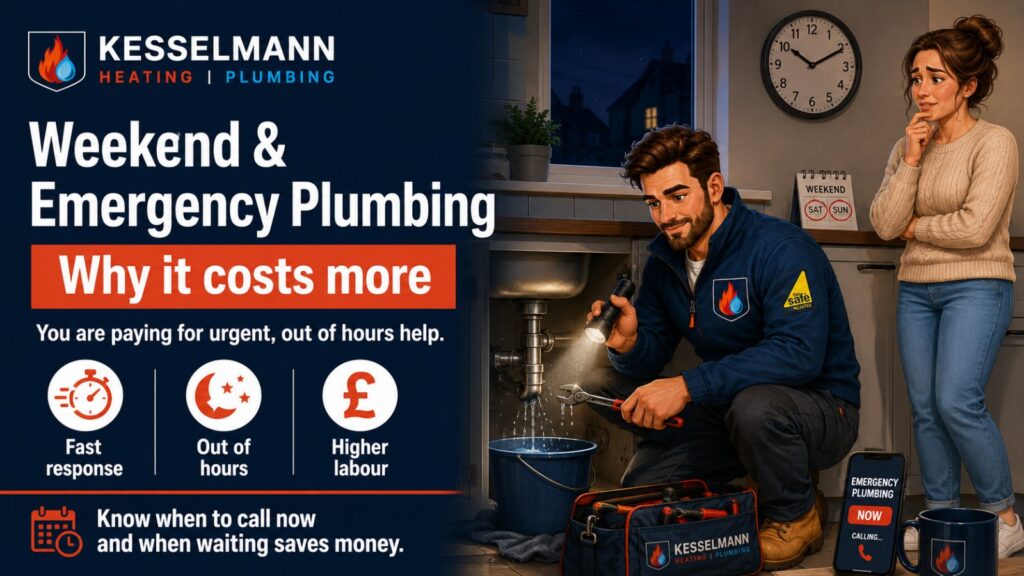
Weekend and Emergency Plumbing: Why Does It Cost More?
TLDR
Weekend and emergency plumbing costs more because you are paying for immediate, out of hours attendance. Current UK pricing guides put normal plumbing labour around £40 to £60 per hour, compared with roughly £75 to £150 per hour for emergency work, often alongside a call out charge.
Spoiler
You are paying for priority.
Someone has to stop what they are doing, travel to your property and deal with your problem now rather than adding you to next week’s diary.
The short answer
Emergency plumbing costs more because the plumber has to keep time available outside normal working hours, respond quickly, travel at short notice and often diagnose an unknown fault under pressure. Weekends, evenings and overnight visits commonly attract higher labour rates and call out charges.
Checkatrade’s June 2026 UK guide gives around £50 per hour as the average normal plumber rate, compared with around £100 per hour for emergency plumbing. The published emergency range is £75 to £150 per hour, with an average emergency call out fee of around £110.
What you need to know
- Normal UK plumbing labour averages around £50 per hour in Checkatrade’s current guide.
- Emergency labour sits around £75 to £150 per hour nationally.
- Emergency call out fees average around £110 in the same guide.
- Nights and weekends often cost more than planned daytime appointments.
- If the problem is safely isolated and no further damage is occurring, waiting for normal hours often saves money.
Fun fact
Checkatrade says an emergency plumber might charge up to twice their ordinary hourly rate for out of hours and weekend attendance.
So the expensive part is often not the washer, valve or fitting.
The expensive part is wanting somebody standing in your kitchen at 11.30pm on Saturday.
Why does weekend plumbing cost more?
A normal plumbing appointment has structure.
The plumber knows where they are going.
The job sits in the diary.
Travel has been planned.
Materials might already be ordered.
Emergency work removes most of those advantages.
The phone rings.
Someone has water pouring through a ceiling.
Plans change.
The plumber travels immediately, often without knowing exactly what fault awaits them.
That level of availability costs money.
Checkatrade lists time of day, urgency, location, job complexity and required materials among the main factors affecting emergency plumbing charges.
What are you paying for during an emergency call out?
You are paying for more than time spent holding a spanner.
The charge often reflects:
- Immediate availability
- Travel at short notice
- Initial fault finding
- Out of hours working
- Giving your job priority over planned work
- The first period of labour, depending on the plumber’s pricing structure
Different businesses structure emergency charges differently.
One plumber might charge a call out fee plus hourly labour.
Another might include the first hour inside the initial charge.
Ask before booking.
A £120 call out including the first hour and a £120 fee for arriving are two different prices.
How much more does an emergency plumber cost?
Checkatrade’s June 2026 UK figures give this comparison:
Type of plumbing workUK guide priceNormal plumber hourly rate£40 to £60Average normal hourly rate£50Emergency plumber hourly rate£75 to £150Average emergency hourly rate£100Emergency call out fee£100 to £120Average emergency call out£110
These are national ballpark figures.
They are not Kesselmann prices or fixed quotations.
Why do plumbers charge a call out fee?
Because attending your property has a cost before any repair begins.
Travel takes time.
Fuel costs money.
The plumber gives up another part of their day or evening.
An emergency visit also involves uncertainty.
You might describe the problem as:
“There’s a leak under the sink.”
The plumber arrives and finds a failed mains fitting behind a kitchen unit with a seized stop tap.
Same phone description.
Different job.
Checkatrade’s March 2026 call out guide puts the average emergency call out charge around £110 and advises customers to ask what the fee covers before booking.
When is paying emergency rates worth the money?
When waiting costs more.
WaterSafe identifies leaks and burst pipes as problems where emergency plumbing help is appropriate.
Examples include:
- Water escaping and you cannot isolate the supply
- A burst pipe
- Water running through a ceiling
- Sewage entering the property
- An overflowing toilet which will not stop
- A serious cylinder leak
- A leak threatening flooring, units or ceilings
- Water reaching electrical fittings
A £100 or £200 emergency attendance starts looking cheap once water begins damaging a £10,000 kitchen.
Water does not care whether the plumber’s normal working hours ended at five.
When should you wait until Monday?
Wait where the fault is safe, contained and no longer causing damage.
A dripping tap neatly dripping into the basin does not normally require Sunday evening emergency attendance.
Neither does:
- One cold radiator
- A slow draining basin
- A stiff tap
- A toilet which will not flush when another toilet is available
- A small leak which has been fully isolated
- Minor planned plumbing work
The important word is contained.
If you have stopped the water and nothing else is getting damaged, waiting for an ordinary appointment often makes financial sense.
If water still escapes into the building, the calculation changes.
What should you do before calling an emergency plumber?
Stop the water first
For a leak or burst pipe, WaterSafe advises turning off the water at the internal stop tap. Their burst pipe guidance also advises switching off the boiler and draining the system.
If you have a local isolation valve for the faulty toilet, tap or appliance, use the local valve where appropriate.
Work out whether the problem is still causing damage
Ask yourself:
Is water still escaping?
Is sewage entering the property?
Is a ceiling becoming wetter?
Is flooring swelling?
Has water reached electricity?
Those answers decide urgency far better than how annoying the fault feels.
Give the plumber useful information
Tell them:
- Where the fault is
- Whether you isolated the water
- Whether water still escapes
- Whether waste water is involved
- Whether electricity is nearby
- What happened immediately before the fault
- Whether photographs or video are available
Better information gives the plumber a better chance of arriving prepared.
Should the plumber tell you the emergency charges before arriving?
Where practical, ask.
You want to know:
- Call out fee
- What the call out includes
- Hourly rate after the initial period
- Whether weekend or night rates differ
- Whether parts sit outside the labour charge
- How additional work gets authorised
GOV.UK guidance on consumer services states that where no exact price has been agreed, the customer has a right to a reasonable charge. Services also need to be carried out with reasonable care and skill.
Clear pricing avoids an argument at 1am when everybody would rather be in bed.
Does more expensive mean you are being ripped off?
No.
Emergency pricing and dishonest pricing are different subjects.
A plumber charging more at midnight than at 10am on Tuesday is understandable.
Someone refusing to explain their charges, inventing extras afterwards or taking advantage of panic deserves more scrutiny.
Checkatrade openly describes higher out of hours and weekend pricing as common industry practice.
What matters is transparency.
You should understand how the bill gets calculated before agreeing to the work where circumstances allow.
Common mistakes
Calling before trying to isolate the water
If water is pouring across the floor, find the stop tap first where safe.
The plumber’s van will not outrun the leak.
WaterSafe advises homeowners to turn off the water at the stop tap when dealing with a serious leak.
Treating inconvenience as an emergency
No heating during severe cold is one thing.
A dripping tap on Saturday night is another.
Emergency attendance buys urgency.
Use urgency where urgency has value.
Waiting because emergency rates sound expensive
This goes wrong at the opposite end.
A homeowner avoids a weekend call out to save £100 or £200.
By Monday the laminate has swollen, the ceiling below is stained and the kitchen unit has absorbed enough water to become modern art.
Judge the potential damage alongside the call out cost.
Forgetting to ask what the call out fee includes
Ask before booking where circumstances allow.
A two minute conversation might prevent a much longer argument later.
What I would recommend
First decide whether the problem is still getting worse.
If yes, deal with the emergency.
If you have safely stopped the water and protected the property, then consider whether you need someone immediately.
For genuine emergencies, do not choose solely on the lowest call out fee.
You want someone competent, available and clear about their pricing.
For problems which safely wait, book normal working hours.
There is no prize for paying Sunday evening rates to repair something which has already been isolated and poses no further risk.
Need an emergency plumber in Weston super Mare?
Kesselmann Heating & Plumbing provides plumbing repairs and emergency plumbing services across Weston super Mare and surrounding North Somerset, including Clevedon, Portishead, Nailsea and nearby areas.
If water is actively escaping, a pipe has burst or you have an urgent plumbing fault, explain the problem clearly when you contact us.
Photos help.
Knowing whether the water has been isolated helps even more.
Need a Gas Safe engineer in Weston-super-Mare?
Frequently asked questions
Why are emergency plumbers more expensive?
Emergency plumbers charge more because the job involves urgent attendance, out of hours working, disrupted schedules and short notice travel. Current UK guidance from Checkatrade puts emergency rates around £75 to £150 per hour compared with £40 to £60 for ordinary plumbing work.
Do plumbers charge more on weekends?
Often, yes. Checkatrade states that weekend and out of hours work commonly attracts higher rates and emergency call out charges.
What is a normal emergency plumber call out fee?
Checkatrade's 2026 UK guide gives £100 to £120 as the typical emergency call out range, averaging around £110. Local businesses set their own charges.
Is the repair included in the call out fee?
Sometimes.
Pricing structures differ between plumbing businesses. Ask whether the fee includes diagnosis, the first hour of labour, travel or arrival only. Parts often sit outside the initial charge.
Is a leaking tap worth an emergency call out?
Usually no, where the water stays safely inside the sink and no further damage occurs. Book ordinary hours and save the emergency rate for a genuine emergency.
Is a burst pipe worth paying emergency rates for?
Yes, especially where water still escapes or the property is being damaged. WaterSafe specifically lists burst pipes among plumbing emergencies requiring prompt help.