What Causes a Boiler to Break Down?
Boilers very rarely wake up one morning and think:
“You know what? Sod this. I’m done.”
Normally something has been going on in the background.
Water has been leaking.
Pressure has been disappearing.
Sludge has been circulating.
A pump has been getting tired.
A condensate pipe has slowly blocked.
A component has been operating outside ideal conditions.
Or, quite simply, something mechanical or electrical has reached the end of its life.
Then eventually the boiler stops.
Usually in January.
Because apparently boilers understand comic timing.
The frustrating bit for homeowners is that “the boiler has broken down” describes the result, not the cause.
So let’s look at what actually causes boiler breakdowns, which ones you may be able to reduce the risk of, and which ones are simply part of owning a machine full of pumps, valves, electronics, water, fire and optimism.
Quick answer: What causes a boiler to break down?
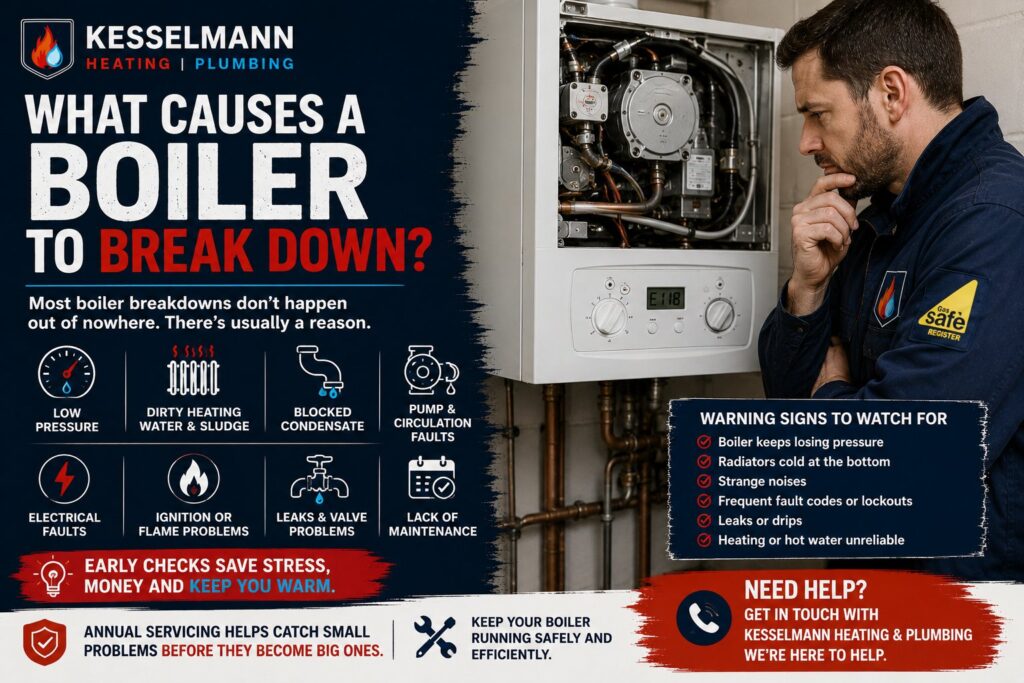
Common causes of boiler breakdowns include:
- Low system pressure
- Water leaks
- Expansion vessel and pressure problems
- Dirty heating water and sludge
- Pump and circulation faults
- Blocked or frozen condensate pipes
- Ignition and flame detection problems
- Electrical and control faults
- Sensors failing
- Valves sticking or failing
- Poor installation or system conditions
- Lack of maintenance
- Normal component wear with age
Manufacturers including Vaillant, Worcester Bosch and Ideal identify pressure loss, leaks, blocked condensate drains and component faults among common reasons boilers stop operating.
Some failures are unavoidable.
But maintenance, correct system water treatment and sorting small faults early can reduce the odds of an expensive breakdown. HSE advises homeowners to have gas appliances, flues and pipework regularly maintained and serviced at least annually by a Gas Safe registered engineer.
First: boilers are machines
This sounds painfully obvious, but it matters.
Inside a modern gas boiler you may have:
- A fan
- Pump
- Gas valve
- Heat exchanger
- Expansion vessel
- Pressure sensor
- Temperature sensors
- Ignition equipment
- Flame sensing equipment
- Printed circuit board
- Diverter valve on many combis
- Safety valves
- Condensate trap
- Various seals and moving components
That’s quite a lot happening inside one relatively small white box.
Eventually components wear.
A boiler can be beautifully installed, serviced every year and connected to a spotless heating system and still suffer a component failure.
Maintenance changes the odds.
It does not create immortality.
Anyone promising that servicing means your boiler can never break down has accidentally confused an annual service with witchcraft.
The main causes of boiler breakdowns
ProblemWhat happensCan you reduce the risk?Pressure lossBoiler may lock out when system pressure fallsOften, by finding leaks rather than repeatedly topping upDirty heating waterSludge can restrict circulation and affect componentsYes, through cleaning, treatment and maintenanceCondensate blockageBoiler may lock out when condensate cannot drainOften, with correct installation and maintenancePump faultWater cannot circulate properlySometimes, through good system water quality and maintenanceExpansion problemPressure rises excessively when heatingFault needs diagnosing and repairingIgnition faultBoiler cannot establish or maintain flameUsually professional diagnosis requiredSensor faultBoiler receives incorrect informationNormal component failure in some casesElectrical/control faultBoiler or controls fail to communicate or operateSometimes maintenance catches early signsLeakWater and pressure are lostEarly repairs can prevent secondary damageGeneral wearMechanical and electrical components ageMaintenance helps, but components still eventually fail
1. Your boiler keeps losing pressure
This is one of the most common warning signs homeowners notice.
You look at the gauge.
Pressure is low.
You top it up.
Three weeks later it’s low again.
You top it up.
Eventually this becomes part of Sunday morning.
Coffee.
Dog walk.
Feed the boiler.
No.
A sealed heating system should not normally require constant topping up.
Vaillant lists leaks from the boiler or heating system, including radiator valves and system components, among common causes of repeated pressure loss.
Ideal similarly advises that if low pressure repeatedly returns, there is a problem requiring investigation rather than endless repressurisation.
Common causes include
- Leaking radiator valves
- Tiny pipework leaks
- Boiler leaks
- Pressure relief valve discharge
- Expansion vessel problems
- Water lost while bleeding radiators
Low pressure itself does not necessarily mean your boiler is dying.
In fact, Ideal specifically notes that low pressure alone does not damage the boiler or shorten its lifespan.
The important question is:
Why did the pressure disappear?
That is what needs finding.
2. Expansion vessel problems
This one creates a classic pattern.
Boiler cold:
Pressure looks normal.
Heating comes on:
Pressure climbs.
And climbs.
And climbs.
The pressure relief valve may then discharge water.
Heating cools down.
Pressure falls.
You top it up.
Repeat until everyone loses the will to live.
The expansion vessel exists because water expands as it gets hot.
If the vessel loses its air charge or develops a fault, there may not be enough room to absorb that expansion.
Pressure can rise significantly, and the boiler’s safety valve may open to protect the system.
Vaillant explains that pressure relief valves release water when system pressure becomes excessive, and that repeated valve discharge can point towards a deeper heating system problem requiring investigation.
This is usually repairable.
But repeatedly topping up the system does not repair it.
It merely keeps the cycle alive.
3. Dirty heating water and black sludge
This is one of the big ones because people forget that the boiler is connected to the entire heating system.
It isn’t sitting on the wall having a private life.
The same heating water travels through:
- Radiators
- Pipework
- Pumps
- Valves
- Filters
- The boiler itself
If that water contains corrosion products and black magnetite sludge, the contamination can circulate into expensive boiler components.
Worcester Bosch has published guidance explaining that untreated heating systems deteriorate through sludge and corrosion, which can block radiators and affect boiler, pump and valve performance.
Vaillant’s current service plans even include a water quality check as part of their listed boiler service checks.
Warning signs include
- Radiators cold at the bottom
- Black water
- Magnetic filter full of sludge
- Pump noise
- Poor circulation
- Boiler kettling or overheating symptoms
- Some radiators taking forever to warm
This does not mean every black speck demands a £900 powerflush.
Test the system.
Assess the contamination.
Then choose the correct cleaning method.
The machine should follow the diagnosis.
Not the other way round.
4. Pump failure and poor circulation
The pump moves heated water around the system.
Without it, the boiler can create heat beautifully.
That heat just doesn’t go anywhere useful.
Poor circulation may cause:
- Boiler overheating
- Rapid cycling
- Cold radiators
- Strange noises
- Heating not working properly
- Fault codes
- Lockouts
Ideal lists a central heating pump not running among possible explanations for certain boiler fault conditions.
Pumps fail mechanically and electrically.
But poor water quality can also create unpleasant conditions for pumps and other moving components, which is another reason the condition of the wider heating system matters.
Putting a new pump into filthy water without addressing why the old one struggled is sometimes less of a repair and more of a relay race.
5. Blocked or frozen condensate pipes
Modern condensing boilers produce condensate water during normal operation.
That water has to drain away.
If it cannot, the boiler may lock out.
Worcester Bosch identifies gurgling, repeated lockouts and certain fault codes as possible signs of blocked condensate drainage.
During freezing weather, exposed condensate pipework can also freeze. Ideal publishes specific homeowner guidance for safely thawing accessible frozen condensate pipes and advises getting a Gas Safe engineer involved where there is doubt or unsafe access.
Why does this happen?
Possible reasons include:
- Freezing
- Dirt or debris
- Poor drainage
- Incorrect pipework
- A blocked condensate trap
- Poor fall on the pipe
Vaillant notes that condensate traps need routine maintenance to help prevent problems.
So sometimes a boiler that appears completely dead has not suffered a catastrophic mechanical failure.
Its drain is blocked.
Very dramatic machine.
Very ordinary problem.
6. Ignition and flame problems
Your gas boiler has to establish a safe flame before it can produce heat.
If it cannot ignite, or cannot prove that a flame is safely established, it should shut itself down.
That’s a good thing.
Annoying when you’re cold.
Still better than the alternative.
Possible causes of ignition lockout include problems associated with:
- Gas supply
- Ignition equipment
- Flame detection
- Gas valve operation
- Condensate blockage
- Electrical controls
Ideal’s troubleshooting guidance, for example, lists an L2 ignition lockout and directs homeowners first towards basic external checks such as condensate drainage and whether gas is available to the property. Further boiler investigation belongs with an engineer.
This is where YouTube DIY needs to end.
Do not remove the boiler casing and begin investigating gas components.
For work on gas fittings, use someone currently Gas Safe registered and appropriately qualified for that work.
7. Sensors fail
Modern boilers rely heavily on sensors.
The boiler needs to know things like:
- Water temperature
- System pressure
- Whether there is a flame
- Whether hot water is being requested
- Whether conditions are safe to continue operating
When a sensor fails or produces an unexpected reading, the boiler may stop because it cannot safely establish what is happening.
This can feel frustrating to a customer because the actual mechanical boiler might look completely fine.
But safety controls are deliberately designed to stop the appliance when operating conditions cannot be confirmed.
That’s not the boiler being temperamental.
That’s the boiler refusing to make assumptions about fire.
Which, generally speaking, is quite a good character trait.
8. Electrical faults
A modern boiler is full of electronics.
No electricity means no boiler.
Ideal notes that a completely blank boiler display may indicate loss of electrical power or an internal component fault.
Possible causes outside or inside the appliance can include:
- Failed fused spur
- Electrical supply problem
- Control fault
- Wiring problem
- PCB failure
- Pump electrical fault
- External thermostat or programmer failure
Before assuming the PCB has died, check the boring things first.
Is there power?
Has something tripped?
Are the controls actually asking the boiler to turn on?
People have purchased expensive boiler parts because somebody forgot the thermostat had flat batteries.
Humanity continues.
9. Thermostats and controls
Sometimes the boiler hasn’t broken down at all.
It has simply not been asked to do anything.
Possible causes include:
- Thermostat turned down
- Programmer schedule changed
- Wireless thermostat lost connection
- Flat batteries
- Control switched into holiday mode
- External control fault
Before calling an engineer because the heating is completely dead, check the thermostat.
Turn it above the current room temperature.
Does the boiler respond?
If it does:
Excellent.
You have fixed the cheapest boiler breakdown available.
10. Water leaks inside the boiler
A boiler contains multiple water carrying components and seals.
They can leak.
Vaillant advises treating boiler leaks seriously and says homeowners should not remove the boiler casing to investigate them themselves.
Possible sources can include:
- Seals
- Pumps
- Valves
- Internal connections
- Heat exchangers
- Pressure related components
A tiny leak can become more serious if water reaches electrical components.
So if you can see water coming from the boiler itself:
Don’t ignore it because it’s only three drops.
Water has no ambition.
It is perfectly happy to ruin something slowly.
11. The heating system has been badly installed
Sometimes the boiler is blamed for problems created outside the boiler.
Poor installation can leave the appliance working under conditions it was never meant to deal with.
That can include issues with:
- Gas supply
- Water circulation
- System cleaning
- Condensate drainage
- Controls
- Flue installation
- Pipework
- System commissioning
Gas appliances and flues have to be installed and maintained safely, and gas work must be carried out by appropriately qualified Gas Safe registered engineers. HSE warns that poorly installed or maintained gas appliances can create risks including fire, explosion, gas leaks and carbon monoxide poisoning.
A good boiler installed badly is still a bad heating system.
You cannot buy your way out of poor workmanship with a more expensive badge.
12. Lack of servicing
A boiler service cannot guarantee your boiler will not break tomorrow.
Let’s get that out of the way.
Anyone promising otherwise is selling confidence by the bucket.
What servicing can do is give an engineer an opportunity to identify:
- Leaks
- Seal deterioration
- Combustion problems
- Poor operating conditions
- Unsafe components
- Early signs of failure
- Water quality issues, depending on the service
- Unusual performance
Vaillant says annual servicing can spot problems early, support safe operation, maintain guarantees and help extend boiler life.
Gas Safe Register similarly says a service should check that a gas boiler is operating safely and efficiently and that faults are not present.
HSE strongly advises homeowners to have gas appliances, flues and pipework serviced at least annually by a Gas Safe registered engineer.
A service buys you information.
Information gives you choices.
Discovering in July that a component looks tired is irritating.
Discovering at 6am on Christmas Eve that it has finally died is more irritating.
13. Components simply wear out
Sometimes there isn’t a villain.
No cowboy.
No missing inhibitor.
No filthy system.
A component simply fails.
Pumps contain motors.
Fans contain bearings.
Valves move.
Seals age.
Electronics fail.
Nothing mechanical lasts forever.
That is why the question:
“Why did this part fail?”
sometimes has a very complicated answer.
And sometimes the answer is:
“Because it’s been moving thousands of times for twelve years.”
Maintenance can influence reliability.
It cannot repeal ageing.
Is an old boiler more likely to break down?
Generally, the risk of component wear increases as equipment ages, but boiler age alone doesn’t tell us whether replacement is justified.
Look at the whole picture:
- Repair history
- Current condition
- Parts availability
- Water quality
- Installation quality
- Reliability
- Cost of the required repair
- Whether the boiler still suits the property
An older boiler that has been maintained properly can remain dependable.
A newer boiler connected to dirty system water and installed badly can spend half its life sulking.
Date of manufacture is useful.
Condition is better.
The warning signs before a boiler breakdown
Boilers sometimes fail without warning.
But plenty give hints.
Pay attention to:
- Pressure repeatedly dropping
- Pressure rising dramatically when hot
- New noises
- Water leaks
- Radiators taking longer to warm
- Hot water temperature changing
- Repeated fault codes
- Frequent resets
- Boiler constantly turning on and off
- Dirty system water
- Magnetic filter repeatedly filling
- Condensate gurgling
- Heating behaving differently than normal
One of these does not mean catastrophe.
A pattern matters.
Your boiler usually speaks before it dies.
Unfortunately, its vocabulary consists mainly of pressure gauges, fault codes and weird noises.
One reset is fine. Twenty seven resets is not diagnosis
A boiler reset exists for a reason.
Sometimes a temporary fault clears and everything continues normally.
But if the same fault keeps returning:
Stop resetting it.
The boiler is telling you that whatever caused the shutdown is still there.
Resetting a recurring fault is basically saying:
“I acknowledge your complaint. Please continue.”
Not terribly useful.
What can homeowners safely check themselves?
Before calling an engineer, you can usually check:
Check the display
Take a photograph of the fault code.
Do this before resetting it.
That information can be very useful.
Check the pressure
Compare it with the manufacturer’s instructions for your boiler.
Do not assume every boiler should sit at exactly the same pressure.
Check the thermostat
Turn it up.
Check the batteries.
Check the schedule.
Check the power
Does the boiler display work?
Has anything tripped?
Check whether gas appears available
If you normally use another gas appliance safely, its operation may help establish whether the property has a wider supply issue. Do not attempt gas work yourself.
Look for visible leaks
Check:
- Radiator valves
- Visible heating pipes
- Beneath the boiler
- Around accessible components
Listen
Gurgling?
Grinding?
Banging?
Whistling?
Record the sound on your phone.
Boilers have an extraordinary ability to become silent the second the engineer walks through the door.
Check the condensate externally
During freezing weather, an accessible external condensate pipe may be worth inspecting for ice. Follow the boiler manufacturer’s instructions and do not take risks climbing ladders or opening the appliance.
What should homeowners NOT do?
Do not:
- Remove the boiler casing
- Adjust gas components
- Bypass safety devices
- Keep resetting a recurring fault
- Constantly refill a system losing pressure
- Open boiler filters while hot and pressurised
- Buy a replacement PCB because Facebook said so
- Ignore water leaking from the appliance
- Block or alter flue components
- Use someone unregistered for gas work
Gas work must be completed by an appropriately qualified Gas Safe registered engineer.
A boiler casing is not like the bonnet on a Ford Fiesta.
Opening it can alter the room sealed combustion arrangement.
Leave internal gas appliance work alone.
Important safety warning: gas and carbon monoxide
A boiler breakdown is inconvenient.
A gas or carbon monoxide problem is different.
Carbon monoxide is colourless, odourless and poisonous.
If you suspect carbon monoxide, HSE advises you to switch off the appliance, ventilate the property, call the National Gas Emergency Service on 0800 111 999 and seek medical advice if exposure is suspected.
If you smell gas, contact the National Gas Emergency Service immediately on the same number. HSE advises shutting off the gas supply where safe and not turning it back on until the leak has been dealt with by a competent person.
This is not a fault finding exercise for YouTube.
Get out and deal with it properly.
Common homeowner mistakes that can make things worse
Constantly topping up pressure
Once after bleeding radiators?
Fine.
Every two weeks?
Find the leak or fault.
Ignoring dirty heating water
The boiler is connected to the heating system.
Treat the system, not just the white box.
Waiting until winter to test the heating
Turn it on in summer.
Does it work?
Excellent.
Doesn’t work?
Even better.
You’ve discovered it while nobody is freezing.
Ignoring small leaks
Small leaks do not generally heal through encouragement.
Skipping services
A service is an opportunity to spot deteriorating conditions before they become urgent.
Assuming every breakdown means replacement
A failed sensor is not the same thing as a ruined boiler.
Diagnose first.
Repairing indefinitely because replacement feels painful
The opposite mistake exists too.
If repairs become frequent and expensive, look at the pattern.
Sometimes another repair makes sense.
Sometimes you’re keeping the boiler alive through financial life support.
What actually prevents boiler breakdowns?
You cannot prevent every failure.
But these things help.
Annual servicing
HSE and boiler manufacturers recommend regular servicing, with annual servicing commonly required to maintain manufacturer guarantees.
Healthy heating water
Keep the system correctly cleaned, treated and maintained.
Correct inhibitor
Corrosion protection matters.
Magnetic filtration
A suitable magnetic filter can help capture circulating magnetic debris.
Repair leaks promptly
Pressure loss is information.
Use it.
Maintain correct pressure
Follow your boiler manufacturer’s instructions.
Test the heating before winter
Do not make October the first time you’ve turned it on since April.
Fix recurring faults
One lockout may be temporary.
Repeated lockouts deserve investigation.
Use the right engineer
Gas boiler repairs need an appropriately qualified Gas Safe registered engineer.
Boiler breakdown checklist
If your boiler suddenly stops working, check:
- Is there power?
- Is there a fault code?
- What does the manufacturer’s user manual say?
- What is the system pressure?
- Is the thermostat actually asking for heat?
- Does hot water work?
- Does heating work?
- Are both dead?
- Are there visible leaks?
- Has the pressure been falling recently?
- Has it been making unusual noises?
- Is the external condensate frozen?
- Have you recently bled radiators?
- Has anything changed with the controls?
- Has this fault happened before?
Photograph everything useful.
Then tell the engineer exactly what happened.
“Boiler broke” is technically correct.
“Pressure has fallen from 1.3 bar to zero three times this month and now it’s showing fault code X” is considerably more helpful.
When should you call a heating engineer?
Get professional help when:
- The fault repeatedly returns
- The boiler is leaking
- Pressure continually drops
- Pressure rises excessively when heating
- The boiler won’t ignite
- You hear severe new noises
- The boiler repeatedly overheats
- The pump appears not to operate
- The system water is badly contaminated
- Several radiators perform poorly
- Electrical supplies keep tripping
- The boiler casing needs opening
- You suspect an internal fault
- You’re simply not sure
For gas appliances, always use someone appropriately Gas Safe registered.
Our professional recommendation
When a boiler breaks down, don’t start with the part.
Start with the reason.
The boiler has lost pressure.
Why?
The pump failed.
Why?
The system is filthy.
Why?
The condensate keeps blocking.
Why?
The boiler keeps overheating.
Why?
Good fault finding works backwards from the symptom.
Otherwise you get parts changed until the fault disappears.
That can work.
Eventually.
So can buying every key on the keyring until one opens the door.
A competent engineer should be able to explain:
- What the boiler is doing
- What they tested
- What failed
- Why they believe it failed
- Whether anything else contributed
- Whether repair is sensible
- Whether something needs changing to stop it happening again
That last question matters.
Because fixing the failed component without fixing the reason it failed can leave you paying for part two of the same story later.
Boiler repairs in Weston super Mare and North Somerset
Kesselmann Heating & Plumbing provides boiler fault finding, repairs and heating system diagnostics across:
- Weston super Mare
- Clevedon
- Portishead
- Nailsea
- Bristol
- North Somerset and surrounding areas
The aim isn’t just to get the boiler firing again for twelve minutes.
It’s to understand why it stopped.
That might mean looking beyond the appliance at:
- Pressure loss
- Radiators
- Water quality
- Filters
- Pumps
- Controls
- Heating circulation
- System condition
Sometimes it’s a simple repair.
Sometimes it exposes a wider problem.
Either way, you should know what you’re paying to fix and why.
Need a Gas Safe engineer in Weston-super-Mare?
Frequently asked questions
Why has my boiler suddenly stopped working?
Common reasons include low pressure, blocked condensate drainage, electrical faults, ignition problems, pump faults, leaks and failed internal components. Check the display, pressure, controls and power before arranging professional diagnosis.
Why does my boiler keep breaking down?
Repeated breakdowns can suggest an underlying problem has not been resolved, the wider heating system is affecting the boiler, or several ageing components are beginning to fail.
Does low pressure damage a boiler?
Ideal states that low pressure itself should not damage or shorten the boiler's life, but low pressure can prevent the appliance operating correctly. Repeated pressure loss needs investigating because it usually means water is being lost or another fault exists.
Why does my boiler pressure keep dropping?
Common causes include leaks from radiator valves, pipework, boiler components and water lost from the system.
Why does boiler pressure rise when the heating comes on?
A problem with expansion provision may allow system pressure to rise excessively as the water heats. The expansion vessel and associated components should be checked.
Can sludge cause my boiler to break down?
Yes. Heating system contamination can restrict circulation and affect pumps, valves and boiler components.