What Is a Combi Boiler?
TLDR
A combi boiler heats your hot water and your radiators from one unit, straight off the mains, with no tank in the loft and no cylinder in the airing cupboard. It’s compact, cheap to install and instant. The trade off is limited flow when more than one tap wants hot water at the same time.
Spoiler: A combi is brilliant right up until two people want a shower at once. Then the size of your pipework and mains pressure decide who gets the hot water and who gets a shock.
The short answer
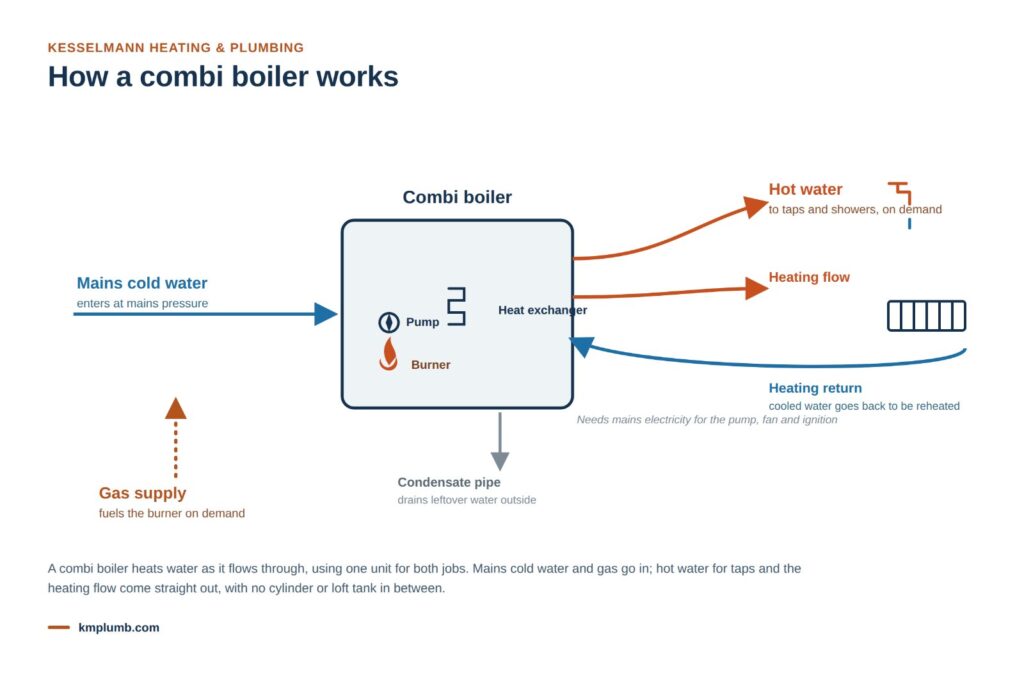
A combi boiler (short for combination boiler) heats water for your taps and your central heating on demand, drawing straight from the mains. There’s no hot water cylinder and no cold water tank in the loft. Turn a tap on, the boiler fires up and heats the water as it passes through. Turn it off, the boiler stops. One box does both jobs. This is why combis dominate flats, small and medium houses across the UK. Gas Safe Register calls the combi “the most frequently installed type of boiler” in Britain.
Key takeaways
- A combi heats water instantly from the mains, so there’s no cylinder or loft tank taking up space.
- Hot water flow drops when more than one tap or shower runs at once, because it’s all coming through the same pipe.
- Combis need mains electricity to run the pump, fan and ignition, so a power cut stops them working.
- Only a Gas Safe registered engineer is legally permitted to install or service one. Never let anyone else near the gas connections.
- A combi suits a flat or a one or two bathroom house better than a house full of teenagers who all shower at 7am.
Fun fact: Every gas boiler sold in the UK since 2005 has had to be a condensing model by law, which is why there’s a white plastic pipe (the condensate pipe) dripping outside almost every home with a combi. It’s carrying away the acidic water left over once the boiler has squeezed extra heat out of the flue gases before they escape.
What makes a boiler a “combi”?
Strip away the marketing and a combi boiler does two jobs inside one metal box: it heats your radiators, and it heats your hot water, on the spot, whenever you ask for it.
There’s no cylinder sitting in an airing cupboard holding fifty litres of water at a steady temperature, and no cold water tank up in the loft feeding it. Mains water goes into the boiler, a heat exchanger warms it in seconds, and it comes straight out of your tap. Energy Saving Trust describes this simply: with a combi, “all the heat and hot water comes directly from the boiler itself.”
Less kit in the house, a quicker install, and hot water you don’t have to wait for a tank to reheat. That’s the whole appeal.
How is it different from a system or heat-only boiler?
A system boiler still heats water on demand for your radiators, but it stores hot water in a cylinder, which suits a house where two bathrooms might be in use at once. A heat-only (regular) boiler goes further and needs both a hot water cylinder and a cold water tank in the loft, the classic setup in older houses built before combis took over.
Boiler typeStorage neededBest suited toCombiNoneFlats, smaller houses, one or two bathroomsSystemHot water cylinderHouses with multiple bathrooms, steady simultaneous demandHeat-only (regular)Cylinder plus loft tankOlder properties, homes with low mains pressure
Energy Saving Trust’s guidance is blunt about who each suits: larger families running lots of hot water at once tend to do better with a system boiler, while smaller households generally get on fine with a combi.
What are the downsides of a combi boiler?
The catch is simultaneous demand. A combi heats water only as fast as it flows through the unit, so if someone’s running a bath while another tap opens downstairs, both slow down. Worcester Bosch’s own guidance to installers makes the point directly: “it is important not to confuse pressure with flow.” A gauge showing decent pressure tells you nothing about how much water your pipework delivers when two outlets are open together.
This is also why an undersized incoming water main causes more comeback calls than almost anything else with a new combi install. Worcester Bosch recommends the boiler gets first draw off the mains supply, precisely so a running tap elsewhere doesn’t starve it.
Do combi boilers need electricity?
Yes, and this catches people out. A combi runs on gas for heat, but the pump, fan, ignition and control board all need mains electricity. Lose power, lose the boiler, gas or no gas. Most restart on their own once electricity returns. If yours doesn’t, call an engineer rather than pressing the reset button over and over.
Is a combi boiler safe?
Used properly, yes. The risks sit around installation and servicing, not the appliance sitting quietly in your kitchen cupboard. Only a Gas Safe registered engineer is legally permitted to install, alter or service a gas combi boiler in a UK home. The engineer must also notify the local authority within 30 days so the work gets a Building Regulations Compliance Certificate. Since April 2018, Boiler Plus rules have also required new combi installations in England to hit a minimum 92% ErP efficiency rating and include an extra energy saving control, such as weather compensation or smart heating controls, alongside the standard timer and room thermostat.
This isn’t homeowner admin you need to chase up yourself. Knowing it exists helps you ask your installer the right questions and check the paperwork lands.
What’s safe for you to check yourself
Safe homeowner checks
- Check the pressure gauge on the front of the boiler sits where the manual says it should, usually around 1 to 1.5 bar when the heating is cold.
- Note whether hot water flow drops noticeably when two taps run together. This is useful information for an engineer, not a fault you need to fix.
- Check the condensate pipe outside isn’t visibly frozen or blocked in cold weather.
- Keep the area around the boiler clear so it draws air properly.
Work that needs a professional
- Removing the boiler casing
- Anything involving the gas supply or gas components
- Adjusting or bypassing pressure relief valves or other safety devices
- Diagnosing low flow rate or repeated pressure loss
- Any electrical work on the boiler’s wiring or controls
Common mistakes
Buying on price alone and ignoring the mains supply is the classic one. A gleaming new 35kW combi means nothing if the incoming water main is still the same 15mm pipe fitted back in 1974. You’ll get a shiny new boiler and the same weak shower you had before.
Assuming “combi” means “unlimited hot water” is another. It means water heated on demand, not two showers and a washing machine running at full pelt with zero compromise. Physics doesn’t care what the brochure says.
Treating a fluctuating pressure gauge as normal because “it’s always done this” isn’t maintenance either. It’s ignoring a symptom until it becomes a breakdown. If the needle keeps creeping down and you keep topping it up, water is escaping somewhere. A combi needing weekly repressurising has a fault, not a personality quirk.
What I would recommend
If you’re choosing a combi for the first time, get someone to check your incoming mains flow rate before you commit to a model, not after it’s fitted. This single check prevents most of the “why is my shower rubbish” calls that come in after a new install.
If you already have a combi and you’re wondering whether it needs replacing, the boiler itself often isn’t the problem. Poor flow, low pressure or lukewarm water more often point to pipework, a clogged filter or a failing part than a dead unit. A service and a proper diagnostic check should happen before anyone starts talking about a full replacement.
Waiting becomes expensive when a small issue, a slow pressure drop, a fault code being ignored, an ageing boiler running past its expected life, turns into a breakdown in the middle of winter with no heating and a house full of people who want answers now.
Need a new boiler or wondering if a combi suits your home?
If you’re weighing up a combi against a system boiler, or your current one isn’t keeping up with your household, we cover installations across Weston-super-Mare, Clevedon, Portishead, Nailsea, Bristol and the rest of North Somerset. We’ll look at your water supply and how your household uses hot water before recommending anything, rather than quoting whichever boiler happens to be on the van.
[Boiler Installation → https://kmplumb.com/boiler-installation-2/]
Need a Gas Safe engineer in Weston-super-Mare?
Frequently asked questions
What's the difference between a combi boiler and a regular boiler?
A combi heats water instantly from the mains with no storage. A regular (heat-only) boiler needs a hot water cylinder plus a cold water tank in the loft. Regular boilers suit older properties or homes with several bathrooms. Combis suit smaller households wanting a simpler setup.
Can a combi boiler run two showers at once?
Not well. A combi heats water as it flows through, so demand from two outlets at once splits between them. You'll usually notice reduced flow or a temperature dip on whichever tap opened second, particularly if your incoming water main is narrow.
Do combi boilers need a cold water tank in the loft?
No. That's the main appeal of choosing one. A combi takes water directly from the mains supply, so there's no tank to install, maintain or worry about freezing in winter.
How long does a combi boiler last?
Vaillant's guidance suggests a well maintained combi should run for up to 15 years, though this depends heavily on the quality of the model and whether it gets an annual service by a Gas Safe registered engineer.
Will a power cut stop my combi boiler working?
Yes. Combis need mains electricity for the pump, fan, ignition and controls, regardless of running on gas. Most restart automatically once power returns. If yours doesn't, get an engineer to check it rather than repeatedly resetting it.