What Should My Boiler Pressure Be When the Heating Is Off?
TLDR
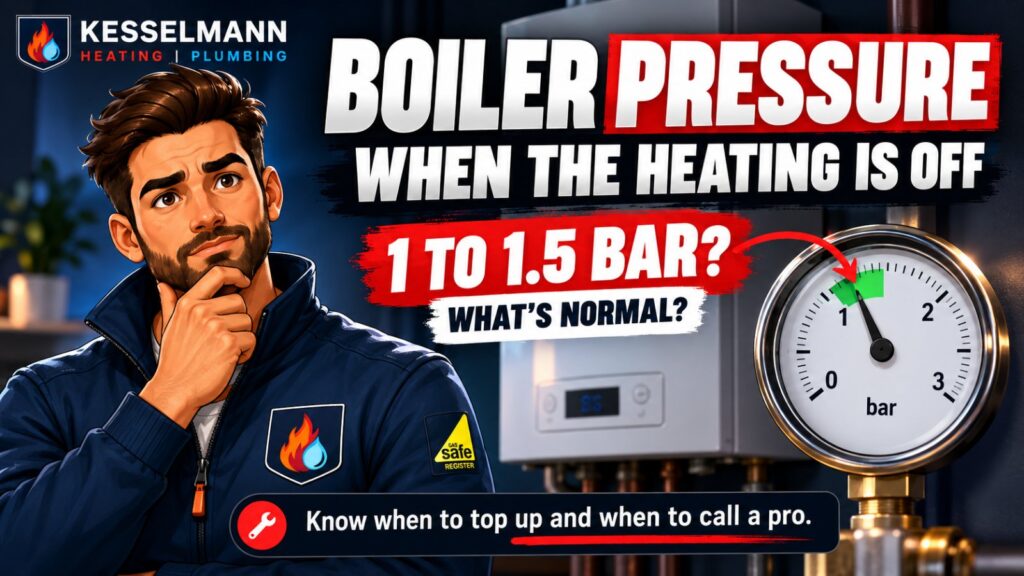
For most sealed heating systems, boiler pressure should sit around 1 to 1.5 bar when the heating is off and the system has cooled down. Worcester Bosch, Vaillant and British Gas all give figures around this range. Your own boiler manual still takes priority because manufacturers and systems differ.
Spoiler
Around 1 to 1.5 bar cold is usually perfectly boring.
Boring is good.
The interesting bit starts when the pressure keeps dropping, keeps climbing, or changes dramatically every time the heating comes on.
The short answer
If your heating has been off long enough for the system to cool, a pressure reading around 1 to 1.5 bar is normal for many modern sealed boilers. Worcester Bosch says around 1 bar with the heating off, while Vaillant and British Gas give 1 to 1.5 bar. A slightly different figure does not automatically mean trouble, so check the manufacturer’s instructions for your exact boiler.
What you need to know
- Around 1 to 1.5 bar cold is normal for many boilers.
- A reading below 1 bar deserves checking against the boiler manual.
- Pressure normally rises when the heating gets hot.
- A rise of more than about 1 bar from cold to hot deserves investigation.
- Repeated pressure loss or repeated high pressure means something else needs diagnosing.
Fun fact
Worcester Bosch says the heating system should generally need topping up only once or twice a year.
If you know the filling loop better than some members of your extended family, we have moved beyond “occasional topping up”.
Does “heating off” mean the boiler must be cold?
Ideally, yes, if you want a useful baseline reading.
Switching the thermostat off five minutes after the radiators have been roasting does not instantly return the heating water to room temperature.
The water is still hot.
Hot water expands.
Pressure therefore stays higher until the system cools.
For the clearest reading, check the gauge before the heating has run for a while. First thing in the morning often works well.
Vaillant explains that system pressure rises naturally as heating water gets warmer.
So when comparing readings, compare like with like.
Cold today against cold tomorrow.
Not cold Monday against full blast Thursday evening.
What pressure do different manufacturers recommend?
There is broad agreement, although exact figures vary.
SourceGuidanceWorcester BoschAround 1 bar with heating off, commonly 1 to 1.5 bar when coolVaillantGenerally 1 to 1.5 bar with central heating offBritish Gas1 to 1.5 bar with heating offBaxiNormal operating range around 1 to 2 bar
This is why one universal number does not exist.
Your boiler manual wins.
There is also another exception worth mentioning. Vaillant’s published installation guidance notes that taller heating systems serving several storeys sometimes need a higher filling pressure.
Again, boiler model and system design matter.
Is 1 bar boiler pressure normal when the heating is off?
Yes, for many systems.
Worcester Bosch specifically says around 1 bar while the heating is off for its Greenstar i guidance.
If the pressure remains stable around there and the boiler works normally, there is usually little reason for excitement.
Do not start adding water simply because somebody on the internet said 1.5 bar is “better”.
More pressure is not an upgrade.
Is 1.5 bar too high when the boiler is cold?
Generally, no.
Vaillant, Worcester Bosch and British Gas all include 1.5 bar within normal cold or heating off guidance.
Again, check the markings on your gauge and the manufacturer’s instructions.
A boiler sitting steadily at 1.5 bar cold is a different situation from one sitting at 1 bar Monday and somehow reaching 2.5 bar by Wednesday without anyone touching anything.
Behaviour matters as much as the number.
What if my boiler pressure is below 1 bar?
Start with the manual.
Many modern boilers continue operating slightly below 1 bar, but a sufficiently low pressure eventually causes a fault or shutdown.
Vaillant says around 1 to 1.5 bar is the typical target when repressurising. Worcester Bosch says pressure below 0.5 bar means water has been lost and needs replacing.
Possible reasons include:
- Radiators were recently bled
- A small heating leak
- A leaking radiator valve
- Water escaping from the boiler
- Pressure relief valve discharge
- An expansion vessel problem
The important question is not only:
“How do I put the pressure back?”
Ask:
“Why did the pressure disappear?”
We already have a full guide covering safe repressurisation if your boiler genuinely needs topping up.
What if the pressure keeps dropping?
Once in a while and repeated loss are two different things.
Worcester Bosch says topping the system up once or twice a year is normal for its guidance. Much more frequent repressurisation needs investigation.
If pressure drops every few days, look around accessible areas for:
- Damp radiator valves
- Water beneath radiators
- Green or rusty staining
- Damp pipe joints
- Water beneath the boiler
- Water from the pressure relief pipe outside
Do not remove the boiler casing.
The leak might be tiny.
That does not make repeated water loss normal.
What if pressure rises when the heating comes on?
Some rise is expected.
Water expands as it gets hotter.
Baxi says its boilers normally operate between 1 and 2 bar, with some increase while the boiler heats water or radiators.
Worcester Bosch gives homeowners a particularly useful clue.
If pressure rises by more than around 1 bar between cold and fully hot, the expansion vessel might need attention from an engineer.
For example:
Cold: 1.1 bar
Hot: 1.5 bar
Nothing there screams disaster.
Cold: 1.0 bar
Hot: 2.8 bar
Now I want to know what the expansion vessel is doing.
What if my boiler pressure keeps going up even when the heating is off?
That is different again.
If the boiler and heating are completely cold but pressure keeps creeping upwards, heat expansion cannot explain the increase.
Possible causes include a filling arrangement allowing mains water into the heating circuit, and on some combi boilers an internal crossover fault.
We covered this separately in our guide to boiler pressure which keeps increasing.
The important thing for the homeowner is simple.
Tell the engineer exactly when the pressure rises.
That clue is useful.
Is 2 bar too high when the heating is off?
On some systems, 2 bar remains inside the manufacturer’s normal operating range.
Baxi, for example, gives 1 to 2 bar as its normal operating range.
For many other domestic systems, a cold reading nearer 1 to 1.5 bar is more typical.
So 2 bar cold does not automatically mean emergency.
I would still ask why the system sits there.
Was the boiler recently topped up?
Has the reading always been 2 bar?
Does pressure head towards 3 bar when hot?
Context decides whether 2 bar means “leave alone” or “investigate”.
What happens if pressure reaches 3 bar?
Now we are getting into the wrong end of the gauge.
Most sealed heating systems have a pressure relief valve designed to discharge water if system pressure becomes excessive.
Baxi says pressure climbing into the red area needs attention, and high pressure might operate the PRV, sending water through a copper discharge pipe outside.
Do not keep bleeding radiators every morning as a permanent solution.
Find out why the pressure keeps getting there.
What you can safely check yourself
Safe homeowner checks:
- Read the gauge when the system is fully cold
- Take a photo of the reading
- Check again after the heating has been running
- Compare the difference
- Look for visible leaks around accessible pipework
- Check whether the pressure slowly drops over several days
- Check whether pressure rises even when the boiler remains cold
- Read the user manual for the correct operating range
This gives an engineer useful information without anybody dismantling anything.
Work that needs a professional
Get a heating engineer involved where:
- Pressure repeatedly drops
- Pressure rises sharply from cold to hot
- Pressure approaches 3 bar
- Water discharges from the external PRV pipe
- Water leaks from inside the boiler
- Pressure increases when the system is cold and unused
- The pressure gauge behaves strangely
- The boiler repeatedly locks out
Vaillant specifically advises professional attention where pressure problems point towards internal faults, and its fault guidance warns against opening the boiler casing yourself.
Common mistakes
Chasing an exact 1.5 bar
If your boiler is happily sitting at 1.2 bar cold and the manufacturer’s range says that is fine, leave it alone.
The gauge is not a high score.
Topping up every time the needle moves slightly
Pressure rises when the heating warms.
That is supposed to happen.
Ignoring repeated pressure loss
Adding water again fixes the number on the gauge.
It does not fix the reason the water left.
Watching the gauge only when the heating is hot
The cold reading gives us the baseline.
Take both readings.
Assuming any pressure fault means a new boiler
No.
Leaks, filling valves, expansion vessels and other individual faults all affect pressure.
Diagnosis first.
Boiler funeral later, if genuinely required.
What I would recommend
Check the boiler first thing in the morning before the heating starts.
Take a photo.
Run the heating normally.
Take another photo once everything is properly warm.
That gives you two useful numbers.
If the boiler sits around 1 to 1.5 bar cold and rises modestly when hot, excellent.
If the pressure repeatedly falls below its normal range, find out where the water is going.
If the reading shoots upwards as the system heats, get the expansion side checked.
If pressure rises while everything is cold, mention that specifically when booking the repair.
You have already done a decent chunk of the diagnostic work without touching a screwdriver.
Boiler pressure not behaving in Weston super Mare?
Kesselmann Heating & Plumbing provides boiler servicing and fault finding across Weston super Mare, Worle, Clevedon, Portishead, Nailsea, Burnham on Sea, Bristol and surrounding North Somerset. Our website lists boiler repair and emergency heating services alongside annual servicing.
For pressure which keeps dropping, climbing or triggering boiler faults:
Kesselmann boiler repair in Weston super Mare
Need a Gas Safe engineer in Weston-super-Mare?
Frequently asked questions
What should boiler pressure be first thing in the morning?
For many sealed boilers, around 1 to 1.5 bar is normal once the system is fully cold. Worcester Bosch says around 1 bar with heating off, while Vaillant gives 1 to 1.5 bar. Check your boiler manual for its specific range.
Is 0.5 bar too low?
Yes, for most modern sealed systems. Worcester Bosch says pressure below 0.5 bar indicates water has been lost and needs replacing. Some boilers also shut down at low pressure.
Should boiler pressure rise when the heating is on?
Yes. Heating water expands, so pressure normally rises. The amount matters. Worcester Bosch says a rise greater than around 1 bar between cold and hot points towards the expansion vessel needing attention.
Is 2 bar boiler pressure dangerous?
Not automatically. Baxi gives 1 to 2 bar as its normal operating range. A cold pressure of 2 bar deserves comparing with your manufacturer's instructions and watching what happens when the heating gets hot.
Why does my boiler pressure keep falling overnight?
Repeated pressure loss suggests water is leaving the sealed heating system somewhere. Possible causes include leaks, PRV discharge or boiler related faults. Look for visible signs, then arrange diagnosis if the pattern continues.
How often should I need to repressurise my boiler?
Worcester Bosch says roughly once or twice a year is normal for its systems. More frequent topping up deserves investigation.