
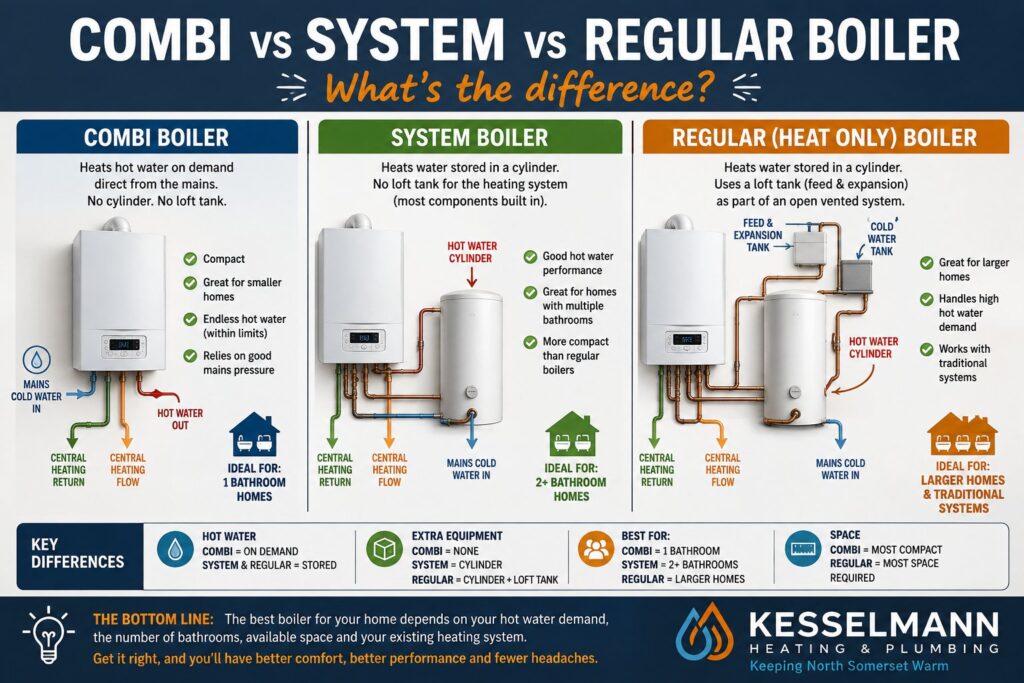
What’s the Difference Between a Combi, System and Regular Boiler?
TLDR
A combi boiler heats hot water when you open a tap and needs no cylinder. A system boiler works with a hot water cylinder but normally has no small feed and expansion tank in the loft. A regular boiler also uses stored hot water and usually forms part of a more traditional system with tanks in the loft.
Spoiler
The boiler itself is only part of the difference.
The bigger difference is how your house stores and delivers hot water.
The short answer
A combi boiler provides heating and hot water from one appliance, heating tap water as you use it. A system boiler heats your radiators and a separate hot water cylinder, with many heating components built into the boiler. A regular boiler, also called heat only or conventional, normally works with a hot water cylinder plus a feed and expansion tank in the loft.
What you need to know
- Combi: no hot water cylinder or loft tank.
- System: hot water cylinder, normally no heating feed and expansion tank.
- Regular: hot water cylinder and usually traditional loft tanks.
- Combi hot water performance depends heavily on the incoming mains supply.
- Homes using several showers or taps together often suit stored hot water better.
Fun fact
“Regular boiler”, “conventional boiler” and “heat only boiler” often describe the same basic boiler type.
Three names for one thing.
Because apparently buying a boiler was not confusing enough already.
Combi, system and regular boilers at a glance
Boiler typeHot water cylinderLoft tankHot waterCombiNoNoHeated when neededSystemYesUsually no heating feed tankStoredRegular / heat onlyYesUsually yes on an open vented systemStored
The exact layout still depends on the property and existing installation. Boiler type alone does not describe every pipe, valve and cylinder connected to the system.
What is a combi boiler?
Combi is short for combination boiler.
One box performs two jobs:
- Heats the water circulating through your radiators
- Produces domestic hot water when you open a tap or shower
Cold water enters from the mains and passes through the boiler, where the boiler heats it on demand.
There is no separate hot water cylinder.
There is normally no cold water storage tank in the loft either.
That makes combis attractive in smaller homes where cupboard space matters.
Where does a combi work well?
A combi often suits:
- Flats
- Smaller houses
- One bathroom properties
- Households with modest hot water demand
- Homes with a decent incoming mains supply
Which? specifically describes combis as a strong option for smaller homes and flats with one bathroom.
What is the downside?
Hot water has to be produced as you use it.
Run one shower and things might be lovely.
Run two showers, fill a bath and ask somebody to wash up at the same time, and the boiler has suddenly been invited to a much more demanding event.
Which? notes that combi flow drops when several hot water outlets operate together.
A bigger combi helps to a point.
The incoming water supply still matters.
A boiler does not manufacture extra water.
What is a system boiler?
A system boiler provides heating and works with a separate hot water cylinder.
The cylinder stores heated water ready for use.
Unlike a traditional regular boiler arrangement, important heating components such as the pump and expansion vessel normally sit inside the boiler rather than around the airing cupboard or loft.
That gives you a cleaner installation without the traditional feed and expansion tank associated with an open vented heating system.
Why use a system boiler?
Stored hot water suits homes with heavier demand.
For example:
Two people showering.
Someone fills a bath.
Another person uses the kitchen tap.
A suitable cylinder gives the household a reserve of hot water rather than asking the boiler to heat every litre as it passes through.
Worcester Bosch recommends system boilers for homes with more than one bathroom and simultaneous hot water use.
What is the downside?
You need somewhere for the cylinder.
That normally means an airing cupboard, plant room or another suitable location.
Stored hot water also has a finite capacity. Use the contents of the cylinder and you need to wait for the boiler to reheat it.
What is a regular boiler?
A regular boiler is also called:
- Heat only boiler
- Conventional boiler
- Traditional boiler
The boiler itself mainly deals with heating water for the central heating circuit and heating the water stored in a cylinder.
On a traditional open vented setup, you will usually find:
- Boiler
- Hot water cylinder
- Small feed and expansion tank
- Cold water storage cistern associated with the domestic hot water system
- External pump and controls
Which? describes this arrangement as particularly suited to larger households with high simultaneous hot water demand.
Why would anybody still choose a regular boiler?
Because old does not automatically mean bad.
Plenty of older houses already have traditional systems which work perfectly well.
If the cylinder is good, pipework is sensible and the system provides all the hot water the household needs, replacing a failed regular boiler with another regular boiler often avoids redesigning half the house for no useful reason.
Worcester Bosch makes the same point. Regular boilers remain a straightforward choice where a traditional heating layout already exists.
Changing a boiler should solve a problem.
Creating three new ones to make the installation feel modern seems a poor exchange.
What is the main difference between a system and regular boiler?
This causes the most confusion because both normally use a hot water cylinder.
The difference sits mainly on the heating side.
A system boiler normally contains components such as:
- Pump
- Expansion vessel
- Pressure gauge and associated sealed system components
A traditional regular boiler leaves more of those components outside the boiler and often operates on an open vented heating circuit with a feed and expansion tank.
The regular boiler arrangement therefore tends to involve more equipment around the property.
Which one gives the best shower?
That depends on the whole hot water system.
With a combi, shower performance depends on:
- Incoming mains pressure
- Available mains flow
- Boiler hot water output
- Other outlets running at the same time
With a system boiler and suitable unvented cylinder, strong mains pressure hot water is possible across several outlets, provided the incoming supply is up to the job.
Kesselmann’s current unvented cylinder guidance describes this type of system as suited to homes wanting strong hot water delivery and multiple showers.
With a traditional vented regular system, hot water pressure often relies on the height of the storage tank unless a suitable pump or other arrangement is present.
So asking:
“Which boiler gives the best shower?”
misses half the plumbing.
The cylinder, pipework and water supply matter too.
Which boiler takes up the least space?
Combi.
One appliance.
No separate hot water cylinder.
No traditional loft tanks.
For a small home, the space saving is significant.
A system boiler requires cylinder space.
A traditional regular system uses the most space because the property often contains a cylinder plus loft storage.
Which boiler is best for a large home?
Often a system or regular boiler with stored hot water.
Especially where several bathrooms get used together.
Which? recommends considering heat only or system boilers where hot water demand is high. Worcester Bosch also positions both options towards larger or busier homes.
That does not mean every four bedroom house needs a cylinder.
Number of bedrooms is a poor way to design a heating system on its own.
Four bedrooms with one retired couple is different from four bedrooms containing six people and three bathrooms.
Use matters.
Does a combi mean better efficiency?
Be careful with this one.
Nearly all modern gas boilers sold in the UK are condensing boilers and achieve an A rating for space heating under the current ErP label.
A combi avoids storing a cylinder full of hot water, so storage losses disappear.
That does not automatically make a combi the best option for every property.
System design, controls, boiler sizing, flow temperatures and how the household uses hot water all matter.
Picking the wrong system to gain a tiny theoretical efficiency advantage is not much of a win.
Should you convert from a regular boiler to a combi?
Sometimes.
Good reasons include:
- You want the airing cupboard back
- Hot water demand is modest
- The incoming mains supply is suitable
- The old cylinder needs replacing anyway
- The current system has reached the end of its useful life
Poor reason:
“Combis are newer.”
Worcester Bosch notes that regular boilers still suit larger homes and busy households, particularly where multiple showers run together.
Before removing a cylinder, understand what that cylinder currently does for you.
Cupboard space is nice.
So is having a shower while somebody fills the bath.
What should be checked before changing boiler type?
A proper survey should look at:
- Existing boiler type
- Number of bathrooms
- Number of people
- Hot water use
- Mains pressure and flow
- Existing cylinder
- Radiators
- Heating pipework
- Boiler location
- Flue position
- Gas supply
- Heating controls
- Heating water condition
- Future extensions or bathrooms
Kesselmann’s current boiler guide makes the same point. The boiler itself is only one part of the job. Existing pipework, controls, gas supply, system cleanliness and hot water requirements all affect the right installation.
Common mistakes
Choosing a combi because everybody else has one
Combis are popular.
Popularity is not a heat loss calculation or a hot water survey.
Removing a perfectly good cylinder without considering demand
If three people need hot water together every morning, removing storage deserves some thought.
Assuming regular boilers are outdated
The technology is traditional.
The application still makes sense in the right house.
Assuming system boiler means “no cylinder”
Quite the opposite.
A system boiler normally works with a cylinder.
This one catches people constantly.
Choosing the boiler before measuring the water supply
Especially with a combi.
Measure first.
Buy second.
What I would recommend
Start with what you already have.
Then ask what you want to improve.
If you have a one bathroom house, want more cupboard space and have a strong mains supply, a combi might make perfect sense.
If the house has several bathrooms and lots of simultaneous hot water use, stored hot water deserves serious consideration.
If you already have a traditional regular system which serves the house properly, another regular boiler might be the least disruptive and most sensible replacement.
There is no superior boiler type for every property.
You are choosing a system for your home, not selecting the winner of Boiler Top Trumps.
Choosing a new boiler in Weston super Mare?
Kesselmann Heating & Plumbing installs boilers across Weston super Mare, Clevedon, Portishead, Nailsea, Bristol and surrounding North Somerset.
We currently install combi, system and other boiler arrangements, with a home survey used to establish what suits the property before providing a quotation.
Boiler installation with Kesselmann Heating & Plumbing
Need a Gas Safe engineer in Weston-super-Mare?
Frequently asked questions
Is a combi boiler the same as a system boiler?
No. A combi produces domestic hot water on demand and normally has no separate cylinder. A system boiler heats water stored in a hot water cylinder.
Does a system boiler need a water tank?
A system boiler needs a hot water cylinder. It normally does not use the traditional heating feed and expansion tank found on an open vented regular boiler system.
Does a regular boiler need a tank in the loft?
Traditional open vented regular boiler installations normally use a feed and expansion tank, with traditional vented domestic hot water systems also using cold water storage. Exact layouts vary.
Which boiler is best for two bathrooms?
A system or regular boiler with stored hot water often suits households where both bathrooms get used together. A suitably selected combi remains an option where simultaneous demand is low and the mains supply is strong.