When Do I Need an Emergency Plumber?
TLDR
You need an emergency plumber when water is escaping uncontrollably, you cannot isolate it, sewage is backing up, essential plumbing has completely failed or delaying the repair could cause significant damage. Turn off the water where possible, protect the property and deal with safety risks first.
Spoiler
Not every plumbing problem is an emergency.
A dripping tap can normally wait.
Water pouring through the ceiling while you search Google for “plumber near me” has rather moved beyond the appointment booking stage.
The short answer
Call an emergency plumber when the problem cannot safely wait until normal working hours without risking serious water damage, loss of essential facilities or further damage to your plumbing system.
Typical examples include burst pipes, uncontrollable leaks, overflowing toilets that cannot be stopped, serious cylinder leaks and situations where you cannot shut the water off.
If you smell gas, that is different. Call the National Gas Emergency Service on 0800 111 999 rather than simply calling a plumber.
Key takeaways
- Turn the water off first if you safely can.
- A controllable drip is normally not an emergency.
- Water escaping uncontrollably usually is.
- Water near electricity needs extra care.
- Gas smells require the National Gas Emergency Service, not ordinary plumbing fault finding.
Fun fact
Your internal stop tap is most commonly under the kitchen sink, but WaterSafe also lists downstairs toilets, utility rooms, garages, cellars and under the stairs as common hiding places.
Which is useful information to discover now rather than while your kitchen is turning into Centre Parcs.
What actually counts as a plumbing emergency?
The easiest test is this:
Will leaving this until tomorrow significantly increase the damage, risk or disruption?
If the answer is yes, treat it seriously.
Problems that normally need urgent attention
ProblemEmergency?WhyBurst pipe with water escapingYesDamage continues until the supply is isolatedLeak you cannot stopYesFloors, ceilings and units can quickly become damagedWater through a ceilingUsuallyThe source needs finding and electrics may be involvedOverflowing toilet that will not stopUsuallyRisk of water and potentially sewage damageMajor hot water cylinder leakUsuallyLarge stored volume can cause significant damageNo water throughout the propertyMaybeFirst establish whether the water supplier has an outageBoiler breakdownDependsMore urgent in severe weather or vulnerable householdsDripping tapUsually noIrritating, wasteful, but normally controllableSlightly leaking radiator valveDependsIf containable it may wait, if worsening it should notSlow draining sinkUsually noUnless it has become completely blocked or is overflowing
WaterSafe specifically identifies leaks and burst pipes as situations where an emergency plumber may be required. If the problem is no water, very low pressure or water quality, they advise contacting the local water company first because the fault may not be inside your property at all.
What should I do before the emergency plumber arrives?
The first five minutes can matter more than the next five hours.
1. Turn off the water
If the problem involves mains water escaping, locate your internal stop tap and turn it off.
WaterSafe advises turning the stop tap clockwise and doing it gently rather than forcing a seized valve.
If you have a working local isolation valve for the affected toilet, tap or appliance, you may only need to isolate that item.
Better.
You can keep the rest of the house working.
2. If a pipe has burst, switch off the boiler
WaterSafe recommends turning off the incoming water and switching off the boiler when dealing with a burst pipe. Their guidance also advises draining the system and managing the escaping water.
3. Protect the property
Once the water is isolated:
- Use buckets
- Put towels around the affected area
- Move furniture and valuables
- Remove anything stored beneath the leak
- Photograph the damage if an insurance claim may follow
The aim is not to beautifully mop the floor while the leak continues.
Stop the source first.
Mop second.
4. Be careful with electricity
If water has reached electrical fittings, sockets or wiring, do not touch wet electrical equipment.
WaterSafe advises switching off the electricity at the mains where water has reached electrics, but only do this when the consumer unit and route to it can be accessed safely.
If there is any doubt, stay clear and get professional help.
5. Call the plumber with useful information
Instead of:
“My plumbing is broken.”
Tell them:
- Where the water is coming from
- Whether you have turned it off
- Whether it is still flowing
- Whether water has reached electrics
- Whether the leak is upstairs or downstairs
- Whether it is clean water or waste water
- What caused it, if known
- Send photographs or video if possible
That information helps the plumber understand what they are actually walking into.
What if I cannot turn the water off?
This changes the urgency.
If the internal stop tap:
- Will not turn
- Turns but does not stop the water
- Is inaccessible
- Has broken
- Cannot be found
tell the emergency plumber immediately.
Do not apply unlimited force to a seized stop tap.
Snapping the valve while attempting to stop a leak is a fairly effective way of giving yourself two plumbing emergencies.
WaterSafe says an external stop tap normally belongs to the water supplier and ideally should be operated by a plumber or the supplier. Permission may sometimes be required.
If the internal supply genuinely cannot be isolated, your water company may also need to become involved.
Is a burst pipe always an emergency?
Pretty much.
A burst pipe can continue releasing water until the supply is stopped.
WaterSafe advises homeowners to isolate the water, switch off the boiler, drain the pipework and call a suitable plumber.
The ABI also advises shutting off the stopcock quickly because this can substantially limit escape of water damage.
This is one of those situations where watching the leak for another twenty minutes to see whether it improves is unlikely to produce an exciting plot twist.
Turn it off.
Is a leaking toilet an emergency?
Depends on the leak.
A slight trickle internally into the toilet pan is normally not an out of hours emergency.
Water pouring across the bathroom floor is.
Likewise, an overflowing toilet becomes more urgent if:
- You cannot stop the water entering the cistern
- The bowl is continuing to rise
- Waste water is escaping
- It is the only toilet in the property
- Water is reaching the floor or room below
If there is sewage involved, avoid unnecessary contact.
That is not ordinary clean water.
Is water coming through the ceiling an emergency?
Yes, or at the very least something that needs investigating quickly.
The water may be coming from:
- A bath
- Shower
- Toilet
- Heating pipe
- Radiator
- Hot water cylinder
- Mains pipe
- Waste fitting
- Appliance
Stop using plumbing directly above the affected area where practical.
If water is around a light fitting, do not touch it.
The stain on the ceiling tells you where the water eventually arrived.
It does not necessarily tell you where it started.
Water is annoyingly creative like that.
Does a blocked toilet need an emergency plumber?
Not automatically.
If another toilet is available and the blockage is contained, it may be possible to arrange a normal appointment.
It becomes more urgent where:
- Waste is overflowing
- Several drains or toilets are backing up
- It is the only toilet
- Sewage is escaping into the property
- You cannot use essential facilities
Do not keep flushing an already full toilet.
The second flush rarely frightens the blockage into submission.
It normally just puts more water on the floor.
Is a boiler breakdown a plumbing emergency?
Sometimes.
A boiler breakdown does not automatically mean the house is unsafe.
But urgency increases when:
- The weather is extremely cold
- Elderly or vulnerable people live in the property
- Young children are present
- There is no other heating
- There is no hot water
- Pipes are at risk of freezing
- The boiler is leaking
- You suspect a gas or carbon monoxide problem
Kesselmann currently advertises emergency boiler repair and plumbing services across its North Somerset service area.
A boiler displaying a normal fault code is one thing.
A gas smell is another.
What if I smell gas?
This is not a normal emergency plumber call.
HSE guidance says that if you suspect a gas leak you should:
- Call the National Gas Emergency Service on 0800 111 999
- Open doors and windows
- Turn off the gas at the meter if you know how and can do so safely
- Do not use a gas appliance you suspect is unsafe
Do not start dismantling the boiler.
Do not start looking for the leak yourself.
Call the emergency service.
What can safely wait until tomorrow?
This is important because an emergency call out should actually be for an emergency.
Usually non emergency problems include:
- A slowly dripping tap
- A radiator that needs bleeding
- One radiator not heating properly
- A stiff tap
- A slowly draining basin
- A minor leak you have completely isolated
- A toilet that will not flush when another toilet is available
- Cosmetic plumbing damage
- Planned replacement work
If the problem is contained and cannot cause further damage, waiting for a normal appointment may make considerably more sense.
An emergency plumber at midnight because the bathroom tap goes “drip” every 18 seconds is technically possible.
Also slightly dramatic.
Common mistakes during a plumbing emergency
Looking for the plumber before turning off the water
Call the plumber.
Absolutely.
But if twenty litres a minute is entering the kitchen, isolate the water first if you can.
The plumber cannot drive faster than the water can leak.
Not knowing where the stop tap is
This is the big one.
ABI recommends knowing where your stopcock is and testing it regularly because being able to isolate the water quickly can reduce damage.
Find it before you need it.
Forcing a seized stop tap
If it does not move with sensible force, stop.
WaterSafe specifically warns against forcing or overtightening an internal stop tap because it can be damaged.
Continuing to use the leaking fixture
If every shower produces another wet patch downstairs, stop showering in it.
It sounds obvious.
And yet.
Immediately ripping ceilings apart
Sometimes access is required.
Sometimes it is not.
Find the likely source first.
A hole in the ceiling is easy to make.
Putting it back beautifully is generally less exciting.
What I would recommend
Every homeowner should know three things before an emergency happens:
Where is the stop tap?
Does it work?
Who are you calling if something goes wrong?
That is most of the battle.
If you have an active leak, isolate it as early as possible.
If you cannot isolate it, call somebody.
If water is getting into the structure, ceilings or electrics, treat it seriously.
And if the situation is safe and completely contained, don’t panic simply because the word “plumbing” is involved.
The aim is not to make everything an emergency.
It is to recognise the ones that actually are.
Need an emergency plumber in North Somerset?
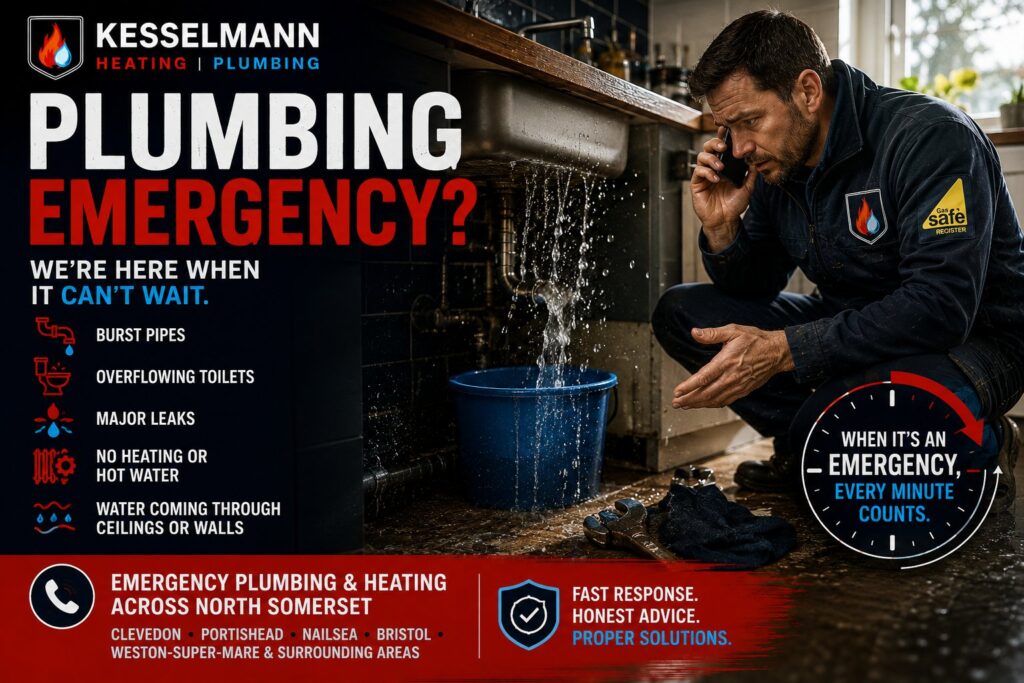
Kesselmann Heating & Plumbing provides emergency plumbing and heating support across Weston super Mare, Clevedon, Portishead, Nailsea, Bristol and surrounding parts of North Somerset. The current Kesselmann website lists emergency plumbing and boiler repair among its services and gives the contact number 07388 494676.
For burst pipes, serious leaks, overflowing plumbing or another urgent problem, call and explain exactly what is happening.
Emergency plumbing and plumbing repairs → https://kmplumb.com/
If the issue is a suspected gas leak, contact the National Gas Emergency Service first on 0800 111 999.
Need a Gas Safe engineer in Weston-super-Mare?
Frequently asked questions
What qualifies as a plumbing emergency?
A plumbing emergency is normally a fault that cannot safely wait without risking significant water damage, loss of essential facilities or another serious problem. Burst pipes, uncontrolled leaks and sewage entering the property are good examples.
How quickly should I turn off the water after finding a leak?
Immediately, where it is safe and practical. Both WaterSafe and the ABI advise isolating the water quickly because doing so can limit the damage caused by an escape of water.
Where is my stop tap?
It is commonly beneath the kitchen sink, but can also be inside a cupboard, downstairs toilet, utility room, garage, cellar or beneath the stairs.
Should I call my insurer after a major leak?
If significant damage has occurred, contact the insurer as soon as practical. ABI guidance advises homeowners to contact their insurer promptly, keep evidence of the damage and check before disposing of damaged items where possible.
Does buildings insurance normally cover burst pipes?