Which Boiler Is Best for My Home?
TLDR
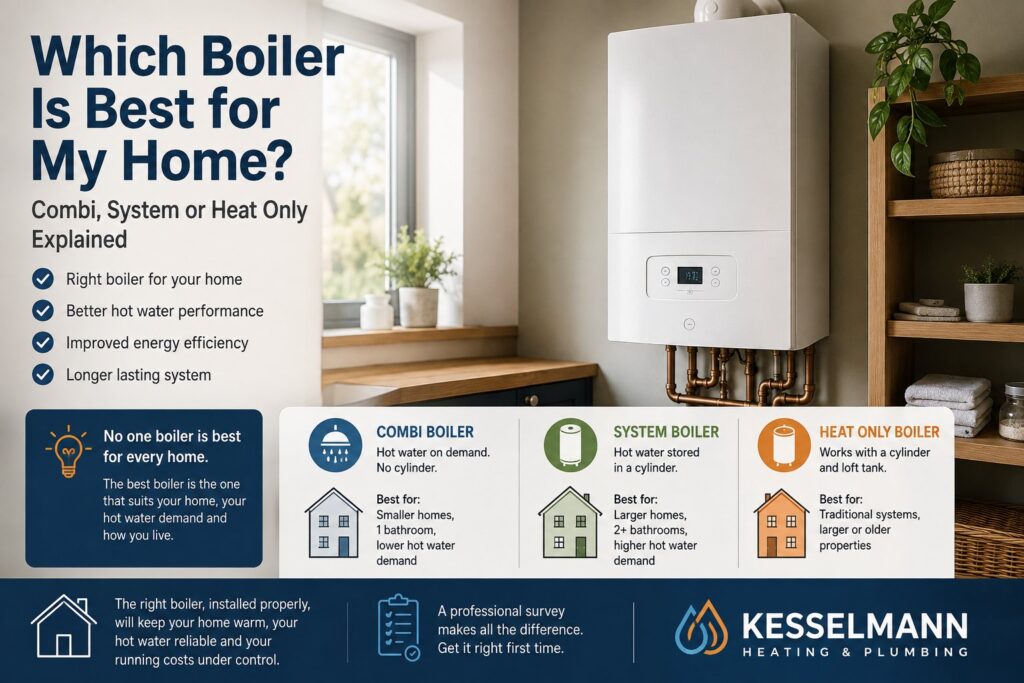
The best boiler depends on your home, hot water demand, number of bathrooms, mains water supply, existing heating system and available space. A combi often suits smaller homes with one bathroom. Larger households using several hot water outlets at once often suit a system or heat only boiler with stored hot water.
Spoiler
There is no universally “best” boiler.
The right answer comes from matching the boiler to the house and how the people inside use hot water.
Buying the biggest boiler available does not automatically improve anything.
The short answer
For a small home or flat with one bathroom, a combi boiler often makes sense because it provides hot water on demand and needs no separate cylinder. For a larger home with several bathrooms or high simultaneous hot water demand, a system or heat only boiler with a hot water cylinder often performs better. Which? and Energy Saving Trust both advise considering household size, hot water use, available space and the existing system before choosing.
What you need to know
- One bathroom and modest hot water demand often points towards a combi.
- Several bathrooms used together often favour stored hot water.
- Mains flow matters enormously with a combi.
- Boiler output should match the property’s heating demand, not somebody’s enthusiasm for large numbers.
- A proper survey should happen before anyone recommends a model.
Fun fact
A combi boiler’s hot water performance is often quoted in litres per minute.
Which? says current combi hot water flow rates range from roughly 9.8 litres per minute to 25 litres per minute. If two showers run together, the available flow gets shared between them.
So a 40kW sticker does not magically create more water at the street.
What are the main types of boiler?
For most gas heated UK homes, you are choosing between three main types.
Boiler typeHot waterStorage neededOften suited toCombiHeated on demandNo cylinderSmaller homes, one bathroomSystemStored in cylinderHot water cylinderLarger homes, higher hot water demandHeat onlyStored in cylinderCylinder and usually loft tanksLarger or existing traditional systems
Energy Saving Trust and Which? both describe these as the main domestic boiler arrangements.
When does a combi boiler make sense?
A combi takes cold water directly from the mains and heats hot water as you use it.
No cylinder.
No loft tank.
Less equipment taking up space.
Which? says combis are particularly well suited to smaller homes and flats with relatively low hot water demand.
A combi often works well where you have:
- One bathroom
- One or two people
- Limited airing cupboard space
- Decent mains water flow
- No regular need to run several hot outlets together
For a lot of houses, a combi is a neat solution.
The problem starts when somebody decides every house needs one.
When is a combi boiler a bad idea?
Multiple bathrooms are the obvious warning sign.
A combi has to heat water as you use it.
If one person is showering and somebody else opens another hot tap, both outlets are drawing from the same available supply and boiler capacity.
Which? warns that combis are less suited to several bathrooms being used simultaneously and also rely heavily on adequate mains pressure and flow.
A combi deserves more thought where you have:
- Two or three busy bathrooms
- Large rainfall showers
- High simultaneous hot water use
- Poor incoming mains flow
- A large family
- Existing stored hot water which already works well
Removing a perfectly useful cylinder because:
“Everyone has combis now”
is not system design.
When is a system boiler better?
A system boiler heats a separate hot water cylinder.
That stored hot water gives the household a reserve rather than asking the boiler to produce everything instantly.
Energy Saving Trust says system boilers suit larger families and homes with greater hot water requirements.
A system boiler starts becoming attractive where:
- Several people shower around the same time
- You have multiple bathrooms
- You want strong hot water delivery to several outlets
- You already have space for a cylinder
- You want compatibility with future technologies such as solar thermal or a heat pump
A good unvented cylinder paired with a suitable supply provides a completely different hot water experience from a modest combi.
The cylinder does take space.
You are swapping cupboard space for stored hot water capacity.
What about a heat only boiler?
Heat only boilers are common in older traditional systems.
They heat radiators and a separate hot water cylinder. Open vented versions also use a feed and expansion tank in the loft.
Which? says heat only systems remain well suited to larger homes where several people use hot water at the same time.
If your existing heat only system works properly, replacing the boiler with another suitable heat only appliance is often far less disruptive than converting the entire house to a combi.
A boiler replacement does not need to become a plumbing identity crisis.
Sometimes replacing like for like is the sensible answer.
Does the number of bedrooms decide boiler size?
No.
Bedrooms give a rough clue about property size.
They do not calculate the heat loss.
The heating output your house needs depends on things such as:
- Floor area
- Insulation
- Windows
- External walls
- Building age
- Desired room temperatures
- Radiator sizes
- Heat loss through the structure
Which? makes the same point. The correct boiler size depends on the specific home, insulation, radiators, bathrooms and occupants.
For combis there are really two sizing questions:
- How much heating does the property need?
- How much hot water do you want at the taps?
Those numbers are often quite different.
Why are combi boilers often much higher output than the house needs?
Hot water.
A typical house might need a relatively modest output to heat the radiators.
Producing a decent shower instantly requires much more power.
That is why combis often have outputs of 25, 30, 35 or 40kW even though the home’s space heating requirement sits far below that.
Which?’s sizing guidance separates heating requirement from combi hot water flow for exactly this reason.
A good installer therefore looks at how low the boiler modulates for heating as well as how much hot water it produces.
Bigger is not automatically cleverer.
How important is mains water flow?
For combis, crucial.
A combi heats the water reaching it.
If your incoming main only delivers a weak flow, fitting a larger combi does not create a stronger mains supply.
Which? specifically warns that combis perform less well where mains water pressure is poor.
Before recommending a combi, a useful survey should establish:
- Static pressure
- Dynamic pressure
- Available flow rate
- How the supply behaves when several outlets run
Otherwise somebody is selecting the boiler before measuring what feeds it.
Interesting approach.
What if I have two or three bathrooms?
Think carefully before defaulting to a combi.
Which? says homes with three or more bathrooms should consider a system or heat only boiler rather than relying on a conventional combi.
Why?
Stored water copes better with short periods of heavy demand.
For example:
- Shower upstairs
- Bath filling
- Kitchen tap running
A normal combi has to divide its available hot water between those outlets.
A properly designed cylinder system handles simultaneous demand far better, subject to the incoming water supply and cylinder specification.
Does brand matter?
Yes.
But brand comes after system design.
Which? surveys both boiler owners and heating engineers when assessing boiler brands, looking at reliability, customer satisfaction, engineer views, build quality, parts availability and servicing.
Those things matter.
So do:
- Warranty terms
- Local parts availability
- Manufacturer support
- Ease of servicing
- Installer familiarity
- Controls compatibility
But the greatest boiler on Earth is still the wrong boiler if somebody has specified the wrong system for your house.
Does efficiency vary much between modern gas boilers?
Less than people sometimes think.
Which? says nearly all modern gas condensing boilers sold in the UK achieve an A rating under the ErP energy label.
The installation and controls matter hugely.
A sensible system should consider:
- Correct boiler sizing
- Weather or load compensation where suitable
- Flow temperatures
- Heating controls
- System cleanliness
- Balancing
- Radiator output
Energy Saving Trust also stresses the role of heating controls in reducing energy use.
Buying an expensive A rated boiler and then running a badly set up heating system is a slightly disappointing use of money.
Should I keep my existing boiler type?
Often worth considering.
If you already have:
- A suitable cylinder
- Good hot water performance
- Sensible pipework
- An existing system which works well
there needs to be a reason to completely redesign it.
Likewise, if you have an old gravity system and want cupboard space back, a conversion might make sense.
The survey should answer:
What problem are we trying to solve?
If nobody has identified one, ripping half the system out simply because a new boiler is going in deserves questioning.
What should a proper boiler survey include?
Which? says a good installer should conduct a proper survey, understand the household’s heating and hot water requirements and only then recommend a boiler type and model.
I would expect the discussion to cover:
- Current boiler and system type
- Number of bathrooms
- Number of occupants
- Simultaneous hot water demand
- Incoming mains flow and pressure
- Number and size of radiators
- Property age and insulation
- Existing pipework
- Boiler location
- Flue options
- Condensate route
- Heating controls
- Condition of the heating water
- Future plans for the property
If the survey consists of:
“Three bed semi? 30kW combi.”
and then they leave…
That is not much of a survey.
What you can check before getting quotes
You do not need to size the boiler yourself.
You do need to think about how your house gets used.
Write down:
- Number of bathrooms
- Number of people living there
- Whether two showers run together
- Whether baths matter
- Current hot water complaints
- Whether you want to lose or keep the cylinder
- Planned extensions
- Planned extra bathrooms
- Whether your current shower pressure is good
Those answers help the installer specify around real life rather than a property listing.
Common mistakes
Choosing by brand first
Brand matters later.
Start with the correct system.
Assuming a larger boiler is better
Oversizing solves very little and often creates poor heating behaviour.
Converting to a combi solely to gain cupboard space
Great if the hot water performance still suits the household.
Less great when everyone discovers only one shower works properly at a time.
Ignoring mains flow
This matters enormously with combis and unvented cylinders.
Measure it.
Replacing the boiler without looking at the rest of the heating system
Which? says the installer should consider whether the existing heating system needs work alongside the boiler replacement, including cleaning and balancing.
A new boiler attached to filthy heating water is still attached to filthy heating water.
Choosing purely on warranty length
A long warranty has value.
Read the conditions.
Look at manufacturer support.
Ask who deals with problems afterwards.
Ten years written in large font does not tell you the whole story.
What I would recommend
Start with your hot water.
That normally tells us more than the boiler brochure.
How many people live there?
How many bathrooms?
Do two showers run together?
Do you want baths filled quickly?
Then look at the property itself.
Heat loss.
Radiators.
Pipework.
Mains supply.
Existing system.
Only after those questions should anyone start arguing about brands and model numbers.
For a smaller one bathroom property, a well selected combi often works brilliantly.
For a bigger home with serious hot water demand, stored hot water often makes more sense.
There is no prize for fitting a combi into every house.
The best boiler is the one which suits how you live.
Need help choosing a new boiler in Weston super Mare?
Kesselmann Heating & Plumbing installs replacement boilers across Weston super Mare, Clevedon, Portishead, Nailsea, Bristol and surrounding North Somerset.
A boiler survey should establish what your property and household need before recommending an appliance.
That includes the boiler type, output, hot water requirements and the condition of the existing system.
Boiler installation in Weston super Mare → Kesselmann Heating & Plumbing
Need a Gas Safe engineer in Weston-super-Mare?
Frequently asked questions
Is a combi boiler best for a three bedroom house?
Often, but not automatically. A three bedroom home with one bathroom and modest hot water demand might suit a combi well. The same size property with two busy bathrooms and several occupants might benefit from stored hot water instead. Which? advises sizing around the actual household and hot water requirement.
What boiler is best for two bathrooms?
A larger combi might work where the mains supply is strong and the bathrooms are rarely used simultaneously. If both showers need to operate together regularly, a system or heat only boiler with a suitable cylinder often gives better performance.
What boiler is best for a small flat?
Which? recommends a combi for many small flats with one bathroom. A combi saves space because there is no separate hot water cylinder or cold water storage tank.
Is a system boiler better than a combi?
Neither is universally better. System boilers suit homes with higher simultaneous hot water demand. Combi boilers suit smaller households where space matters and hot water demand is lower.
How many kW should my boiler be?
The correct heating output depends on the property's heat loss, insulation, radiators and other factors. For a combi, hot water demand also affects the appliance size. A heating engineer should calculate and survey rather than selecting a boiler from bedroom count alone.
Does a bigger boiler use more gas?
A larger maximum output does not mean it runs at full output continuously. Boiler efficiency depends on system design, controls, modulation and how the appliance operates. Oversizing still deserves avoiding because correct sizing helps the heating system work properly.