
Who Qualifies for a Boiler Grant, and How Much Is Available Under the Boiler Upgrade Scheme?
TLDR
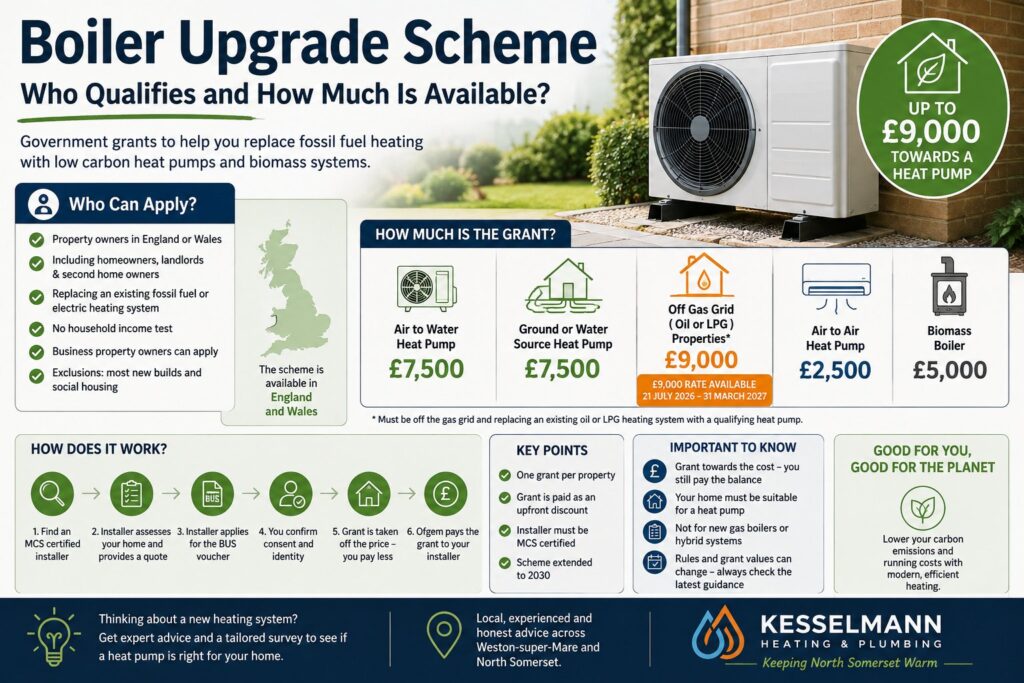
The Boiler Upgrade Scheme gives property owners in England and Wales money towards replacing an existing fossil fuel or electric heating system with eligible low carbon heating. Most heat pump grants are £7,500. Eligible off gas grid homes replacing oil or LPG currently get £9,000. Air to air heat pumps receive £2,500 and qualifying biomass boilers receive £5,000.
Spoiler
Despite the name, the Boiler Upgrade Scheme does not give you £7,500 towards a shiny new gas boiler.
The main purpose of the scheme is getting people away from gas, oil and LPG heating and onto heat pumps.
The short answer
You normally qualify if you own an eligible property in England or Wales and replace an existing fossil fuel or electric heating system with an approved heat pump. There is no household income test in the current eligibility rules. Homeowners, landlords, second home owners and qualifying business property owners are included. Most new builds and social housing are excluded.
What you need to know
- Standard air to water heat pump grant: £7,500
- Ground or water source heat pump grant: £7,500
- Eligible off gas grid oil or LPG property: £9,000 until 31 March 2027
- Air to air heat pump grant: £2,500
- Qualifying biomass boiler grant: £5,000
- You get one BUS grant per property
- An MCS certified installer handles the application
Fun fact
The scheme has changed quite a bit.
From 28 April 2026, a valid EPC stopped being a standing eligibility requirement. If a valid EPC exists, your installer supplies the number. Where there is no valid EPC, the installer supplies other evidence instead.
So if you have found an older article telling you an EPC is absolutely mandatory, check when somebody wrote it.
The rules moved.
How much is the Boiler Upgrade Scheme grant in 2026?
As of 25 August 2026, the current grant levels are:
Heating systemCurrent grantAir to water heat pump£7,500Ground source heat pump£7,500Water source heat pump£7,500Air to air heat pump£2,500Eligible biomass boiler£5,000Eligible off gas grid air to water heat pump replacing oil or LPG£9,000Eligible off gas grid ground source heat pump replacing oil or LPG£9,000
The temporary £9,000 rate started on 21 July 2026 and runs until 31 March 2027. The property must have no mains gas connection and the heat pump must replace oil or LPG heating.
That extra £1,500 matters.
Especially for rural properties where oil and LPG remain common.
Does the Boiler Upgrade Scheme pay for a new gas boiler?
No.
This catches people because the scheme has the word boiler in the name.
Reasonable assumption.
Wrong scheme.
The BUS supports eligible heat pumps and, in more limited circumstances, biomass boilers. Hybrid systems which combine a fossil fuel boiler and heat pump are also excluded.
If your old gas boiler dies and you want another gas boiler, the Boiler Upgrade Scheme does not contribute £7,500 towards it.
Who qualifies for the Boiler Upgrade Scheme?
The broad eligibility is simpler than many people expect.
You need to own the property.
That includes:
- Your main home
- A second home
- A property you rent to tenants
- Certain business properties
The property needs to be in England or Wales and the eligible installation must replace an existing fossil fuel or electric heating system.
There is no stated income threshold.
You do not need to be receiving benefits.
A household earning £30,000 and a household earning £130,000 are not separated by an income test under the current BUS eligibility rules.
Do landlords qualify?
Yes.
Private landlords who own the property fall within the scheme’s current property owner rules.
The same eligibility checks still apply to the property and heating system.
Social housing is different and sits outside the scheme.
Do second homes qualify?
Yes.
GOV.UK explicitly includes second homes within eligible property ownership, subject to the rest of the scheme rules.
That is worth knowing because plenty of grant schemes focus tightly on a person’s main residence.
BUS does not use that same restriction.
Do new builds qualify?
Most new builds do not.
A developer building a new property cannot normally use BUS to subsidise the heating installation.
There are exceptions.
Eligible self builds qualify where the property meets the scheme’s self build rules.
A completed new build which somebody later buys with fossil fuel heating also sits in a different position from a house still under construction. GOV.UK says a finished new build with a fossil fuel boiler might qualify for a later heat pump installation.
Do self builds qualify?
Some do.
Current Ofgem rules allow qualifying self builds where the property:
- Was built mainly using the labour or resources of the first owner
- Has never been owned by a business or organisation
- Is not part of an excluded property development
Biomass grants are not available for eligible self builds under the current scheme.
What about biomass boilers?
The rules get tighter.
To receive the £5,000 biomass grant, the property needs to be:
- Off the gas grid
- In a rural location
- Using an eligible biomass boiler with the required emissions certification
The biomass system also needs to provide both space heating and hot water.
So no, £5,000 towards a wood pellet boiler in a gas connected city terrace is not what the scheme has in mind.
Do I need an EPC?
This changed in April 2026.
A valid EPC is no longer a standing BUS eligibility requirement.
If your property already has a valid EPC, your installer supplies its certificate number.
If there is no valid EPC, the installer needs alternative evidence to show the property qualifies.
This is exactly why researching grants from a four year old blog post is risky.
Government schemes have a habit of changing the rules while leaving the old internet lying around.
Do I need to insulate my loft or cavity walls first?
The current BUS rules no longer use the old EPC requirement as a standing eligibility condition.
That does not mean insulation suddenly stopped mattering.
Heat pump design still needs to account for the actual heat loss of the building, and installers must meet the relevant MCS design standards.
A poorly insulated house might need more work to heat efficiently.
That becomes a system design question rather than a simple grant checkbox.
How does the Boiler Upgrade Scheme application work?
You do not normally apply to Ofgem yourself.
The scheme is installer led.
The process is roughly:
- Find an MCS certified installer.
- Ask them to assess your property.
- Agree the proposed system and quotation.
- The installer applies for the BUS voucher.
- Ofgem contacts you for consent and identity verification.
- The installer deducts the grant from the amount you pay.
- Ofgem pays the grant through the installer once the scheme requirements are met.
The current rules require the BUS grant to appear as an upfront discount. The installer should not collect the grant amount from you and tell you to claim it back later.
Much better.
Nobody needs another government form to fill in on a Sunday evening.
Do I receive £7,500 or £9,000 in my bank account?
No.
The grant reduces the price of the eligible installation.
Your MCS installer handles the voucher and applies the grant as a discount.
For example, if an eligible installation costs more than the grant, you pay the remaining balance.
The grant is support towards the installation.
It does not promise a free heating system.
Is every heat pump eligible?
No.
The equipment and installation need to satisfy BUS technical requirements and the relevant MCS standards.
Current eligible technologies include:
- Air to water heat pumps
- Air to air heat pumps
- Ground source heat pumps
- Water source heat pumps
- Shared ground loop systems within scheme limits
- Qualifying biomass systems
Hybrid fossil fuel and heat pump systems are excluded.
The installer is responsible for checking detailed product and installation eligibility.
What if I already received another energy grant?
Funding for insulation or other energy efficiency improvements does not automatically rule you out.
GOV.UK says property owners remain eligible where previous support funded things such as insulation.
The problem arises where the property has already received government support towards the heat pump or biomass system itself.
You do not get the government to buy the same heat pump twice.
Fair enough.
Common mistakes
Assuming “boiler grant” means a free gas boiler
BUS is mainly a heat pump scheme.
The name has done some heavy lifting in confusing people.
Looking only at the £7,500 figure
Eligible oil and LPG heated off gas grid properties currently receive £9,000 for qualifying air to water or ground source heat pumps until 31 March 2027.
Reading old eligibility advice
EPC rules changed on 28 April 2026.
Use current Ofgem or GOV.UK guidance.
Choosing an installer before checking MCS certification
BUS applications need an MCS certified installer for the relevant technology.
Choosing a heat pump because there is a grant
A £7,500 grant does not automatically make a heat pump the right heating system for every property.
The house still needs surveying.
Heat loss matters.
Radiators matter.
Hot water demand matters.
Space matters.
The heating system still has to work after everybody has finished celebrating the funding.
What I would recommend
Start with the house.
Not the grant.
If you are already considering replacing an old gas, oil or LPG system, find out whether a heat pump suits the property before treating £7,500 as the reason to buy one.
You want proper answers to:
- What is the property’s heat loss?
- What flow temperature will the system need?
- Are existing radiators suitable?
- Does pipework need changing?
- Where will the hot water cylinder go?
- Where will the outdoor unit go?
- What will the finished installation cost after the grant?
- What should you expect from running costs?
Then compare the whole proposition with the alternatives.
A grant makes an appropriate system cheaper.
A grant does not make an inappropriate system appropriate.
Deciding between a new boiler and a heat pump in Weston super Mare?
Kesselmann Heating & Plumbing installs gas boilers and works on heating systems across Weston super Mare, Clevedon, Portishead, Nailsea, Bristol and North Somerset.
If your existing boiler needs replacing and you are deciding whether to stay with a gas boiler or investigate a heat pump, start by understanding the existing heating system and what the house needs.
For the BUS grant itself, the heat pump installer must hold the relevant MCS certification and handle the scheme application.
For the gas boiler replacement route:
Kesselmann Boiler Installation in Weston super Mare
Need a Gas Safe engineer in Weston-super-Mare?
Frequently asked questions
How much is the Boiler Upgrade Scheme grant now?
Most air to water and ground source heat pump installations receive £7,500. Air to air heat pumps receive £2,500. Biomass grants are £5,000. Eligible off gas grid properties replacing oil or LPG currently receive £9,000 towards qualifying air to water or ground source heat pumps until 31 March 2027.
Is the Boiler Upgrade Scheme means tested?
No household income test appears in the current GOV.UK eligibility criteria. Eligibility centres on property ownership, property type, existing heating and the proposed low carbon heating system.
Does the £7,500 grant cover a gas boiler?
No. The scheme supports eligible heat pumps and biomass systems rather than replacement fossil fuel boilers.
Does a landlord qualify?
Private landlords are included because the scheme permits applications from owners of properties rented to tenants. Social housing is excluded.
Do I need an EPC for the Boiler Upgrade Scheme?
Since 28 April 2026, a valid EPC is no longer a standing eligibility requirement. Where a valid EPC exists, its number needs supplying. Without one, the installer provides alternative evidence.
Who applies for the grant?
Your MCS certified installer handles the BUS voucher application. Ofgem then contacts you to confirm consent and verify your identity.