Why Does My Boiler Keep Gaining Pressure?
TLDR
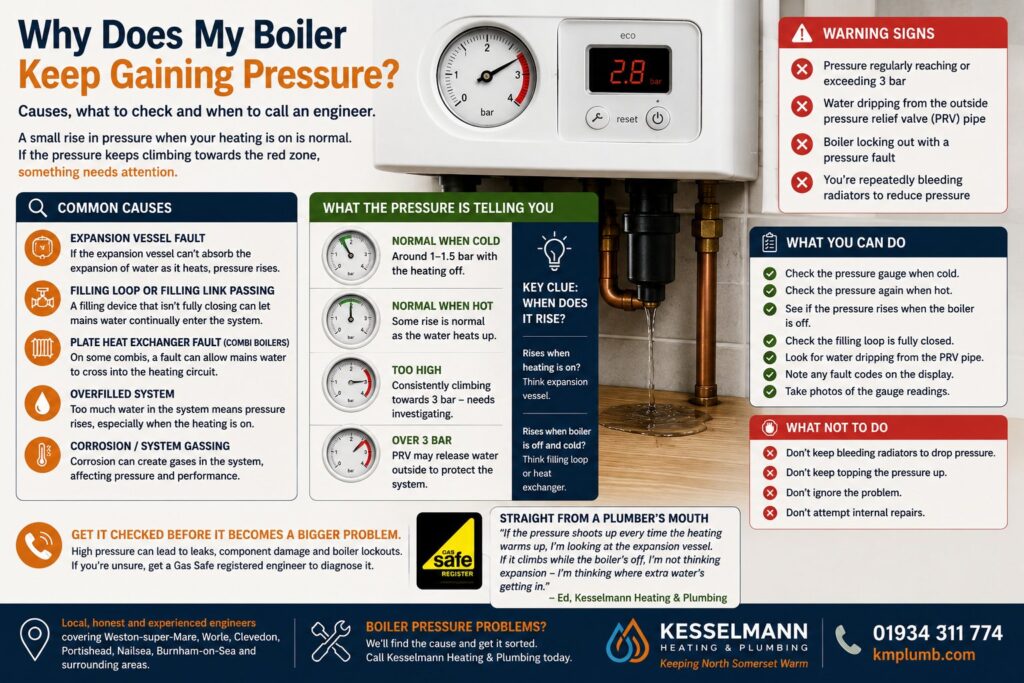
Some pressure rise when your heating gets hot is normal. A boiler which keeps climbing towards the red zone needs investigating. If pressure rises mainly when the heating runs, the expansion vessel is a common suspect. If pressure rises even when the boiler is cold and switched off, look towards the filling arrangement or, on some combis, an internal heat exchanger fault.
Spoiler
Watch when the pressure rises.
Cold boiler gaining pressure while doing absolutely nothing points us in a different direction from a boiler which shoots from 1 bar towards 3 bar every time the radiators get hot.
That one observation is extremely useful.
The short answer
A boiler keeps gaining pressure when either too much water enters the sealed heating system or the system cannot properly accommodate the normal expansion of water as it heats. Common causes include overfilling, a filling loop which is passing water, an expansion vessel fault and, on some combi boilers, a plate heat exchanger allowing mains water to cross into the heating circuit. Worcester Bosch uses this exact hot versus cold pressure behaviour as part of its fault finding process.
What you need to know
- A small pressure rise when the heating gets hot is normal.
- A rise of more than about 1 bar from cold to hot is worth investigating. Worcester Bosch points towards the expansion vessel in this situation.
- Pressure creeping upwards when the boiler is cold or switched off points elsewhere.
- A filling link or filling loop which is not fully closing can continually add mains water.
- On suitable combi boilers, an internally leaking plate heat exchanger is another recognised cause of pressure rising while the boiler is off.
Fun fact
Worcester Bosch’s own boiler fault finding flowchart begins by asking whether the system pressure keeps increasing while the boiler has been switched off for an extended period.
That is how useful this one clue is.
Heating engineer diagnosis sometimes begins with:
“Does it do it when it’s doing nothing?”
Rather sophisticated stuff.
First, how much should boiler pressure rise?
Your boiler contains a sealed circuit of heating water.
When water heats up, it expands.
The expansion vessel absorbs this increase in volume so the pressure stays within the boiler’s intended operating range.
Vaillant says boiler pressure generally sits around 1 to 1.5 bar with the central heating switched off. Pressure rises when the water heats, which is normal.
Worcester Bosch gives a useful diagnostic threshold. If the pressure rises by more than around 1 bar when the heating reaches temperature, the expansion vessel may need attention from an engineer.
So:
Cold at 1.2 bar.
Hot at 1.6 bar.
Nothing immediately dramatic there.
Cold at 1 bar.
Heating comes on.
Gauge heads towards 3 bar.
That deserves investigating.
What does the pressure behaviour tell us?
What you noticeWhat an engineer will want to investigatePressure was high straight after topping upSystem might simply have been overfilledPressure rises mainly as heating gets hotExpansion vessel or expansion capacityPressure rises even with boiler cold and offFilling loop, filling link or internal crossoverPressure climbs towards 3 bar then water discharges outsidePRV operation and why pressure became excessivePressure goes high when hot, then very low when coldExpansion vessel and PRV become strong suspectsPressure rises and radiators repeatedly need ventingSystem water condition and possible gassing also deserve investigation
The first four behaviours appear directly within current manufacturer guidance and Worcester Bosch diagnostic material.
Why does an expansion vessel fault make boiler pressure rise?
This is one of the big ones.
Inside many sealed heating systems sits an expansion vessel.
The vessel contains a diaphragm separating system water from a compressed air or gas charge.
As the heating water expands, the vessel accepts the extra volume.
If the vessel loses its charge, the diaphragm fails or the vessel cannot accommodate enough expansion, system pressure rises much more sharply as the heating warms.
Vaillant describes the expansion vessel’s job as keeping pressure stable while heating water expands and contracts. Worcester Bosch advises checking the vessel where pressure rises excessively as the boiler reaches operating temperature.
And this creates a classic pattern.
Boiler cold.
Pressure looks fine.
Heating starts.
Pressure climbs.
2 bar.
2.5.
Towards 3.
The pressure relief valve opens.
Water leaves the system.
Heating cools.
Pressure becomes low.
Homeowner tops it up.
Next heating cycle, we do the whole dance again.
Straight from a plumber’s mouth
“I’ve seen boilers sit at a sensible pressure cold, then climb straight towards 3 bar the moment the heating’s fully warm. At that point I’m looking at the expansion vessel, not the water level. Topping it up again does nothing, because the system was never short of water to begin with.”
What does the pressure relief valve do?
The pressure relief valve, normally shortened to PRV, is a safety component.
Vaillant explains that the PRV opens when pressure becomes too high, providing a safe route for heating water to escape. The discharge pipe normally terminates outside the property.
You might therefore notice:
- Boiler pressure approaching 3 bar
- Water dripping from a copper pipe outside
- Pressure dropping again after the heating cools
The important point is this:
The PRV opening does not automatically mean the PRV caused the original fault.
The valve may be doing its job.
You still need to know why the pressure got too high.
Replacing a perfectly obedient safety valve while ignoring the reason it opened is an excellent way of arranging another visit.
Why does my boiler gain pressure even when it’s switched off?
This is where diagnosis changes direction.
If the heating has been off for hours and the pressure still creeps upwards, thermal expansion is a poor explanation.
Nothing is getting hotter.
Worcester Bosch specifically tells engineers faced with this pattern to check whether the filling link is passing water. If the problem continues, its fault finding process moves towards checking the plate heat exchanger for internal cross leakage.
This distinction matters.
Pressure rising when hot:
Think expansion.
Pressure rising stone cold while everyone is asleep:
Where is extra water entering the heating system?
Much better question.
Could my filling loop be causing the pressure rise?
Yes.
The filling loop or filling link connects the mains water supply to the sealed heating circuit when the heating system needs repressurising.
Normally you open it briefly.
Pressure rises.
You close it again.
Problem occurs when the valve:
- Has not been fully closed
- Has become faulty
- Allows water to pass even though it appears closed
Vaillant lists a faulty external filling device as one recognised cause of continuously increasing pressure. Baxi also advises checking the filling loop is completely closed when pressure keeps rising.
Mains water sits at a higher pressure than the heating system.
So even a small amount getting through can slowly push the boiler pressure upwards.
What is a cross leaking plate heat exchanger?
This one catches people out.
Some combi boilers have a plate heat exchanger separating domestic mains water from the sealed central heating water.
The two water systems normally remain completely separate.
If an internal failure develops between those passages, higher pressure mains water can enter the lower pressure heating circuit.
The result?
The boiler pressure slowly increases without anybody touching the filling loop.
Worcester Bosch specifically includes plate heat exchanger cross leakage in its diagnostic process for boiler pressure which keeps increasing while the appliance is switched off.
This pattern also appears repeatedly in practical heating engineer discussions.
Engineers tend to separate the fault by asking:
Does the pressure rise only when hot?
Does it rise while completely cold?
Has the filling loop definitely stopped passing?
That sequence avoids firing parts at the boiler until one happens to work.
Straight from a plumber’s mouth
“A boiler that’s been cold for hours with pressure still climbing isn’t an expansion problem. Nothing’s expanding by that point. I want to know where water’s getting into the circuit from. First stop is the filling arrangement, then, depending on the model, an internal crossover.“
Could I have simply overfilled the boiler?
Absolutely.
Especially if the pressure problem started immediately after repressurising.
Baxi lists overfilling as one of the common reasons for high boiler pressure. Vaillant gives similar advice.
If you were aiming for 1.2 bar and became slightly enthusiastic with the filling loop, you might have ended up at 2.4 bar cold.
Turn the heating on and that pressure will rise further.
Different problem.
Simple explanation.
This is why knowing what happened immediately before the problem started is useful.
Why does my pressure reach 3 bar?
Most domestic sealed heating systems have a pressure relief valve designed to protect against excessive pressure.
Vaillant says the PRV typically starts releasing water when system pressure exceeds around 3 bar.
If your gauge repeatedly reaches that area, do not treat 3 bar as your new normal operating pressure.
Something needs attention.
The PRV might also continue dripping after it has operated, particularly if debris prevents it reseating properly or the valve has been damaged.
Again, diagnosis matters.
Could corrosion make the pressure rise?
Less commonly, yes.
Worcester Bosch’s newer technical guidance discusses “system gassing”.
Where corrosion takes place inside heating systems, gases can form. Worcester says a clue is repeatedly rising pressure alongside radiators which fail to heat fully and need regular venting. Its guidance then points towards testing and treating the heating water.
This is not the first explanation for every high pressure boiler.
But if you are:
- Constantly venting radiators
- Getting poor heating at the tops of radiators
- Seeing strange pressure behaviour
system water condition belongs in the conversation.
Is high boiler pressure dangerous?
Your boiler has safety controls designed to manage excessive pressure.
That does not mean repeated high pressure should be ignored.
A PRV discharging regularly means something is wrong.
High pressure can also produce leaks and repeated loss of heating water.
If the boiler is entering its red pressure zone, repeatedly faulting, leaking or behaving abnormally, arrange professional diagnosis.
If at any point you suspect the gas appliance itself is unsafe, HSE advises switching it off and leaving it off until checked by a Gas Safe registered engineer.
If you smell gas, call the National Gas Emergency Service on 0800 111 999.
What you can safely check yourself
You can gather a surprising amount of useful information without touching anything internal.
Check:
- Boiler pressure when completely cold
- Boiler pressure after the heating has been running
- Whether pressure rises while the boiler is switched off
- Whether you recently repressurised it
- Whether the filling control appears fully closed
- Whether water drips from the outside PRV discharge pipe
- Whether radiators regularly need venting
- Whether any fault code appears on the display
Take two photographs.
One cold.
One hot.
That gives the engineer far more useful information than:
“Pressure’s doing something funny.”
Work that needs a professional
Do not start dismantling the boiler to test:
- Expansion vessel
- Pressure relief valve
- Plate heat exchanger
- Internal filling link
- Internal pressure components
- Boiler pipework inside the appliance
Gas Safe Register explains that many boiler casings form part of the combustion circuit. If removing the casing requires screws, consumers should generally leave it alone and use a suitably qualified Gas Safe registered engineer.
Common mistakes
Bleeding water out every morning
Pressure high.
Bleed radiator.
Gauge falls.
Tomorrow pressure high again.
Bleed radiator.
You have found a way of managing the symptom.
The fault is still sitting there.
Assuming every pressure problem is the expansion vessel
Expansion vessels cause lots of pressure trouble.
They do not explain every pressure fault.
Pressure rising while the boiler is cold should send the investigation in another direction.
Replacing the PRV because water comes out of the PRV pipe
Ask why it opened.
That question matters.
Continually adjusting the filling loop
If nobody has touched the filling loop and the pressure keeps rising, adding and removing water every few days turns fault diagnosis into a strange household hobby.
Ignoring what happens cold versus hot
This is one of the most useful clues you have.
Write the readings down.
What I would recommend
Start tomorrow morning.
Before anyone uses the heating, photograph the boiler pressure.
Then run the heating properly.
Take another picture once everything is hot.
Turn the heating off and see where the pressure returns once the system cools.
If the pressure rises sharply with temperature, the expansion vessel deserves investigation.
If the pressure keeps climbing with the boiler cold and doing nothing, tell the engineer exactly that.
They should then be thinking about where additional pressure or water is entering the system.
Expansion vessel.
Filling loop.
Plate heat exchanger on applicable boilers.
PRV behaviour.
System condition where relevant.
Work through the evidence.
Guessing at parts gets expensive remarkably quickly.
Boiler pressure keeps rising in Weston super Mare?
Kesselmann Heating & Plumbing provides boiler fault finding and repairs across Weston super Mare, Worle, Clevedon, Portishead, Nailsea, Burnham on Sea and surrounding North Somerset.
Our boiler repair service covers pressure related faults, pressure relief valves, leaking heat exchangers, circulation problems and other boiler failures.
If your pressure gauge keeps heading towards the red, we can work out why before another component gets blamed for something it didn’t do.
Kesselmann Boiler Repair in Weston super Mare
Need a Gas Safe engineer in Weston-super-Mare?
Frequently asked questions
Why does my boiler pressure go up when the heating is on?
Heating water expands, so some pressure increase is normal. Worcester Bosch says a rise greater than around 1 bar as the system reaches temperature might indicate that the expansion vessel needs attention.
Why does my boiler pressure rise to 3 bar?
Common causes include overfilling, expansion vessel trouble or additional water entering the heating system. Around 3 bar, the pressure relief valve normally begins releasing water to protect the system.
Why does my boiler pressure rise when the boiler is off?
Worcester Bosch's diagnostic guidance says pressure which continually rises with the boiler off warrants checking whether the filling link is passing water. If that is not the cause, an internal plate heat exchanger cross leak is another recognised fault on applicable boilers.
Will a faulty expansion vessel increase boiler pressure?
Yes. The expansion vessel absorbs the increase in water volume as your heating warms. If the vessel loses its charge or fails, pressure might climb excessively when the heating operates.
Can a filling loop cause high boiler pressure?
Yes. A filling loop or filling device which has not fully closed or is allowing mains water through can continually increase system pressure. Both Vaillant and Baxi identify this as a recognised cause.
Can a plate heat exchanger make boiler pressure rise?
On applicable combi boilers, yes. An internal cross leak can let higher pressure mains water pass into the sealed heating circuit. Worcester Bosch includes this specifically within its pressure fault diagnostic guidance.