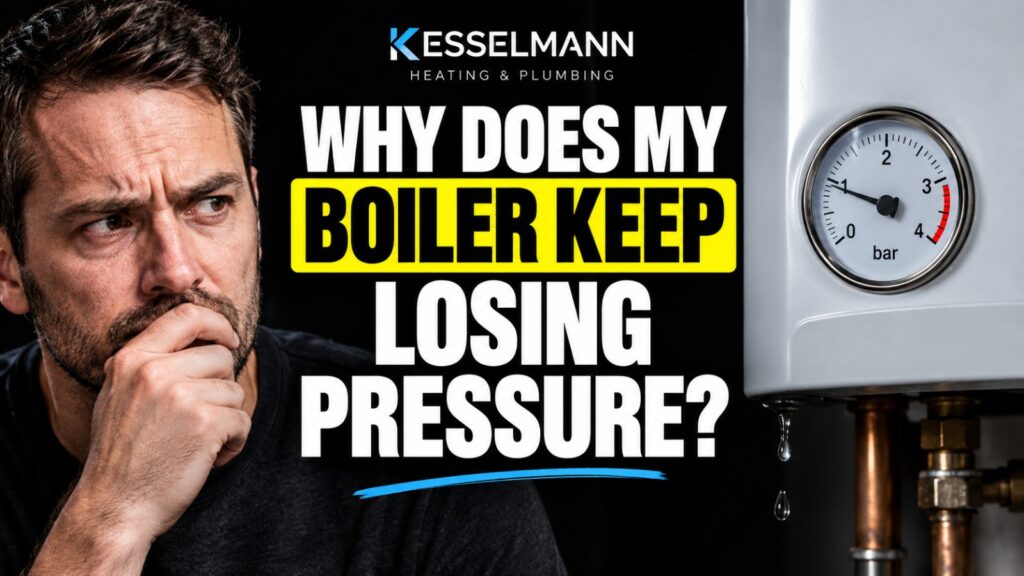
Why Does My Boiler Keep Losing Pressure?
TLDR
A sealed heating system usually loses pressure because water is leaving somewhere. Common causes include leaking radiator valves or pipework, a leak inside the boiler, pressure relief valve discharge or an expansion vessel fault. Bleeding radiators also lowers pressure. Repressurising restores the missing water, but repeated topping up means the underlying cause still needs finding.
Spoiler
If you top the boiler up on Monday and need to do the same thing again on Friday, repressurising is no longer the repair.
Somewhere, water is leaving the system.
The short answer
Boiler pressure normally falls because the sealed heating system has lost water. Start by checking radiator valves, visible pipe joints, the boiler itself and the pressure relief pipe outside. If the pressure drops mainly after the heating has been running, an expansion vessel or pressure relief valve fault also deserves investigation. Worcester Bosch advises getting help if you need to repressurise far more often than once or twice a year.
What you need to know
- Around 1 to 1.5 bar when cold is normal for many sealed systems.
- Bleeding radiators lowers system pressure.
- A tiny leak is enough to cause repeated pressure loss.
- Pressure shooting upwards when hot, then falling when cold, points towards the expansion side of the system.
- Constantly topping up replaces lost water. It does not repair the fault.
Fun fact
A heating leak does not always produce a puddle.
Baxi warns that tiny leaks around warm pipework sometimes evaporate before enough water gathers to drip. Rust, corrosion or staining might be the only visible clue.
Which is wonderfully inconvenient.
The leak exists.
The evidence has decided to leave.
What pressure should your boiler normally sit at?
For many sealed heating systems, around 1 to 1.5 bar when cold is normal.
Worcester Bosch gives 1 to 1.5 bar as the normal cool pressure range. Vaillant also uses roughly this range in its homeowner guidance.
Pressure normally rises as the heating warms.
That part matters.
A boiler sitting at:
Cold: 1.2 bar
Hot: 1.6 bar
is behaving very differently from:
Cold: 1.0 bar
Hot: 2.8 bar
Then back to 0.5 bar the following morning.
Those numbers tell an engineer quite a lot.
Why does bleeding radiators make the pressure drop?
When you bleed a radiator, air leaves the system.
Sometimes a little water leaves too.
Pressure falls as a result.
British Gas and Vaillant both list radiator bleeding as a common explanation for low system pressure.
So if you have bled six radiators and the gauge has fallen afterwards, nothing particularly mysterious has happened.
Follow the manufacturer’s instructions for repressurising.
Then watch what happens afterwards.
If the pressure stays stable, lovely.
If the gauge keeps dropping over the following days, start looking elsewhere.
Is there a leak somewhere in the heating system?
This is one of the first places I would look.
A sealed heating system includes:
- Radiators
- Radiator valves
- Pipework
- Joints
- The boiler
- Various valves and components
A small leak anywhere on that circuit removes water.
Less water means lower pressure.
Vaillant recommends checking around radiator connections for damp, staining, flaking paint and water marks. Worcester Bosch advises inspecting visible joints, radiator valves and considering hidden underfloor pipework too.
Look around:
Radiator valves.
Pipe connections.
Under the boiler.
Ceilings beneath heating pipework.
Skirting boards.
Any areas where flooring has started staining or swelling.
Do not start pulling floors apart because the gauge dropped half a bar.
Start with evidence.
A real Kesselmann example
I’ve had this exact type of fault.
The customer’s boiler kept losing pressure.
So they topped it back up.
Everything worked again.
Then the pressure dropped.
Top it up again.
After a while, repressurising the boiler had become part of the household routine.
When I investigated the system properly, the boiler itself was not where the problem sat.
There was a tiny leak on the heating system.
No dramatic flood.
No water pouring through the ceiling.
Nothing screaming:
“Hello. I’m the leak.”
Enough water was escaping over time to drop the system pressure.
Once we found the leak and repaired it, the pressure stayed where it should.
That is the important difference.
Repressurising restored the pressure.
Finding the leak repaired the fault.
What if you cannot find a leak?
A lack of visible water does not rule one out.
Pipework might run:
- Beneath floors
- Behind boxing
- Inside walls
- Through ceilings
- Behind kitchen units
Vaillant specifically notes that hidden pipe leaks make pressure loss difficult to diagnose.
There is another possibility too.
The water might be leaving through the boiler’s pressure relief valve.
Check the pressure relief pipe outside
Most sealed boiler systems include a pressure relief valve, usually shortened to PRV.
Its job is to release water if system pressure gets too high.
The discharge pipe normally runs through an outside wall.
Worcester Bosch specifically advises checking this pipe where a system continually loses pressure. Signs of dripping mean the PRV or the reason behind its operation needs investigation.
Go outside.
Look at the pipe.
Is it wet?
Are there water marks underneath?
Has it been dripping?
That is useful information for the engineer.
Do not assume the valve itself caused the problem though.
Sometimes the valve opens because another fault pushed the pressure too high.
Which brings us to the expansion vessel.
Could the expansion vessel cause pressure loss?
Yes.
This creates one of the most useful pressure patterns to watch.
The expansion vessel deals with the increase in water volume as your heating gets hot.
If the vessel loses its charge or develops a fault, boiler pressure often climbs much higher than normal when the heating warms.
Worcester Bosch says a rise of more than around 1 bar from cold to hot suggests the expansion vessel needs attention.
A typical pattern looks like this:
- Boiler sits around 1 bar when cold.
- Heating starts.
- Pressure heads towards 3 bar.
- PRV opens and releases water.
- Heating cools.
- Pressure falls too low.
- You refill the boiler.
- Repeat.
The homeowner experiences:
“My boiler keeps losing pressure.”
The original problem might have started with pressure getting too high.
That is why watching the gauge cold and hot helps.
What about the pressure relief valve itself?
The valve might also leak.
Baxi lists debris inside the PRV as one reason a boiler loses pressure. If the valve drips, water leaves the sealed heating circuit and the pressure falls.
Sometimes a PRV has previously opened at high pressure and then fails to reseal cleanly.
Again, diagnosis matters.
Changing the PRV without checking why it opened risks repairing the consequence rather than the cause.
Could the boiler itself be leaking?
Yes.
Leaks inside the appliance also reduce system pressure.
Vaillant advises looking for visible dripping beneath the boiler but warns homeowners not to remove the casing to investigate further. Internal boiler work belongs with a Gas Safe registered engineer.
Possible internal faults include:
- Leaking seals
- Internal joints
- Pump leaks
- Expansion vessel trouble
- Pressure relief valve faults
- Heat exchanger leaks
Seeing water underneath the boiler deserves attention.
Where the drip appears does not always tell you which component leaked.
Water travels.
Gravity remains annoyingly reliable.
How often should you need to repressurise a boiler?
This gives homeowners a useful benchmark.
Worcester Bosch says its systems normally need topping up only once or twice a year.
Much more frequent repressurising deserves professional investigation.
So:
Once after bleeding radiators?
Fair enough.
A small top up several months apart?
Nothing immediately alarming.
Every few days?
No.
Every morning?
Definitely no.
You have not acquired a needy boiler.
You have a fault.
What you should safely check yourself
Start with simple observations.
- Check pressure when the heating is completely cold.
- Take a photo.
- Run the heating.
- Check pressure again when everything is hot.
- Look around radiator valves and visible pipe joints.
- Look underneath the boiler without removing its casing.
- Check for damp patches or staining.
- Look at the PRV discharge pipe outside.
- Note how long pressure takes to fall.
Those observations make fault finding considerably easier.
What needs an engineer?
Arrange professional diagnosis where:
- Pressure falls every few days
- No visible leak explains the loss
- Pressure rises dramatically when heating starts
- Water comes from the outside PRV pipe
- Water appears beneath the boiler
- The boiler repeatedly locks out
- Repressurising no longer restores normal operation
- An expansion vessel or internal component needs testing
HSE says domestic gas appliance work must be completed by a Gas Safe registered engineer competent for the work involved.
Do not remove the boiler casing and start exploring.
The pressure gauge has already given you enough homework.
Common mistakes
Topping the boiler up every week
This is the big one.
If pressure keeps disappearing, find out why.
Adding more water every Friday has turned the filling loop into a subscription service.
Assuming there must be a huge leak
No.
Tiny losses add up.
A damp radiator valve or hidden pipe joint might lose enough water over several days to drop the pressure without producing a dramatic puddle.
Looking only at the boiler
The heating system stretches through the entire house.
Radiators and pipework matter too.
Replacing the PRV without asking why it opened
Sometimes the PRV is faulty.
Sometimes another fault caused excessive pressure first.
Check the behaviour.
Assuming low pressure means a new boiler
Pressure loss is a symptom.
Find the cause before holding a funeral for the boiler.
What I would recommend
Start by recording what happens.
Check the boiler cold.
Photograph the pressure.
Run the heating.
Photograph the pressure again.
Then check it the following morning.
If the pressure simply falls slowly over days, look for water loss.
If it climbs dramatically when hot then collapses again when cold, tell the engineer exactly that.
If water comes from the outside pressure relief pipe, mention it.
Good fault finding starts with patterns.
Repressurising once makes sense.
Repressurising constantly is your heating system asking for an investigation.
Boiler keeps losing pressure in Weston super Mare?
Kesselmann Heating & Plumbing provides boiler fault finding and repair across Weston super Mare, Worle, Clevedon, Portishead, Nailsea, Bristol and surrounding North Somerset.
Pressure loss might come from the boiler or elsewhere on the heating system. The job is finding the cause before throwing parts at it.
[Boiler repair with Kesselmann Heating & Plumbing] Boiler repair in Weston super Mare
Need a Gas Safe engineer in Weston-super-Mare?
Frequently asked questions
Why does my boiler lose pressure overnight?
Water is likely leaving the sealed system somewhere. A small radiator or pipe leak, boiler leak or pressure relief discharge are recognised causes. Check visible joints and the outside discharge pipe. If the pressure keeps falling, arrange diagnosis.
Why does my boiler lose pressure when the heating is on?
Watch whether the pressure rises substantially first. A large cold to hot rise followed by pressure loss after cooling points towards the expansion vessel and PRV. Worcester Bosch recommends professional attention where pressure rises more than around 1 bar as the system heats.
Why is my boiler losing pressure with no visible leak?
The leak might sit beneath flooring, behind walls, inside the boiler or at the outside PRV discharge. Hidden leakage is specifically recognised in Vaillant's homeowner guidance.
How often should I top up my boiler pressure?
Worcester Bosch says once or twice a year is usual for its systems. Frequent repressurising suggests a fault needs finding.
Does bleeding radiators reduce boiler pressure?
Yes. Releasing air and water during bleeding reduces system pressure. Check the gauge afterwards and follow your boiler manufacturer's repressurising instructions where needed.
Is low boiler pressure dangerous?
Low pressure usually causes poor operation or boiler lockout rather than creating an immediate danger. The cause still needs attention, especially where water keeps escaping. If you suspect the gas appliance itself is unsafe, HSE advises switching it off until checked by a Gas Safe registered engineer.