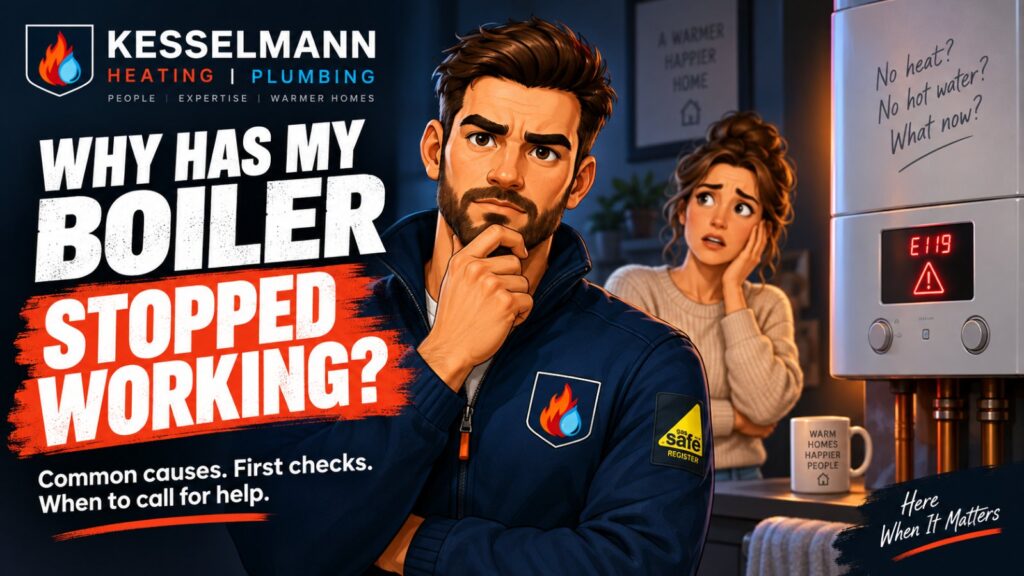
Why Has My Boiler Stopped Working, and What Usually Causes It?
TLDR
A boiler often stops because of low or high pressure, loss of power or gas, thermostat or control problems, a frozen or blocked condensate pipe, ignition failure, poor circulation or a faulty internal component. Start with the display, pressure, power and controls. If it keeps locking out, leaks, smells of gas or needs repeated resets, get an engineer involved.
Spoiler
A boiler stopping does not automatically mean the boiler is dead.
Quite often the appliance has deliberately shut itself down because something elsewhere is wrong.
The short answer
Modern boilers monitor pressure, ignition, water flow, temperatures, combustion and other operating conditions. When something falls outside the safe operating range, the boiler often stops or enters lockout. Common causes include low pressure, supply problems, thermostat settings, frozen condensate, ignition faults, circulation problems, pumps, fans, valves and sensors. The fault code and what stopped working usually give the first useful clues.
What you need to know
- Check the boiler display before pressing anything. Write down the fault code.
- Check the pressure gauge, power supply and thermostat.
- If only heating or only hot water has failed, that narrows the fault considerably.
- One reset following the manufacturer’s instructions is reasonable. Repeated resets are evidence of a fault.
- Do not remove the boiler casing or start investigating internal gas components yourself.
Fun fact
A boiler entering lockout is often doing exactly what it was designed to do.
Worcester Bosch describes lockout as a safety feature which stops the boiler operating after faults such as low water pressure or ignition failure.
Annoying?
Absolutely.
Still preferable to the boiler deciding safety systems are optional.
First question: what exactly has stopped working?
This sounds obvious, but it is one of the most useful questions.
There is a big difference between:
- No heating and no hot water
- Hot water but no heating
- Heating but no hot water
- Boiler completely dead with no display
- Boiler display working but showing a fault
- Boiler starting, then shutting itself down
Those symptoms point towards different areas.
For example, Vaillant specifically identifies a faulty diverter valve as one possible cause where a combi provides heating but struggles with hot water, or the other way around.
So before diagnosing “the boiler”, establish what the boiler has stopped doing.
Has the boiler got power?
Start with boring things.
Boring things are brilliant when they save a callout.
Check whether the boiler display is illuminated.
If completely blank:
- Check the boiler isolation switch
- Check the consumer unit
- Think about any recent power cut
- Check whether a timer or programmer reset after the outage
British Gas and Vaillant both put power supply and controls among the first homeowner checks when a boiler stops operating.
A boiler with no electricity will demonstrate remarkably little enthusiasm for heating water.
Check the thermostat and programmer
Next, make sure the boiler is being asked to do something.
Turn the thermostat above the current room temperature.
Check:
- Heating is switched on
- Programmer times are correct
- Batteries in wireless controls are working
- Holiday mode has not been left on
- Summer mode has not disabled central heating
Vaillant notes that a boiler will quite correctly refuse to fire if the room has already reached the requested temperature. British Gas also highlights timer and thermostat settings as common reasons for apparent boiler failure.
This is the cheapest boiler repair available.
Turn thermostat up.
Boiler starts.
Put tools back in van.
Check the pressure
Look at the pressure gauge or digital pressure reading.
For many sealed systems, cold pressure commonly sits somewhere around 1 to 1.5 bar, though you should use the figure given for your own boiler.
Vaillant says pressure which becomes too high or too low can cause the appliance to shut itself down. British Gas similarly identifies low pressure as a common reason for boilers switching off.
If the pressure is low and your manufacturer gives homeowner instructions for repressurising, follow those instructions.
If pressure keeps disappearing, that is no longer a “top it up” problem.
Something needs investigating.
Why does low pressure stop a boiler?
The boiler needs adequate water pressure and circulation through the heating system.
If pressure falls too low, modern appliances often stop running.
Possible reasons behind low pressure include:
- Radiators recently bled
- Small leaks
- Boiler leaks
- Pressure relief valve discharge
- Expansion vessel problems
- Other heating system faults
The low pressure is often the symptom rather than the original fault.
There is a reason the water went somewhere.
Find that reason.
Could the condensate pipe have frozen?
Definitely in cold weather.
Modern condensing boilers produce condensate water which needs to drain away.
Where the condensate pipe runs outside, freezing weather can block it.
Worcester Bosch says common signs include gurgling from the boiler, repeated lockouts and an EA fault code on relevant models. Baxi gives similar guidance and says the boiler shuts down to prevent condensate backing up into the appliance.
If your manufacturer’s guidance permits homeowner thawing, use warm water, a warm cloth, heat pack or hot water bottle.
Do not pour boiling kettle water over plastic pipework.
Nobody improved a heating breakdown by melting the drainage pipe.
What does boiler lockout mean?
Lockout means the boiler has detected a fault and stopped operation.
Common triggers include:
- Ignition failure
- Low pressure
- High pressure
- Frozen or blocked condensate
- Circulation faults
- Fan problems
- Sensor faults
- Gas supply issues
Vaillant and Worcester Bosch both describe lockout as a protective response rather than a fault in itself.
That distinction matters.
If your dashboard warning light comes on, replacing the warning light would be an odd repair strategy.
Same principle.
Should I reset the boiler?
Once, perhaps.
Check the boiler manual first.
Manufacturers provide specific reset procedures for individual models.
If the cause was temporary, a reset might restore operation. Vaillant also warns that frequent lockouts need investigation rather than endless resetting.
If you are resetting the boiler every morning before making coffee, you have not repaired anything.
You have simply joined the boiler’s startup procedure.
Why isn’t the boiler igniting?
Ignition faults cover several possible problems.
Vaillant identifies causes including:
- Gas supply problems
- Gas valve faults
- Fan faults
- Ignition component faults
- Flue or air supply problems
- Frozen pipework
- Electrical problems
Some of these sit firmly inside Gas Safe territory.
Do your external checks.
Read the error code.
Then stop.
Opening the casing to see whether you fancy repairing the gas valve is not the next homeowner troubleshooting step.
Could the pump stop my boiler working?
Yes.
The pump moves heated water around the boiler and heating system.
If circulation fails, the boiler might overheat, shut down or display a fault.
Vaillant’s fault information includes pumps, valves and blockages among recognised circulation faults which can stop normal boiler operation.
This is also why heating system condition matters.
Sludge, air and restrictions outside the boiler can affect circulation through the boiler.
Sometimes the appliance getting blamed is simply the part clever enough to notice the rest of the system is struggling.
Could the fan cause a boiler breakdown?
Yes.
Modern room sealed boilers use a fan as part of the combustion and flue process.
If the appliance cannot confirm correct fan or flue operation, it may refuse to fire.
Vaillant lists defective fans, electrical connections and PCB faults among causes associated with fan fault codes.
Internal fan and flue work belongs with a Gas Safe registered engineer.
Why do I have hot water but no heating?
First check the controls.
A combi might have central heating switched off during warmer months.
If controls are correct, possible causes include:
- Thermostat problems
- Heating controls
- Zone valves on applicable systems
- Pump or circulation problems
- Diverter valve faults on some boilers
- Boiler faults
Vaillant specifically notes that a combi left in hot water only mode after summer is a common explanation worth checking before assuming component failure.
Why do I have heating but no hot water?
On a combi, the diverter valve becomes one possible suspect.
Its job is to direct boiler heat towards either the central heating or domestic hot water.
Vaillant says common signs of diverter trouble include radiators working normally while taps remain cold or lukewarm.
Other hot water faults still exist.
This is why symptom first, diagnosis second works better than:
“Internet says diverter valve. Order one.”
What does the fault code tell me?
Quite a lot.
Write it down before resetting anything.
Boiler manufacturers publish fault code information which might identify:
- Low pressure
- Sensor faults
- Ignition failure
- Fan faults
- Flue problems
- Circulation faults
- Condensate issues
For example, Vaillant’s fault listings distinguish between pressure, fan, sensor, flow and flue related problems rather than treating every lockout as the same fault.
Use the code as evidence.
Do not treat it as a guaranteed parts diagnosis.
A fault code usually tells you what the boiler has detected, not necessarily which exact component should be replaced.
What you can safely check yourself
Safe homeowner checks include:
- Read the fault code
- Check boiler pressure
- Check power at the boiler
- Check the consumer unit
- Check thermostat settings
- Check timer or programmer
- Check whether other gas appliances have supply
- Check whether heating, hot water or both have failed
- Look for visible leaks
- Listen for unusual noises
- In freezing weather, inspect accessible external condensate pipework
- Follow the manufacturer’s instructions for one reset
Take a photograph of the display before resetting.
That tiny bit of evidence sometimes saves a surprising amount of diagnostic mucking about.
What needs an engineer?
Call a Gas Safe registered engineer where:
- The boiler repeatedly locks out
- Pressure repeatedly drops
- Internal water leakage is visible
- Ignition repeatedly fails
- A fan, pump, valve, PCB or sensor fault is suspected
- The boiler makes new or severe noises
- A reset does not restore normal operation
- You need to remove the boiler casing
- You suspect any combustion, flue or gas fault
HSE states that work on gas appliances in domestic properties must be carried out by someone Gas Safe registered and competent for that work.
When should you treat the problem as an emergency?
If you smell gas, stop troubleshooting the boiler.
HSE advises switching the appliance off, opening doors and windows, shutting off the gas at the meter if you know how and doing so is safe, then calling the National Gas Emergency Service on 0800 111 999.
Carbon monoxide also has no smell.
Warning signs associated with combustion problems include soot or staining, abnormal flames on relevant appliances, increased condensation and CO alarm activation. Symptoms of exposure include headache, dizziness and nausea.
That is a safety problem.
Not a “try another reset” problem.
Common mistakes
Resetting the boiler repeatedly
One reset is troubleshooting.
Seven resets is persistence aimed in the wrong direction.
Repressurising every week
Repeated pressure loss needs investigation.
You have replaced the missing water.
You have not answered where it went.
Assuming the boiler itself has failed
Thermostats, programmer settings, zone valves, pipework, pressure and condensate problems can all stop the appliance doing what you expect.
Ignoring the fault code
Take a picture first.
Then reset if the manual says you should.
Calling every breakdown “the PCB”
PCBs fail.
So do pumps, fans, sensors, valves, controls and supplies.
A diagnosis should involve evidence rather than choosing the most expensive sounding component and hoping for the best.
Assuming no heating means you need a new boiler
No.
A boiler stopping tells us there is a fault.
It does not tell us the appliance is beyond repair.
What I would recommend
Start simple.
Check:
Display.
Fault code.
Pressure.
Power.
Thermostat.
Programmer.
Then establish whether you have lost heating, hot water or both.
That gives the engineer something useful before they have even opened the tool bag.
If those checks do not explain the fault, get it diagnosed properly.
There is a big difference between replacing the faulty component and replacing components until the boiler accidentally works again.
I prefer the first approach.
Boiler stopped working in Weston super Mare?
Kesselmann Heating & Plumbing provides boiler fault finding and repair across Weston super Mare, Worle, Clevedon, Portishead, Nailsea, Burnham on Sea and surrounding North Somerset. The current boiler repair service covers pressure faults, pumps, ignition faults, condensate problems, PCBs, heat exchangers, fans and flue related faults.
For a boiler which has stopped working:
Kesselmann Boiler Repair in Weston super Mare
Need a Gas Safe engineer in Weston-super-Mare?
Frequently asked questions
Why has my boiler suddenly stopped working?
Common causes include loss of power or gas, low or high system pressure, thermostat or programmer issues, frozen condensate, ignition failure or an internal boiler fault. Start with the display, pressure, controls and power before arranging repair.
Why is my boiler not firing but has power?
If the display works but the burner does not fire, possible causes include no demand from the thermostat, gas supply problems, ignition failure, fan faults, pressure faults or lockout. Check the fault code and manufacturer instructions before calling an engineer.
Why is my boiler showing a fault code?
The boiler has detected an abnormal operating condition. The code points towards the area affected, such as pressure, ignition, temperature sensing, circulation or fan operation. Check the manufacturer's manual for the exact meaning.
Why does my boiler start and then stop?
Possible causes include low or high pressure, thermostat issues, poor circulation, trapped air, pump trouble or another safety related fault. Vaillant lists these among recognised reasons for boilers repeatedly switching off.
Can a frozen pipe stop my boiler?
Yes. A frozen external condensate pipe can cause modern condensing boilers to lock out. Gurgling, cold weather and relevant fault codes are common clues. Manufacturer instructions often explain how to thaw accessible condensate safely using warm rather than boiling water.
Should I keep resetting my boiler?
No. Follow the manufacturer's reset procedure once where appropriate. If the appliance continues entering lockout, the underlying fault needs diagnosis.