Why Is My Boiler Leaking Water From Underneath?
TLDR
Water underneath a boiler might come from excessive pressure, a pressure relief valve, expansion vessel fault, worn seal, leaking joint, corrosion, condensate pipework or a heat exchanger problem. The drip you see underneath does not necessarily show where the leak started. Switch the boiler off and arrange proper diagnosis rather than opening the casing yourself.
Spoiler
Seeing water underneath the boiler tells us where the water finished its journey.
It does not tell us where the leak started.
That distinction matters quite a lot.
The short answer
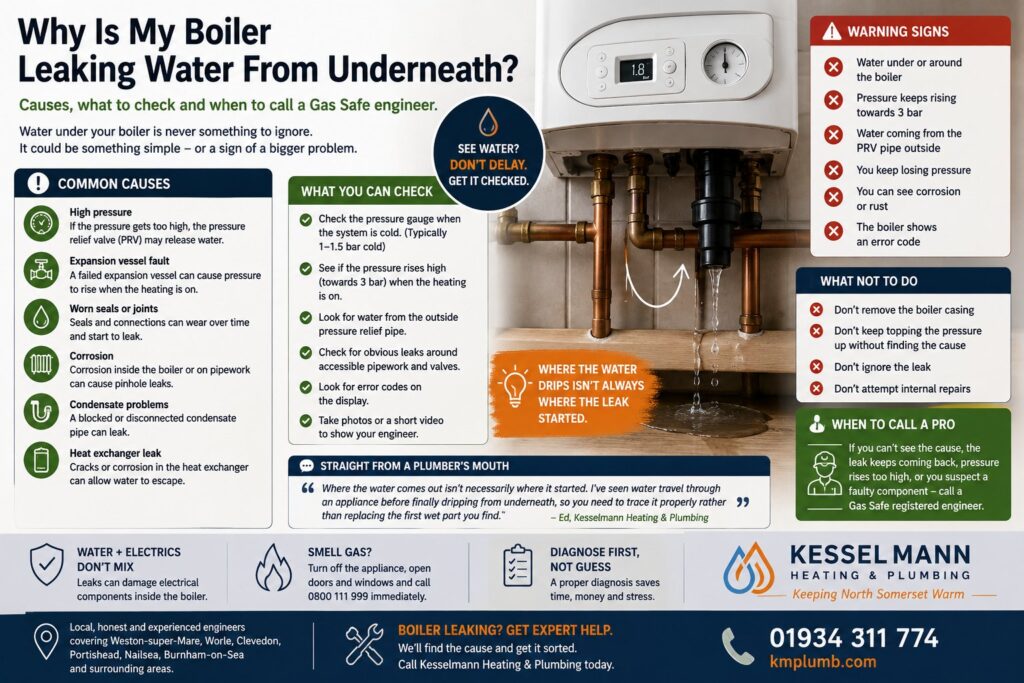
A boiler leaking water from underneath needs investigating. Common causes include excessive system pressure, a faulty pressure relief valve, expansion vessel trouble, damaged seals, corrosion, loose connections, condensate faults and, less commonly, a leaking heat exchanger. Vaillant advises treating boiler leaks seriously because water can damage electrical components inside the appliance.
Key things to know
- Check the boiler pressure before doing anything else.
- Note whether the leak happens constantly or only when the heating runs.
- Do not remove the boiler casing.
- A pressure relief valve leaking outside might point towards another fault rather than the valve itself.
- If water keeps appearing, get the cause diagnosed rather than continually repressurising the boiler.
Fun fact
Most sealed heating systems have a pressure relief valve designed to protect the system if pressure becomes excessive. Vaillant says the valve typically starts releasing water at around 3 bar.
So if your boiler gauge is heading towards 3 bar every time the heating comes on, the gauge is giving you useful information.
Do not ignore it.
First, is the boiler definitely leaking?
Modern condensing boilers deliberately produce water.
That water is called condensate.
Normally, condensate travels through plastic pipework into a suitable waste connection. Water flowing through the condensate pipe therefore does not automatically mean something has failed.
Water dripping onto your kitchen worktop, down the wall or from the bottom of the boiler is different.
Worcester Bosch identifies damaged or blocked condensate pipework as one possible source of unwanted water around a boiler.
The useful first question is:
Where exactly is the water appearing?
Why does water drip from the bottom when the leak might be higher up?
Water has an annoying habit of obeying gravity.
A joint might leak higher inside the boiler.
The water runs down internal components.
It collects at the bottom.
Then you see a drip underneath and quite reasonably assume the fault lives there.
Experienced heating engineers regularly work backwards from the highest visible sign of moisture rather than assuming the lowest drip marks the failed part.
That matters because several completely different faults produce the same puddle on the worktop.
Straight from a plumber’s mouth
One thing I have learnt with leaks is that where the water is, isn’t necessarily where it the leak is coming from. I’ve seen water travel from one side of an appliance to the other before leaking from underneath, so you need to trace it properly rather than replacing the first thing you touch
Is high boiler pressure causing the leak?
Possibly.
Look at the pressure gauge while the system is cold.
For many sealed systems, normal cold pressure sits around 1 to 1.5 bar, although your boiler manual gives the correct figure for your appliance.
Now watch what happens when the heating gets hot.
A moderate rise is normal.
A pressure gauge racing towards 3 bar deserves investigation.
Vaillant explains that excessive pressure might cause the pressure relief valve to release water. Causes behind excessive pressure include an expansion vessel problem or a filling loop allowing too much water into the system.
So the dripping valve might be doing exactly what it was designed to do.
The interesting question becomes:
Why is the pressure getting too high?
What does the expansion vessel have to do with a leaking boiler?
Quite a lot.
Water expands as it heats.
A sealed heating system needs somewhere to accommodate that change in volume.
The expansion vessel does that job.
If the vessel loses its charge or fails, pressure might rise sharply when the heating gets hot.
The pressure relief valve then opens to protect the system.
Water leaves.
The heating cools.
Pressure falls.
You top it back up.
Then the whole performance starts again.
This pattern comes up repeatedly in trade diagnostics because replacing a leaking pressure relief valve without checking why it opened risks fixing the messenger rather than the problem.
Straight from a plumber’s mouth
If a boiler’s losing pressure and the outside discharge pipe has started dripping, I don’t jump straight to blaming the pressure relief valve. First I want to see what the pressure’s actually doing from cold to hot. If it climbs sharply once the heating’s up to temperature, that points to the expansion side of the system, not the valve itself.
Could a seal or joint be leaking?
Yes.
A boiler contains plenty of joints, seals and connections.
Heating and cooling repeatedly puts those parts through expansion and contraction. Eventually seals wear and joints leak.
Vaillant identifies damaged seals as a recognised cause of water escaping from boilers. Worcester Bosch also lists worn joints and seals among common boiler leak causes.
A tiny drip from a seal might remain small for weeks.
Or it might decide Tuesday morning is the day to become considerably more enthusiastic.
That is why visible leakage deserves attention before the boiler cupboard develops its own ecosystem.
Could corrosion cause the leak?
Yes.
Corrosion might attack:
- Internal boiler components
- Heating pipes
- Connections
- Radiators
- Heat exchangers
Vaillant explains that corrosion weakens metal until small holes or cracks allow water to escape.
If you see green staining around copper, rusty marks, flaking metal or obvious corrosion around an accessible connection, photograph it for the engineer.
Do not start dismantling anything.
Could the heat exchanger be leaking?
Yes, although this is one of the faults where diagnosis becomes especially important.
The heat exchanger is one of the main components inside a boiler.
Vaillant lists a cracked or failed heat exchanger as a possible source of internal boiler leakage and notes that replacement can become expensive, particularly on older appliances.
That does not mean:
Water under boiler = new boiler.
Far too quick.
The engineer needs to establish the actual source, assess the appliance condition and then compare repair with replacement.
A £20 seal and a damaged main heat exchanger are both technically “boiler leaks”.
Financially, they are barely related.
What if the boiler was recently installed?
Tell the installer.
Vaillant specifically identifies incorrectly fitted pipework as one potential cause of leaks following installation and recommends contacting the original engineer where possible.
New equipment does not eliminate human beings from the installation process.
Connections still need making.
Joints still need testing.
If something has started dripping shortly after installation, give the installer the opportunity to inspect and correct it.
What does the pressure gauge tell you?
Quite a lot.
What you noticeWhat an engineer might investigatePressure slowly fallsHeating system or boiler leakPressure rises sharply when heatingExpansion vessel or expansion problemPressure reaches around 3 barPressure relief valve may dischargePressure falls after heating coolsWater may have left through the relief valvePressure stays normal despite leakDomestic water, condensate or another source may be involved
This table is diagnostic guidance, not a parts list.
Two boilers with identical gauge behaviour might still have different faults.
Why is water coming from the pipe outside?
Look outside behind the boiler.
You might find a small copper pipe terminating against the wall.
That is often the pressure relief discharge.
If water is dripping from there, Vaillant says the PRV might be releasing water because the system pressure became excessive. The valve itself might also fail to reseal correctly.
This is one of those faults where changing the valve without understanding why it opened might buy you a return visit.
Pressure behaviour matters.
So does the expansion vessel.
So does the filling loop.
Diagnose first.
Parts second.
Is a leaking boiler dangerous?
A small water leak does not automatically mean the boiler is about to become dangerous.
It still deserves prompt attention.
Water and electrical components make poor housemates.
Vaillant warns that leakage can cause electrical faults inside or around a boiler.
If significant water has reached electrical equipment, Electrical Safety First advises switching off the electricity at the consumer unit only where doing so is safe. Do not touch wet electrical equipment or a wet consumer unit.
If you smell gas, the situation changes completely.
HSE advises:
- Turn the appliance off.
- Open doors and windows.
- Shut off the gas at the meter if you know how and doing so is safe.
- Call the National Gas Emergency Service on 0800 111 999.
What you can safely check yourself
You do not need a screwdriver.
Useful information includes:
- Boiler pressure when cold
- Boiler pressure when hot
- Whether the pressure keeps dropping
- Whether the leak only appears when heating runs
- Whether hot water use triggers the leak
- Any fault code on the display
- Visible water around external pipework
- Whether the outside pressure relief pipe drips
- Obvious corrosion around accessible connections
Take photographs.
A short video of the leak is even better.
Leaks have an extraordinary ability to stop the moment an engineer arrives.
Work that needs a professional
Leave internal diagnosis and repair to a competent Gas Safe registered engineer.
That includes:
- Removing the functional boiler casing
- Replacing internal seals
- Working on the expansion vessel
- Replacing the pressure relief valve
- Repairing internal pumps or valves
- Investigating the heat exchanger
- Work involving combustion or gas components
HSE states that anyone carrying out gas work in domestic premises must be Gas Safe registered and competent for the work involved.
Common mistakes
Putting a bowl underneath and forgetting about it
A bowl is excellent at catching water.
Less good at repairing boilers.
Use it to control damage until somebody investigates the leak.
Repressurising the boiler every few days
We covered this in the pressure guide.
If water keeps leaving a sealed heating system, continually adding more water does not answer why.
Assuming the pressure relief valve itself is the entire problem
Sometimes the valve has failed.
Sometimes it opened because something else caused excessive pressure.
That distinction saves replacing perfectly innocent parts.
Assuming every boiler leak means replacement
No.
Get the diagnosis first.
Some leaks involve small components.
Others involve expensive parts or serious corrosion.
You need to know which one you have.
Taking the boiler casing off to “have a quick look”
You already have the useful information.
Water is coming out.
Leave the internal investigation to someone qualified.
What I would recommend
Switch the boiler off if it is actively leaking.
Contain the water.
Check the pressure gauge.
Photograph where the water appears.
Then note what happens when the boiler is cold, heating or providing hot water.
That information helps enormously.
Most importantly, get the source identified.
If the engineer says:
“Pressure relief valve.”
The next useful question is:
“Why was it letting water out?”
If they say:
“Expansion vessel.”
Fine. How was that confirmed?
Good fault finding should produce an explanation, not a lucky parts order.
Boiler leaking in Weston super Mare?
Kesselmann Heating & Plumbing provides boiler repair services across Weston super Mare, Worle, Clevedon, Portishead, Nailsea, Burnham on Sea and surrounding North Somerset.
Our current boiler repair service covers low pressure, pressure relief valve faults, leaking heat exchangers and other boiler failures.
If water is appearing underneath your boiler, we can diagnose where it is coming from and what needs doing next.
Kesselmann Boiler Repair in Weston super Mare
Need a Gas Safe engineer in Weston-super-Mare?
Frequently asked questions
Should I turn my boiler off if it is leaking?
If the boiler is actively leaking, switching it off using the normal controls is sensible while you arrange an engineer. Vaillant recommends switching off the heating and controlling the leak rather than attempting internal repairs yourself.
Why is my boiler leaking when the heating is on?
A leak which appears as the system heats might relate to rising pressure, expansion vessel trouble, the pressure relief valve, a pump seal or another component affected by heat and circulation. Watching the cold and hot pressure readings gives the engineer useful evidence.
Why is my boiler leaking and losing pressure?
Water leaving a sealed heating circuit reduces system pressure. The leak might sit inside the boiler, around radiator or heating pipework, or leave through the pressure relief valve. Vaillant lists visible and hidden leakage among the main reasons boilers lose pressure.
Why is my boiler leaking clear water?
Yes, water flowing away through the correctly installed condensate drain is part of normal condensing boiler operation. Water escaping from a damaged, blocked or disconnected condensate fitting is a fault. Worcester Bosch lists condensate pipe problems as one possible source of unwanted leakage.
Does a leaking boiler mean I need a new one?
No. Worn seals, valves, connections and other replaceable components all cause leaks. A badly corroded boiler or failed heat exchanger might make replacement more sensible, but diagnosis needs to come first.