Why Is My Boiler Making a Loud or Vibrating Noise?
TLDR
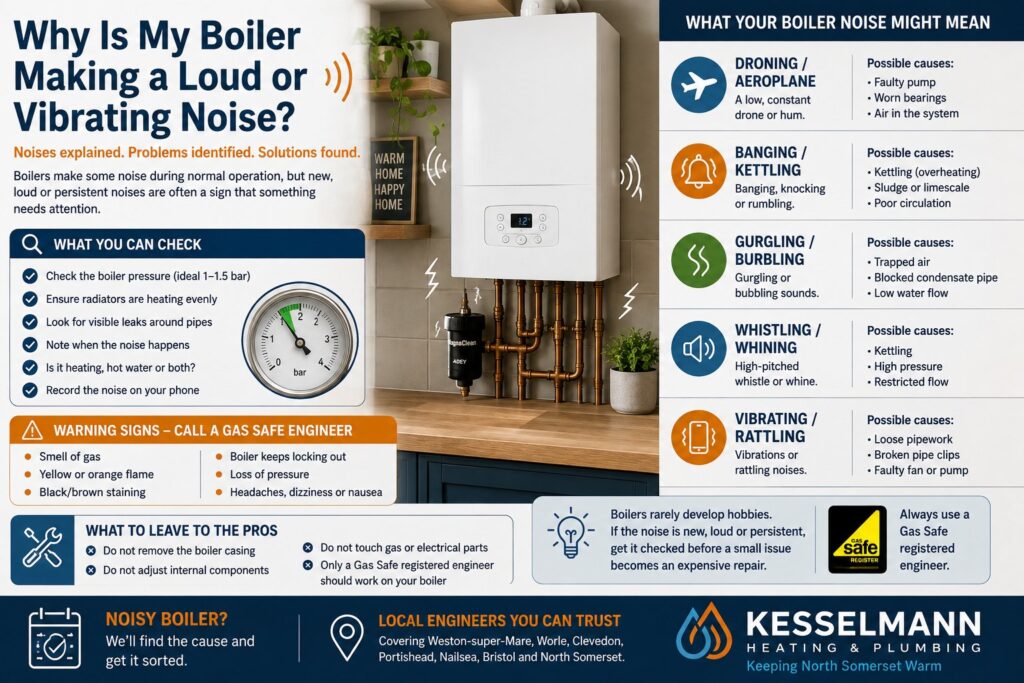
A loud or vibrating boiler often points towards a pump, fan, loose pipework, trapped air, poor circulation, sludge, limescale or another internal fault. Some noise during normal operation is expected. A new, louder or persistent noise deserves attention, especially if heating performance, pressure or reliability has changed.
Spoiler
The noise itself rarely tells you exactly which part has failed.
What the boiler sounds like, when the noise happens and what else has changed gives the engineer the useful information.
The short answer
A vibrating or unusually loud boiler often has a circulation, pump, fan, pipework or system water problem. Banging and whistling often point towards kettling or restricted flow. Gurgling often relates to trapped air or condensate problems. A drone or aeroplane type noise often leads an engineer towards the pump. Persistent humming or vibration deserves inspection rather than repeated resets and hope.
What you need to know
- A quiet hum or brief startup noise is normal on many boilers.
- A sudden change in volume matters more than a boiler which has always sounded the same.
- Vibration often relates to pumps, pipework, brackets or moving components.
- Banging or whistling often points towards poor circulation, sludge or kettling.
- Do not remove the boiler casing to investigate the noise yourself.
Fun fact
British Gas analysed UK searches around boiler noises and found “vibrating boiler” searches running at around 2,740 per month in its 2024 data.
So if your boiler suddenly sounds like an electric toothbrush trapped inside a kitchen cupboard, you are in fairly substantial company.
What boiler noises are normal?
A boiler has moving parts.
The fan starts.
The pump circulates water.
The burner fires.
Water moves through the heat exchanger.
A quiet hum, soft whirr or brief ignition sound is therefore normal on many appliances. Vaillant specifically describes a quiet whirring noise during ignition and circulation as normal boiler operation.
What deserves attention is change.
Your boiler used to sit quietly in the cupboard.
Now the kitchen worktop vibrates every time the heating starts.
That is useful information.
Why is my boiler vibrating?
Several faults produce vibration.
British Gas lists loose brackets and trapped air among possible causes. Vaillant also identifies pipe movement, broken pipe clips and components touching surrounding surfaces as sources of vibration around heating systems.
Possible causes include:
- A worn or faulty pump
- Fan problems
- Loose boiler mounting or nearby brackets
- Pipework moving as the system heats
- Pipe clips which have failed
- Air trapped in the heating system
- Excessive water velocity
- Internal components beginning to wear
The important distinction is where the vibration comes from.
If the boiler casing appears to shake, that points one way.
If the boiler stays still but the floorboards buzz upstairs, pipe movement becomes more likely.
Why does my boiler sound like an aeroplane?
This description comes up surprisingly often.
Vaillant says a drone or aeroplane style noise often points towards a faulty pump. British Gas gives the same general diagnosis.
A pump moves heated water through the boiler and heating system.
As bearings wear or the pump struggles, noise rises.
That work needs an engineer because accessing and replacing boiler components means working inside the appliance.
Do not take the front off and go looking.
Why is my boiler humming?
A quiet hum is often normal.
A new loud hum is different.
Vaillant identifies several possible causes, including high mains pressure affecting valves, a pump moving water too quickly and worn fan bearings.
That gives us an important point.
“Humming” is a symptom.
It is not a diagnosis.
Two boilers making a similar noise might need completely different repairs.
Why is my boiler banging?
Banging deserves more attention.
British Gas lists several possible causes:
- Heat exchanger problems
- Sludge
- Thermostat faults
- Overheating
- Poor circulation
Vaillant links banging and whistling with boiler kettling.
Kettling happens when water inside the boiler gets too hot because flow through the heat exchanger has become restricted. Steam forms and the appliance starts producing the sort of noises you would rather hear from a kettle than something connected to your gas supply.
What is boiler kettling?
Kettling describes localised boiling inside the boiler.
Common causes include restricted water flow from:
- Limescale
- Sludge
- Pump problems
- Component faults
Vaillant explains that reduced flow through the heat exchanger lets water become hotter than intended, producing steam, whistling and sometimes banging.
A boiler engineer needs to diagnose why the flow has reduced.
The answer might involve cleaning.
It might involve repairing a pump.
It might involve replacing another component.
Do not jump straight to “new boiler”.
Noise alone does not prove the appliance is finished.
What does sludge have to do with boiler noise?
Quite a lot.
Heating sludge forms as the metals inside your radiators and pipework corrode.
Baxi lists gurgling, kettling and noisy operation among signs of contaminated heating water. Sludge also causes cold radiator areas, poor circulation and pump problems.
British Gas also lists strange boiler noises among signs a heating system might need cleaning.
This is why replacing a noisy boiler component without looking at the heating water sometimes misses half the problem.
Fit a lovely new pump into filthy water and you have given the sludge something new to attack.
Why is my boiler gurgling?
Gurgling often points towards air or condensate.
Vaillant links gurgling with trapped air moving through the heating system. Worcester Bosch says a blocked condensate pipe also produces gurgling, especially when the boiler tries to start.
Cold weather matters here.
A frozen condensate pipe might also produce gurgling or banging before the boiler locks out. Baxi and Vaillant both identify these symptoms around frozen condensate problems.
So listen to what happens alongside the noise.
Gurgling plus a boiler refusing to fire during freezing weather tells a different story from gurgling radiators in October.
Could the noise come from the pipes rather than the boiler?
Yes.
Copper pipe expands as it heats.
Small clicks and creaks happen naturally.
Long lasting knocking, vibration or banging often means pipework is rubbing against floors, walls or other surfaces, or a pipe clip has failed. Vaillant identifies all of these as recognised causes of heating pipe noise.
This is another reason diagnosis matters.
You do not want somebody replacing a £300 boiler component because a copper pipe is tapping a floorboard upstairs.
Is a noisy boiler dangerous?
Usually, unusual boiler noise does not mean immediate danger.
Vaillant and British Gas both explain that modern boilers contain safety systems designed to shut the appliance down when faults reach unsafe conditions. Both still recommend professional inspection when the noise becomes strange, loud or persistent.
Safety changes immediately if you also notice:
- A gas smell
- Black or brown staining around the appliance
- A yellow or orange flame on an appliance where the flame should be blue
- Unusual condensation
- Carbon monoxide alarm activation
- Headaches, dizziness or nausea
HSE advises switching off an appliance suspected of being unsafe and leaving it alone until checked by a Gas Safe registered engineer. If you suspect a gas leak or carbon monoxide issue, call the National Gas Emergency Service on 0800 111 999.
What should you check yourself?
Keep homeowner checks outside the boiler.
Look at:
- Whether the noise happens during heating, hot water or both
- Boiler pressure
- Any error code on the display
- Whether radiators heat evenly
- Visible leaks around accessible pipework
- Whether the noise started after radiators were bled
- Whether the weather is freezing and the condensate runs outside
- Whether the noise comes from the boiler or nearby pipes
British Gas also recommends recording unusual noises on your phone. That gives an engineer something useful if the boiler behaves perfectly the second somebody arrives with a tool bag.
What should you leave alone?
Do not remove an integral boiler casing.
Do not adjust internal pumps.
Do not touch gas valves.
Do not dismantle the fan.
Do not bypass safety controls.
Gas Safe Register explains that many modern boiler casings form part of the combustion circuit. Where screws need undoing to remove the functional casing, the work belongs with a Gas Safe registered engineer.
Common mistakes
Ignoring a new noise for six months
Boilers rarely develop hobbies.
If it suddenly starts banging, humming or vibrating, something has changed.
Assuming every noise means replacement
A pump fault does not automatically mean new boiler.
Neither does trapped air.
Neither does loose pipework.
Find the fault first.
Resetting the boiler every day
A reset gets the appliance running again after certain faults.
Repeated resets are not maintenance.
You have simply trained yourself to participate in the breakdown.
Replacing components without checking system condition
Dirty heating water often sits behind circulation problems and premature component failure.
The boiler and the heating system belong to the same job.
Taking the casing off because YouTube looked confident
No.
Gas Safe Register guidance is clear about functional appliance casings. Leave internal gas appliance work to somebody qualified for it.
What I would recommend
First, describe the noise properly.
Buzzing.
Banging.
Rumbling.
Vibrating.
Whistling.
Drone.
Then note when the sound happens.
Heating starts?
Hot tap opens?
Boiler shuts down?
Every few minutes?
Next, check the display, pressure and radiators.
Record the noise on your phone.
Then get the boiler inspected if the sound is new, persistent or loud.
The engineer should diagnose the cause before talking about expensive parts or replacement.
A noisy boiler might need a pump.
It might need the heating system cleaned.
It might need pipework securing.
It might need something completely different.
Diagnosis first.
Parts cannon afterwards is an expensive way to repair heating systems.
Boiler making a strange noise in Weston super Mare?
Kesselmann Heating & Plumbing provides boiler repairs across Weston super Mare, Worle, Clevedon, Portishead, Nailsea, Burnham on Sea, Bristol and surrounding North Somerset. The current Kesselmann repair page specifically lists kettling, banging, gurgling, pump failures, circulation faults, fan problems and blocked condensate pipes among faults covered by its boiler repair service.
Book a boiler repair with Kesselmann Heating & Plumbing
Need a Gas Safe engineer in Weston-super-Mare?
Frequently asked questions
Why does my boiler vibrate when the heating starts?
Pump operation, pipe movement, loose brackets, trapped air or another moving component might produce vibration. If the vibration is new or strong enough to shake the boiler or surrounding cupboard, arrange an inspection.
Why is my boiler suddenly louder than normal?
A sudden change often points towards wear, poor circulation, trapped air, contamination, pump trouble or fan trouble. British Gas recommends getting an unusually loud new noise checked rather than assuming the sound is normal.
Why does my boiler bang when I turn the hot water on?
Possible causes include kettling, restricted circulation, sludge, heat exchanger problems or overheating. A Gas Safe engineer needs to identify the cause before deciding on the repair.
Why does my boiler sound like a kettle?
Whistling or rumbling often gets called kettling. Restricted flow through the heat exchanger lets water overheat and form steam. Limescale, sludge and circulation faults sit among recognised causes.
Why does my boiler gurgle?
Trapped air is one common cause. A blocked or frozen condensate pipe also produces gurgling, especially where the boiler struggles to start or repeatedly locks out.