TLDR
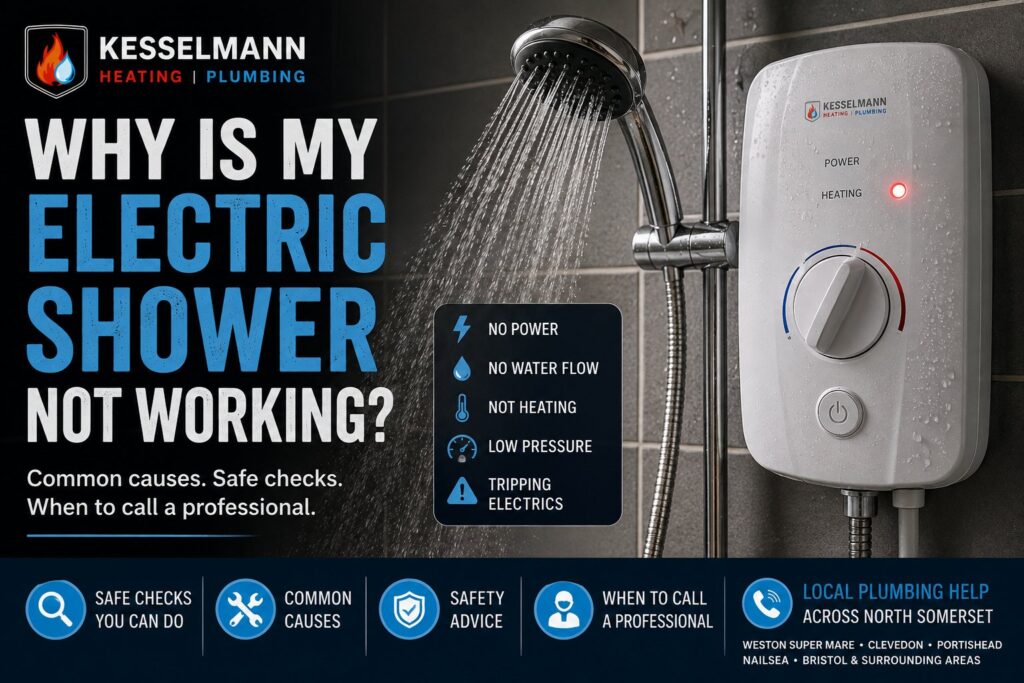
An electric shower can stop working because of a power problem, low water flow, a blocked filter, a failed heating element, a faulty solenoid or another internal electrical fault. Check the obvious external things first. If it is tripping, leaking internally or needs opening up, stop using it and get the right professional involved.
Spoiler
The useful bit is working out what has stopped.
No water?
Cold water only?
Power keeps tripping?
Those are three different faults, and randomly replacing the shower is an expensive way of playing Guess Who.
The short answer
If your electric shower is not working, first check that the water supply is on, the shower isolator is switched on, the circuit has not tripped and the showerhead or hose is not badly blocked. Triton also recommends checking for low water pressure and blocked inlet filters when flow is poor. If the unit has power but will not heat, repeatedly trips the electrics or is leaking internally, it needs professional diagnosis.
Key takeaways
- No water can mean no supply, no power, low pressure, blockage or an internal valve fault.
- Cold water only can point towards a heating element or electrical fault.
- Poor flow may be caused by low mains pressure, a blocked showerhead or inlet filter.
- Tripping electrics is not something to keep resetting and hoping for the best.
- Internal electrical work on an electric shower should be left to someone competent.
Fun fact
An electric shower is basically a small, very powerful instantaneous water heater. It heats cold mains water as you use it, rather than taking hot water from your boiler or cylinder.
That is why your boiler can be completely off and the electric shower can still work perfectly well.
Assuming the shower itself is behaving.
What exactly has your electric shower stopped doing?
This is the first question worth answering.
Because “my shower doesn’t work” can mean several things.
What the shower is doingPossible causeCompletely deadElectrical supply, isolator, circuit or internal electrical faultPower on but no waterWater supply, blocked inlet, solenoid or internal faultWater runs but stays coldHeating element or electrical faultWater is only lukewarmFlow too high, seasonal setting or failed heating elementFlow is very weakLow mains pressure, partially closed isolation, blockageKeeps going hot and coldRestricted flow, pressure changes or overheating protectionTrips the electricsShower, wiring or heater faultWater leaks from inside the unitInternal failure requiring attention
That already narrows things down considerably.
Why is there no water coming from my electric shower?
Start with the painfully obvious things.
Because occasionally the painfully obvious thing is exactly what’s wrong.
Triton’s electric shower troubleshooting guidance recommends checking:
- Is the water supply turned on?
- Is the electricity turned on?
- Is the inlet filter blocked?
- Are relevant internal connections correctly fitted?
The last two are not really homeowner jobs if opening the unit is required.
You can safely check whether other cold taps in the house are working normally.
If the whole property has very low pressure, the shower may not have enough flow to operate correctly.
WaterSafe explains that mains pressure varies with demand, location and property height, and that pressure may be lower at busy times of day.
Check the showerhead first
A badly scaled showerhead can restrict flow.
Unscrew it where the manufacturer’s instructions allow and inspect it.
If the shower suddenly behaves normally without the head attached, congratulations.
You may have diagnosed one of the cheapest possible shower faults.
Limescale has once again attempted to become part of the plumbing system.
Why does my shower have power but no hot water?
This is different.
If cold water runs normally but refuses to get hot, the water supply is clearly reaching the shower.
Now we’re looking more towards the heating side.
Triton says that where an electric shower is not heating properly after an electrical reset, a failed heating element is a likely possibility. The heater assembly and related electrical circuits then need proper testing.
Other possibilities can include:
- Heating element failure
- Internal thermal protection operating
- Electrical control fault
- Faulty PCB on certain models
- Poor electrical supply
- Internal wiring problem
This is the point where the screwdriver should stay in the toolbox.
There are live electrical components inside an appliance deliberately installed in a shower.
That combination deserves slightly more respect than:
“I’ll just whip the cover off and have a look.”
Why is my electric shower only lukewarm?
An electric shower has a limited amount of heating power.
The faster water flows through it, the less time there is to heat that water.
That is why electric showers often produce less flow in winter.
The incoming mains water is colder, so the shower needs to slow the water down to reach the same outlet temperature.
Triton advises checking the temperature control, power setting and water flow if the shower is not getting hot enough.
But if the shower used to perform normally and suddenly becomes lukewarm, a heating element may also have failed.
A 9.5kW shower with part of its heating capacity missing does not quietly upgrade itself into a 5kW model.
It just gives you a disappointing shower.
Why is my shower pressure suddenly poor?
First, technically, what most people call “poor pressure” at the shower is often poor flow.
Still annoying.
Slightly different thing.
Triton recommends checking whether:
- Isolation valves are fully open
- The inlet filter is blocked
- Minimum required pressure and flow are available at the shower inlet
WaterSafe says the mains supply standard is normally at least 1 bar at the boundary, although the actual flow available inside your house depends on the plumbing and demand.
Possible reasons for suddenly poor shower flow include:
- Scaled showerhead
- Kinked or restricted hose
- Partially closed isolation valve
- Blocked inlet filter
- Reduced mains supply
- Another appliance using lots of water
- Internal shower fault
If several taps have suddenly gone weak as well, look beyond the shower.
If only the shower has changed, the fault is more likely local to it.
Why does my electric shower keep tripping?
This one deserves proper attention.
Triton’s technical guidance says the point at which the circuit trips can provide clues. Tripping while heating may indicate a heater assembly problem, while other patterns may suggest a wiring or electrical supply fault. Either way, it recommends professional diagnosis.
Electrical Safety First also advises not to ignore:
- Circuit breakers tripping
- Burning smells
- Buzzing or crackling
- Overheating
- Signs of arcing
Do not stand there resetting the circuit every thirty seconds.
A circuit breaker is a safety device.
When it keeps switching something off, the correct response is not:
“Well, let’s see who gets bored first.”
Stop using the shower.
Get it checked.
Could the pull cord or isolator be the problem?
Yes.
Electric showers normally have a dedicated electrical circuit and local means of isolation.
If the ceiling pull switch or wall isolator has failed, the shower may appear completely dead.
Possible warning signs include:
- Switch feels unusually hot
- Burning smell
- Crackling
- Discolouration
- Switch becomes intermittent
- Shower works only when the switch is moved
Electrical Safety First says burn marks, arcing noises and electrical equipment becoming hot should not be ignored.
Do not dismantle a shower isolator yourself unless you are competent to work safely on that electrical installation.
Why does my shower keep going hot and cold?
A shower that cycles between hot and cold can be reacting to restricted water flow.
If the water moving through the shower becomes too slow, the water can become too hot.
The shower’s protective controls may then reduce or stop heating.
Water cools.
Heating returns.
Repeat.
Possible causes include:
- Scaled showerhead
- Blocked inlet filter
- Low incoming flow
- Shower hose restriction
- Water supply changes
- Internal flow control problems
This is why cleaning the showerhead is a sensible first check.
It is less sensible to immediately buy a new shower because someone on Facebook confidently typed “PCB mate”.
What if the electric shower is leaking?
First establish where it is leaking.
Water from the showerhead after use is different from water coming out of the shower casing.
Triton advises stopping use where water is leaking internally from the unit rather than through the normal pressure relief arrangement.
Water leaking from inside an electrical appliance attached to the wall in a wet room deserves attention.
Do not keep using it because:
“It’s only a little drip.”
Water is famously patient.
Electricity less so.
What can I safely check myself?
Safe homeowner checks
You can usually check:
- Whether the shower isolator is switched on
- Whether the consumer unit shows a tripped circuit
- Whether other cold taps have normal flow
- Whether the showerhead is badly scaled
- Whether the hose is kinked
- Whether the shower is displaying a fault light or code
- Whether the problem is no water, no heat or both
- Whether the fault happens every time
- Whether anything changed immediately before the fault appeared
Take a photograph of any lights or fault indicators.
That can be genuinely useful.
Work that needs a professional
Do not:
- Remove the shower casing
- Test live electrical components
- Replace heating elements yourself unless appropriately competent
- Bypass thermal protection
- Alter the shower electrical circuit
- Install a higher powered shower on the existing cable without assessment
- Work on electrical equipment while wet
- Ignore repeated circuit tripping
Bathrooms are a higher risk electrical environment because wet skin lowers the body’s resistance to electricity. Electrical Safety First specifically highlights the increased shock risk in bathrooms.
Who do I actually call: a plumber or an electrician?
This confuses people because an electric shower is annoyingly greedy.
It wants both trades.
A plumber deals with things like:
- Water supply
- Isolation valves
- Flow problems
- Pipework
- Leaks
- Replacement plumbing connections
An electrician deals with:
- Electrical supply
- Consumer unit
- Shower circuit
- RCD or RCBO issues
- Isolator switches
- Cable sizing
- Electrical testing
A shower repair engineer may be able to diagnose faults inside the appliance itself depending on the manufacturer and repair arrangement.
If the problem is clearly electrical, get an electrician.
If the problem is clearly water supply or plumbing related, get a plumber.
If you don’t know, explain exactly what the shower is doing.
A decent trade should tell you whether they’re the right person rather than arriving and performing an expensive shrug.
Can I simply replace the shower with a more powerful one?
Not automatically.
An electric shower is a large electrical load.
A higher rated shower can require:
- Larger cable
- Different protective device
- Suitable RCD protection
- Confirmation that the existing electrical installation is adequate
Electrical Safety First says an electric shower should have its own circuit. It also notes that bathroom circuits are subject to special electrical safety requirements.
GOV.UK confirms that electrical alterations around baths and showers can fall under Building Regulations requirements.
So replacing an 8.5kW shower with a 10.8kW unit because “more kilowatts means better” without checking the electrical installation first is not an upgrade.
It’s a maths experiment attached to your bathroom wall.
Common mistakes
Assuming the boiler controls the electric shower
Usually it doesn’t.
An electric shower normally takes cold mains water and heats it internally.
Your boiler can be broken and the electric shower may still work.
Your electric shower can be broken while the boiler is completely fine.
They are separate problems.
Repeatedly resetting a tripping shower
If it repeatedly trips, stop using it and get the electrical fault diagnosed.
Buying a new shower before checking the supply
No flow could simply be a supply or filter issue.
Cold water could be a heater fault.
Completely dead could be electrical.
Diagnose first.
Purchase shiny new white box second.
Turning the temperature fully up when the flow is poor
On many electric showers, temperature is controlled partly by changing the flow.
Cranking it up does not repair a blockage.
Removing the casing because “it’s only a shower”
It is a high power electrical appliance full of water.
That sentence should be enough.
What I would recommend
Start by identifying the exact symptom.
Dead completely?
Check external power and controls.
Water but no heat?
Likely heating or electrical fault.
Low flow?
Check the showerhead, hose, supply and whether other taps are affected.
Tripping electricity?
Stop using it.
Water leaking from the casing?
Stop using it.
The big thing is not to muddle plumbing faults and electrical faults together.
Electric showers sit right in the middle of both.
Which is convenient when they work.
Slightly irritating when they don’t.
Need help with an electric shower problem?
Kesselmann Heating & Plumbing provides plumbing repairs and bathroom work across Weston super Mare, Clevedon, Portishead, Nailsea, Bristol and surrounding areas of North Somerset. The current Kesselmann website lists plumbing repairs and bathroom installation among its services.
For water supply problems, leaks or replacement plumbing work, get in touch and explain exactly what the shower is doing.
For electrical faults, alterations or circuit problems, the electrical side should be checked by a suitably competent electrician.
Plumbing Repairs → www.kmplumb.com
Need a Gas Safe engineer in Weston-super-Mare?
Frequently asked questions
Why has my electric shower suddenly stopped working?
Common causes include loss of electrical supply, a tripped circuit, low water flow, a blocked inlet, a faulty solenoid or an internal electrical fault. Start by checking the external supply and controls rather than opening the shower.
Why does my electric shower run cold?
If the water flows normally but remains cold, the heating side may have failed. Triton identifies failed heating elements as one possible cause when a shower no longer heats properly.
Why is my electric shower pressure low?
Possible causes include low mains flow, a blocked showerhead, a blocked inlet filter or a partially closed isolation valve. Triton recommends checking the available pressure and flow when a shower indicates low pressure.
Why does my shower keep tripping the fuse box?
Repeated tripping can indicate an electrical fault within the shower, heater assembly, wiring or supply circuit. Stop repeatedly resetting it and arrange electrical diagnosis.
Can an electrician replace an electric shower?
Yes, where they are competent to carry out the electrical work and plumbing requirements are suitably dealt with. Electrical alterations around showers must comply with the relevant electrical and Building Regulations requirements.