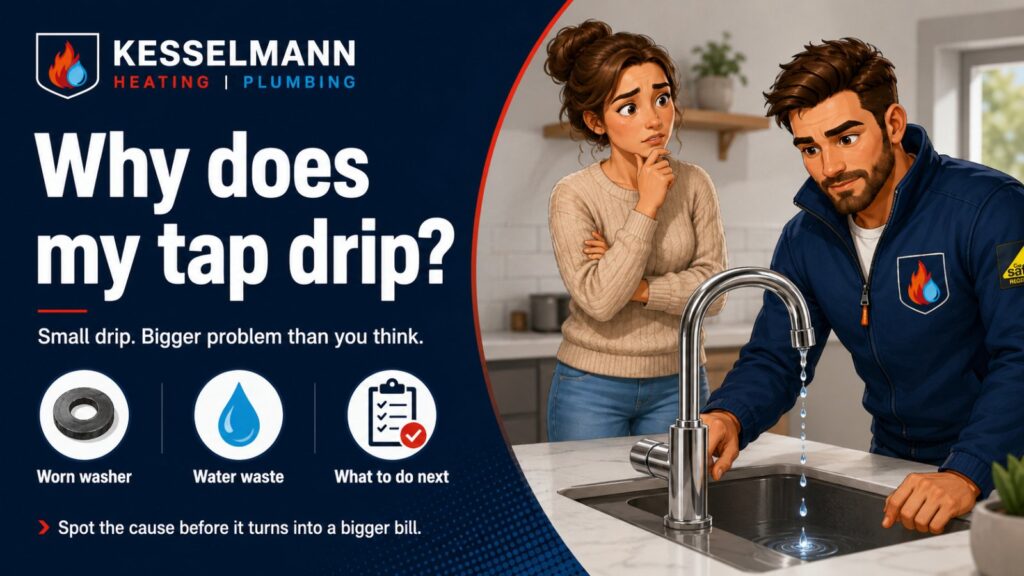
Why Is My Tap Dripping?
We know the sound. You know the sound. Your whole house knows the sound.
Drip. Drip. Drip. At 2am it sounds like a leaking tap is training for the Olympics. During the day you can almost tune it out — almost — right up until you’re trying to concentrate on something and every fibre of your being wants to march into the kitchen and have a stern word with the sink.
Good news: a dripping tap is one of the least dramatic plumbing problems there is. It’s rarely an emergency. It’s very often fixable. And once you know what’s actually going on inside the tap, it stops feeling like a mystery and starts feeling like a five-minute job with a spanner.
The quick answer
Most dripping taps are caused by a worn or perished washer, a tired ceramic cartridge, or a damaged O-ring — small parts inside the tap that are designed to wear out and get replaced. Limescale is usually the accomplice, especially round here where the water is hard. If replacing the washer or cartridge doesn’t stop the drip, the culprit is often the valve seat, and that’s a job for a plumber rather than a trip to the hardware shop.
What’s actually going on inside your tap
Every tap, however smart it looks on the outside, is basically a small gate that opens and closes a channel of water using a rubber, ceramic or metal seal. Turn the tap off, and that seal is meant to sit flush and stop every last drop. When it doesn’t sit flush anymore, water finds its way through, and you get a drip.
There are three main types of internal mechanism, and knowing which one you’ve got saves a lot of guessing.
Traditional rubber washer taps. Usually older taps with a separate hot and cold handle. Inside is a rubber washer that presses down onto a metal valve seat. Washers harden, crack and wear flat with age and use, and once they lose their shape they stop sealing properly, according to guidance from the WaterSafe approved plumbers register.
Ceramic disc taps. Common in mixer taps and modern bathroom fittings. Two ceramic discs slide across each other to control flow. They’re built to be more reliable than washer taps, so when one starts dripping it’s usually down to a worn disc, a perished seal, or — very commonly in this part of the world — limescale getting between the discs and stopping them sealing flat.
Cartridge taps. Single-lever mixer taps that control hot, cold and flow with one lever usually run on a cartridge. If the cartridge wears out or gets clogged with debris or limescale, the tap can drip or feel stiff and gritty to turn, as Checkatrade’s plumbing guidance explains.
Whichever type you’ve got, the underlying story is the same: a small part designed to wear out has finally worn out.
Why hard water makes it worse round here
If you’re in Clevedon, Portishead, Nailsea, Weston-super-Mare or anywhere else served by Wessex Water, you’re living with hard water. Bristol’s average is around 238 parts per million, and the wider Wessex Water area averages around 231 ppm — both comfortably into “hard” territory by World Health Organisation standards, according to independent water hardness data. That’s the local geology at work: water trickling through Jurassic limestone and chalk picks up calcium and magnesium along the way.
That mineral content is exactly what forms limescale, and limescale is one of the most common reasons a tap starts dripping in this area. It builds up on washers, clogs the fine tolerances inside ceramic discs, and stops cartridges seating properly. It’s not that taps round here are made worse — it’s that the water gives them more to fight against.
Common causes at a glance
CauseWhat’s happeningFixable by most homeowners?Worn or hardened rubber washerThe rubber seal has flattened, cracked or perished with ageUsually yesLimescale build-upMineral deposits stop the washer, cartridge or ceramic disc sealing flatOften yes, with cleaning or a replacement partWorn ceramic disc or cartridgeInternal parts have worn down and no longer sealSometimes — depends on tap designDamaged O-ringThe rubber ring sealing the spout or handle has perishedUsually yesDamaged valve seatThe metal seating the washer presses onto has become pitted or scoredNo — needs a plumberRising mains pressure (rare)Usually linked to a failing expansion vessel on the heating system, not the tap itselfNo — needs a Gas Safe registered engineer
Simple definitions
Washer — a small rubber disc that presses onto the valve seat to stop water flow. The classic wear-and-tear part in older taps.
Cartridge — a sealed unit inside single-lever mixer taps that controls both temperature and flow. Cheaper to replace as a whole unit than to repair.
Valve seat — the metal surface the washer presses against. If this gets scratched or pitted, a new washer won’t stop the drip because it’s no longer meeting a flat surface.
O-ring — a small rubber ring that seals joints within the tap body, often where the spout swivels.
WRAS approved — means a part has been independently tested against the Water Supply (Water Fittings) Regulations 1999 and is confirmed suitable for use on the UK mains water supply. It isn’t a legal requirement in itself, but using WRAS-approved parts is the easiest way to stay on the right side of the regulations, which are.
Your homeowner checklist
Before you touch a spanner:
- Confirm which tap is dripping and whether it’s the hot side, cold side, or the spout itself
- Locate the isolation valve under the sink (or the main stopcock if there isn’t one)
- Turn off the water supply and test the tap to make sure it’s actually off
- Put the plug in and lay a towel in the sink — small parts vanish down plugholes with alarming speed
- Take a photo of the tap before you start, so you remember how it goes back together
- Remove the handle and inspect the washer, cartridge or ceramic disc for wear, cracking or limescale
- Take the old part with you to the shop so you buy the right size — washers alone range from about 9mm to 40mm, and there’s no universal fit
- Clean limescale from parts with a proprietary descaler or white vinegar before deciding whether to replace them
- Reassemble without overtightening, then turn the water back on and check for drips
Common mistakes people make
Overtightening the tap “just to be sure.” This is the one we’d bet money on. Cranking the handle down harder doesn’t create a better seal — it just accelerates wear on the washer or cartridge and can eventually damage the valve seat, according to Checkatrade’s plumbing advice. A tap should close with a firm, gentle turn. If you’re leaning on it like you’re trying to shut off a fire hydrant, something’s already wrong.
Buying a washer that “looks about right.” Washers come in a wide range of sizes. Guess wrong and you’ll be back at the shop, or worse, back to a drip within a week.
Assuming a new washer will fix everything. Sometimes it does. Sometimes the drip carries on, and that’s usually because the valve seat underneath has become pitted or scored. No amount of fresh rubber fixes a valve seat that’s had it.
Ignoring it because “it’s only a drip.” A slow drip today is a bigger bill tomorrow, and sometimes a damaged worktop or cabinet under the sink the week after that.
Forgetting the isolation valve exists. Plenty of people head straight for the mains stopcock, sometimes in the depths of an airing cupboard they haven’t opened since they moved in. Most taps have their own isolation valve underneath, which is quicker and doesn’t cut off water to the whole house.
Safety warnings
Water and electricity do not mix. If the tap in question is anywhere near electrical sockets, an immersion heater, or any exposed wiring, switch off the relevant circuit at the consumer unit before you start, or leave the job to a professional.
If you own an unvented hot water cylinder or a combi boiler and you notice dripping from a pressure relief valve or a pipe outside the property (rather than from a tap), do not treat this the same as a simple tap drip. That’s usually a sign of a failing expansion vessel or rising system pressure, and it needs a Gas Safe registered engineer, not a washer. Mixing the two up is a genuinely common misunderstanding — a dripping kitchen tap and a dripping pressure relief pipe outside look similar but come from completely different problems.
Never use excessive force on old or corroded fittings. Older taps, especially in properties with original 20th-century plumbing, can seize or shear. If a nut won’t move with reasonable effort, stop and call a plumber rather than risk snapping a pipe behind the wall.
If your home has a water softener, remember it’s usually plumbed to bypass the kitchen cold tap, which should be left hard for drinking and cooking. If you’re working on that particular tap, don’t assume the softener has anything to do with the fault.
What you can safely do yourself
- Turn off the isolation valve or stopcock before doing anything else
- Identify whether the drip is from the spout, the handle base, or underneath the tap
- Remove the tap head and inspect the washer, O-ring or cartridge for obvious wear or limescale
- Clean limescale from removable parts using a descaling solution
- Replace a worn washer, O-ring or cartridge with a correctly sized, ideally WRAS-approved, replacement part
- Turn the water back on gradually and check for leaks before walking away
When you should call a professional
- The drip continues after you’ve replaced the washer or cartridge — this usually points to a damaged valve seat
- You can’t get the tap apart without forcing it, or parts feel seized or corroded
- The tap won’t turn off fully and water keeps flowing after you’ve tried the obvious fixes
- You’re seeing dripping or pooling water that seems to be coming from behind or underneath the tap, rather than the spout itself
- The problem is affecting more than one tap or outlet at once
- You suspect a pressure relief valve or expansion vessel issue rather than a straightforward tap fault
- You’re simply not confident isolating the water supply, or the fitting looks old enough that you’re worried about breaking something expensive
There’s no shame in any of these. A tap that’s fought you to a standstill is not a character flaw. It’s a job for someone who does this every week.
Our recommendation
If a clean, correctly sized washer or cartridge hasn’t sorted it, don’t keep buying replacement parts on the off-chance. That’s usually money spent chasing a valve seat problem that a washer was never going to fix. A qualified plumber can identify the actual cause in minutes, fit WRAS-approved parts that meet the Water Supply (Water Fittings) Regulations, and make sure the repair lasts — rather than you doing this dance again in three months.
Need a Gas Safe engineer in Weston-super-Mare?
Frequently asked questions
Why does my tap keep dripping even after I've changed the washer?
This almost always means the valve seat — the metal surface the washer presses against — has become worn, pitted or scored. A new washer can't create a seal against a damaged surface. This needs either a professional reseating of the valve or a full tap replacement.
How much water does a dripping tap actually waste?
Estimates from WaterSafe put it at around 5,500 litres a year from a single dripping tap — enough to fill a paddling pool every week over summer. If it's the hot tap dripping, you're also paying to heat water that's going straight down the drain.
Is a dripping tap dangerous?
Not usually. It's a nuisance and a waste of money rather than a safety risk, in most cases. The exception is if the drip is actually coming from a pressure relief valve on your heating system rather than a tap — that's a different problem and needs prompt attention from a Gas Safe registered engineer.
Can I fix a dripping tap myself?
Often, yes. If it's a worn washer, O-ring or straightforward cartridge issue, most confident homeowners can manage it with basic tools, provided the water supply is isolated properly first. If the drip continues after that, it's time to call someone.
Why is my brand new tap already dripping?
This does happen, and it's usually either a manufacturing fault, a part that wasn't tightened correctly on installation, or debris from new pipework that's lodged in the cartridge. Worth checking with whoever fitted it, as it may be covered by warranty.