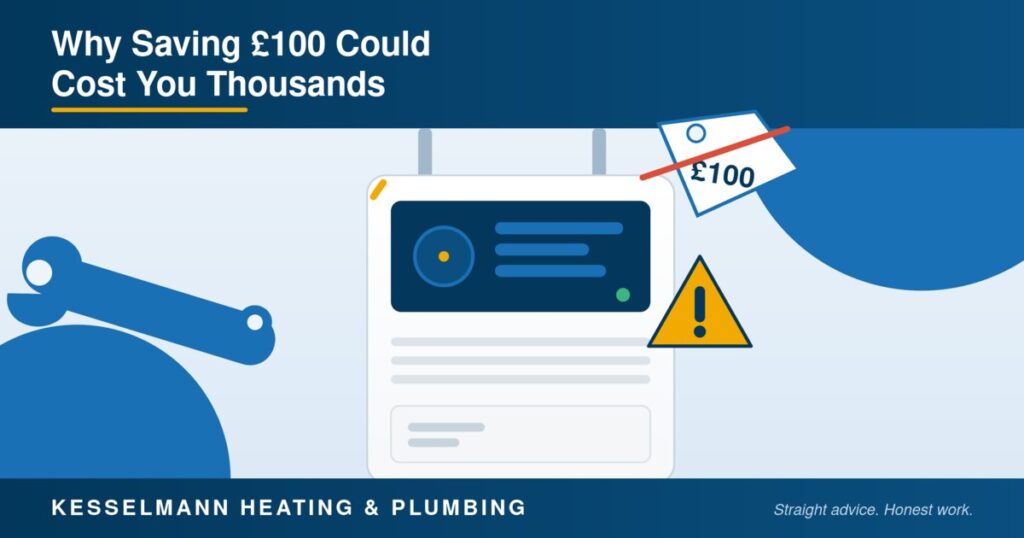
Why Saving £100 on a Boiler Installation Could Cost You Thousands
You’ve got three quotes on the kitchen table. Two are within a whisker of each other. The third is a few hundred pounds lower, and suddenly it’s the one you keep looking at. It’s not unreasonable — nobody wants to overpay for a boiler. But that gap in price is rarely just someone being generous with their margin. It usually means something has been left out, rushed, or done by someone who shouldn’t be doing it at all.This isn’t about scaring you into paying over the odds. It’s about knowing what you’re actually comparing when you line those quotes up, so the “saving” doesn’t turn into a much bigger bill eighteen months from now.
Quick answer
A cut-price boiler quote almost always means something has been removed from the job: a proper system flush, a magnetic filter, correct commissioning, Gas Safe registration, or the Building Regulations paperwork. Any one of those missing steps can void your warranty, invalidate your home insurance, or leave you with a boiler that fails early — and the cost of putting that right is nearly always more than the £100 or so you saved on the quote.
What that £100 “saving” is actually buying you
Every legitimate boiler installation includes a set of steps that cost the installer time and money: removing the old boiler and disposing of it properly, flushing the heating system to clear out old sludge, fitting a magnetic filter, running a proper heat loss calculation to size the new boiler correctly, commissioning it to the manufacturer’s instructions, completing the Benchmark checklist, and notifying your local authority through the Gas Safe Register so you get a Building Regulations Compliance Certificate.None of that is optional if the job is being done properly. So when one quote comes in noticeably lower, one of those things has usually been dropped, not discounted. According to guidance from CIPHE-recognised commissioning standards, failing to complete the Benchmark checklist and follow the manufacturer’s installation instructions is enough on its own to invalidate your boiler’s warranty, regardless of who fitted it.
The most commonly skipped steps
StepWhy it matters if it’s skippedSystem flush (power flush or chemical flush)Old sludge and debris left in the pipework wears out the new boiler’s heat exchanger, sometimes within monthsMagnetic filterWithout one, your boiler has far less protection from the debris that circulates through an older systemHeat loss calculationBuilding Regulations Part L has required a room-by-room heat loss calculation before a replacement boiler is fitted since June 2022 — skipping it risks an incorrectly sized boiler that short-cycles, wastes fuel and wears out fasterBenchmark commissioning checklistThis is the document that proves the boiler was installed and commissioned to the manufacturer’s instructions. No checklist, no warranty claimBuilding Regulations notificationA Gas Safe registered engineer self-certifies the work and notifies your local authority within 30 days, so you receive a compliance certificate. Without it, you may struggle to sell the house later, because your conveyancer will ask for itTime and temperature controlsSince 2018’s Boiler Plus standard, all new and replacement boilers need proper time and temperature controls fitted as a minimum
What “cheap” can actually mean in practice
Sometimes the cheaper quote is simply a smaller company with lower overheads passing on a genuine saving — that happens, and there’s nothing wrong with it. But sometimes “cheap” means one of the following, and this is where it gets serious rather than just mildly inconvenient.Unregistered gas work. It is illegal for anyone who isn’t Gas Safe registered to work on a gas boiler in Great Britain, full stop. Not “not recommended” — illegal. In October 2025, the Health and Safety Executive prosecuted a man in Cheshire for carrying out gas work at two properties without being registered, including issuing a fake Gas Safety Certificate with a false registration number. One of the jobs resulted in a gas leak. He was given a 12-month community order and ordered to pay costs. That’s not a rare, freak case — it’s exactly the kind of thing Gas Safe Register and HSE investigate regularly, and it’s precisely the risk you’re taking on if you don’t check who’s actually turning up at your door.Officially, HSE figures show around 7 deaths a year in Great Britain from carbon monoxide poisoning caused by gas appliances and flues that haven’t been properly installed, maintained, or ventilated. That’s a small number set against the millions of gas boilers in use, but it’s not a risk worth gambling on for the sake of a few hundred pounds.Voided warranties. Every boiler manufacturer in the UK requires installation by a Gas Safe registered engineer as a baseline condition of the warranty, and Which? confirms that the three most common reasons a warranty gets refused are: not using a Gas Safe engineer, not registering the warranty within 30 days of installation, and skipping the annual service afterwards. Get any one of those wrong and a manufacturer can — and will — turn down a claim that would otherwise have been covered.Insurance problems. Standard home insurance rarely covers boiler breakdowns unless you’ve specifically added heating cover, and even then, insurers can reject claims for damage caused by an illegally installed or poorly maintained boiler, such as water leaks or gas escapes. If the installer wasn’t Gas Safe registered, you may find you’re not covered at all.
Simple definitions, so the jargon doesn’t do the talking
Gas Safe Register — the official, legally required list of engineers and businesses allowed to work on gas appliances in Great Britain. If someone isn’t on it, they cannot legally touch your boiler.Benchmark checklist — a form completed by the installer at the back of the boiler’s instruction manual, confirming it was installed and commissioned correctly. It’s your proof for warranty claims.Building Regulations Compliance Certificate — the document confirming your new boiler meets current building regulations. A Gas Safe registered installer notifies your council automatically; you’ll want this when you come to sell.Heat loss calculation — a room-by-room calculation of how much heat your home actually loses, used to pick a boiler that’s the right size. Required under Part L of the Building Regulations before a replacement boiler is fitted.Magnetic filter — a small device fitted to the heating system that catches metal debris and sludge before it reaches the boiler, protecting the heat exchanger.
A note on cost
New boiler installations in the UK in 2026 typically range from around £1,800 to £3,500 for a standard like-for-like combi swap, with more complex jobs — moving the boiler, converting from a regular system to a combi, or replacing old pipework — pushing well beyond that, sometimes to £6,000 or more. Your actual price will depend on your property, access, the boiler you choose, and what your existing system needs. Treat any figures here as a general guide, not a quote — the only way to know what your job will cost is to have it properly assessed.What this means for comparing quotes: if one is dramatically lower than the others for what looks like the same job, ask exactly what’s included. A genuine difference in company overheads might explain £100 or £200. It rarely explains £600 or £700.
Your homeowner checklist before you sign anything
Ask to see the engineer’s Gas Safe ID card, and check the licence number yourself using the free “Check an Engineer” tool on gassaferegister.co.uk, or by calling 0800 408 5500Ask whether the quote includes a system flush, and which typeAsk whether a magnetic filter is included, and whether isolation valves are fitted either side of it (without them, servicing the filter means draining the whole system every time)Ask whether a heat loss calculation has been done to size the boiler correctlyAsk whether the price includes Building Regulations notification and a compliance certificateAsk what warranty you’re getting, whether it’s the manufacturer’s standard warranty or an extended one that requires an accredited installerAsk who registers the warranty, and confirm it’s done within 30 daysGet at least two other quotes for genuine comparison, and make sure they’re all quoting for the same scope of workCheck reviews and ask for references from recent local jobs if you’re unsure
Common mistakes homeowners make
Picking on price alone without checking what’s included is the big one, but it’s rarely malicious — most homeowners simply aren’t told that quotes can differ this much in scope. Other frequent mistakes include assuming any tradesperson can legally fit a gas boiler (only Gas Safe registered engineers can), assuming a boiler under manufacturer warranty is automatically covered no matter what (it isn’t, if the terms weren’t followed), and forgetting to register the warranty after installation, which can undo everything even when the fitting itself was done properly.
Important safety warnings
Gas work carried out by someone who isn’t Gas Safe registered is illegal and can lead to gas leaks, fires, explosions, and carbon monoxide poisoning. Carbon monoxide has no smell and no colour, and early symptoms — headache, dizziness, nausea — are easily mistaken for a cold or tiredness. If you ever suspect a gas leak or carbon monoxide, turn off the gas supply if it’s safe to do so, open doors and windows, leave the property, and call the National Gas Emergency Service on 0800 111 999. Fit an audible carbon monoxide alarm to British Standard BS EN 50291 near sleeping areas as a backup, never as a replacement for proper installation and servicing.
What you can safely check yourself
You can check an engineer’s Gas Safe registration online or by phone before they ever set foot in your home. You can read the quote carefully and ask direct questions about what’s included. You can check whether your existing boiler warranty is still registered and active through the manufacturer’s website. You can also test a carbon monoxide alarm’s battery and keep an eye out for warning signs on an existing boiler, such as a yellow or orange flame instead of blue, soot or staining around the appliance, or increased condensation on windows near it. None of this requires opening the boiler casing or touching any gas or electrical connections — that part is not a DIY job, ever.
When you should call a professional
Any work on the gas supply, boiler, or flue must be done by a Gas Safe registered engineer — there’s no safe DIY route here, and no version of “just this once.” If you notice any of the warning signs above, if your current installer can’t produce a Gas Safe ID card, or if a quote seems to be missing basics like a system flush or Building Regulations notification, that’s the point to stop and ask questions or get someone else in.
Our recommendation
Get more than one quote, and make sure you’re comparing like for like. A properly registered, insured installer who flushes the system, sizes the boiler correctly, fits a filter, and hands you a completed Benchmark checklist and compliance certificate isn’t padding the price — that’s what a legal, warrantied installation actually involves. If a quote is missing any of it, the saving isn’t really a saving. It’s a bill with your name on it, just delayed.Kesselmann example needed: Add a real, anonymised job where a customer called us out after a cut-price installation went wrong — for example, a voided warranty claim, a skipped flush leading to an early breakdown, or a missing Building Regulations certificate causing problems at the point of sale.
Need a Gas Safe engineer in Weston-super-Mare?
Frequently asked questions
Is it actually illegal for someone who isn't Gas Safe registered to install my boiler?
Yes. Under the Gas Safety (Installation and Use) Regulations 1998, all gas work in Great Britain must be carried out by a Gas Safe registered engineer. It's a criminal offence to carry out gas work, or to falsely claim to be registered, without being on the register.
Will my home insurance cover a boiler installed by an unregistered installer?
Most standard home insurance policies don't cover boiler breakdowns unless you've added specific heating cover, and even then, insurers can reject claims linked to illegal or non-compliant gas work. Check your policy wording directly if you're unsure.
Can I install a boiler myself to save money?
No, not the gas connection, flue, or gas-related commissioning — that must be done by a Gas Safe registered engineer by law. Some ancillary work, such as pipework unrelated to the gas supply, may not require Gas Safe registration, but the boiler connection itself always does.
Why do boiler quotes vary so much for what looks like the same job?
Different installers include different things as standard — boiler make and model, warranty length, system flushing, filter, controls, removal of the old boiler, and Building Regulations sign-off. Two quotes for "a new boiler" can be quoting for genuinely different scopes of work. Always ask for an itemised breakdown.
How do I check if my installer is genuinely Gas Safe registered?
How do I check if my installer is genuinely Gas Safe registered?
Ask to see their Gas Safe ID card, then verify the licence number yourself using the "Check an Engineer" tool at gassaferegister.co.uk, or call 0800 408 5500. Don't rely on the ID card alone — registrations are checked annually and can lapse or be revoked.